Browse by Category
Fiction
- Action & Adventure
- African American
- Anthologies
- Children's Fiction
- Classics
- Comics & Graphic Novels
- Coming of Age
- Contemporary
- Cultural & Regional
- Drama
- Erotica
- Fantasy
- General
- Historical Fiction
- Horror
- Humor & Satire
- Literary Fiction
- Mystery, Thriller & Suspense
- Poetry
- Religious & Inspirational
- Romance
- Science Fiction
- Short Stories
- War & Military
- Westerns
- Women's Fiction
- Young Adult
Non-Fiction
- Antiques & Collectibles
- Arts & Photography
- Biographies & Memoirs
- Business & Money
- Children's Non-Fiction
-
Computers & Technology
- Artificial Intelligence
- Computer Science
- Cybersecurity & Cryptography
- Data Science & Analytics
- Databases & Big Data
- Game Development & Design
- General
- Hardware & DIY
- Mobile App Development
- Networking & Cloud Computing
- Operating Systems
- Programming
- Robotics
- Software
- Software Engineering
- User Experience (UX) & Design
- Web Development & Design
- Cooking, Food & Wine
- Crafts, Hobbies & Home
- Education & Teaching
- Engineering
- General
- Health, Fitness & Dieting
-
History
- African History
- African History - North Africa
- African History - Sub-Saharan Africa
- American History
- American History - 20th Century
- American History - Civil War
- American History - Colonial Period
- Ancient History
- Asian History
- Asian History - China
- Asian History - India
- Asian History - Japan
- Asian History - Southeast Asia
- European History
- European History - Ancient Greece
- European History - Ancient Rome
- European History - Medieval
- European History - Modern
- European History - Renaissance
- General
- Middle Eastern History
- Military History
- Military History - Aviation
- Military History - Naval
- Social & Cultural History
- World History
- Humor & Entertainment
- Industrial Technology
- Language Learning
- Law
- LGBTQ+ Non-Fiction
- Literary Criticism
- Medical Books
- Parenting & Relationships
- Philosophy
- Politics & Social Sciences
- Reference
- Religion & Spirituality
-
Science & Math
- Agricultural Sciences
- Astronomy & Space Science
- Behavioral Sciences
- Biological Sciences
- Botany & Plant Science
- Chemistry
- Earth Sciences
- Engineering - Chemical
- Engineering - Civil
- Engineering - Electrical
- Engineering - Mechanical
- Environment
- General
- Geology
- Mathematics
- Nature & Ecology
- Oceanography
- Paleontology
- Physics
- Statistics
- Self-Help
- Sports & Outdoors
- Study Aids
- Sustainability & Green Living
- Textbooks
- Transportation
- Travel
- True Crime
- Urban Planning & Development
- Veterinary Medicine
- Writing & Publishing
Jump to Section
MixCache.com Total Access
Unlimited reading and audiobooks for every book published by MixCache.com.
Included titles carry the MTA badge.
Learn more →
Microhistory of a Continent: Twenty Case Studies that Reveal Europe's Past
MTA
Short, focused studies that use local stories to illuminate broad European transformations
About this book:
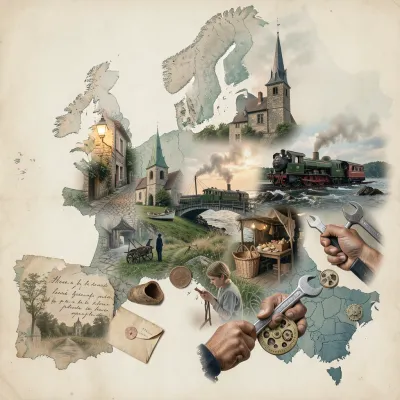
This book explores the broad transformations of European history through the lens of microhistory, using twenty-five specific case studies to illuminate larger social, economic, and political shifts. By focusing on tightly bounded events—ranging from a 1525 village uprising on the Rhine to the 2013 establishment of a Facebook data center in the Swedish Arctic—the text demonstrates how grand historical narratives are experienced and shaped at the local level. These "small stories" serve as entry points into complex processes such as the Reformation, the Industrial Revolution, the rise of the surveillance state, and the impact of modern austerity.
The early chapters focus on the transition from medieval to early modern society, highlighting how local disputes over resources, such as a vineyard tithe or the ringing of parish bells, reflected evolving concepts of sovereignty and social contracts. As the narrative moves into the industrial and revolutionary eras, the focus shifts to the agency of marginalized individuals: a Parisian fishwife petitioning for bread during the Terror, a Ruhr miner documenting the exploitation of the company store in 1848, and a seamstress cooperative in 1905 Łódź. These accounts emphasize that historical change is often negotiated in workplaces and marketplaces rather than just in parliaments.
The final section of the book examines the 20th and 21st centuries, tracing Europe’s path through war, reconstruction, and digital globalization. Case studies from a 1630 Milanese plague register and a 1944 Norman farmhouse are juxtaposed with more contemporary dossiers, such as a 1998 building permit for a Rotterdam minaret and a 1981 Warsaw grocery ledger. These chapters reveal how the "New Europe" continues to grapple with recurring themes of identity, belonging, and the movement of people and data across shifting borders.
Ultimately, the book argues that European history is best understood by examining the "textures of the present"—the bureaucratic forms, personal diaries, and municipal files that capture how individuals navigate systemic change. By reconstructing the lives of pharmacists, refugees, and technicians, the work moves beyond abstract theory to show that continental transformations arrive as practical, often difficult, choices made by ordinary people. Through this method, the book connects the intimate details of the past to the structural realities of contemporary Europe.
What You'll Find Inside:
- Microhistory reveals how local events like village uprisings, merchant trials, and city festivals reflect broader European transformations in power, economy, and culture.
- Close analysis of specific documents—ledgers, petitions, transcripts, and licenses—illuminates large-scale historical processes from religious reform to digital infrastructure.
- Recurring themes of authority, trust, risk, and belonging emerge across different historical periods and locations through varied local grammars.
- Europe is portrayed as both geographic and historical—a continent of shifting borders, multiple languages, and overlapping sovereignties where local stories connect to continental patterns.
- The book models historical reasoning by demonstrating how to move from archival sources to interpretation, equipping readers to apply microhistorical methods to their own questions.
Who's It For:
This book is ideal for history students, educators, and intellectually curious readers seeking to understand European history through focused case studies that reveal broader transformations. Designed for accessibility with primary sources embedded in each chapter, it serves both as a classroom resource for practicing close historical analysis and as a compelling demonstration of how microhistorical methods connect intimate local stories to continent-wide patterns in politics, economics, and culture.
Table of Contents:
- Introduction
- Chapter 1 Ashes in the Vineyard: A Village Uprising on the Upper Rhine (1525)
- Chapter 2 Weights, Measures, and Trust: The Merchant Trial of Marseille (1770)
- Chapter 3 Masks and Magistrates: A City Festival in Gdańsk (1605)
- Chapter 4 A Baker’s Bookshelf: Heresy and Everyday Reading in Ferrara (1580s)
- Chapter 5 Ledgers and Bulbs: A Weaver’s Household in Haarlem during the Tulip Crash (1637)
- Chapter 6 Salt and Sovereignty: Smugglers on the Breton Coast (1748)
- Chapter 7 Hearth and Guild: A Smith’s Apprenticeship in Prague (1410)
- Chapter 8 Contagion in the Courtyard: A Plague Register from Milan (1630)
- Chapter 9 Bread and Barricades: A Fishwife’s Petition in Revolutionary Paris (1793)
- Chapter 10 Bells over the Border: A Parish Dispute in Silesia (1820)
- Chapter 11 Iron and Ink: A Miner’s Diary in the Ruhr (1848)
- Chapter 12 Threads of Emancipation: A Seamstress Cooperative in Łódź (1905)
- Chapter 13 Between Two Shores: Refugees and Shopkeepers in Thessaloniki (1923)
- Chapter 14 Wireless at War: A Radio Club in Barcelona (1936)
- Chapter 15 Farmhouse at the Front: Normandy Letters (June 1944)
- Chapter 16 Rebuilding the Block: A Budapest Street after War (1948)
- Chapter 17 Classroom on the Fault Line: A School in East Berlin (1961)
- Chapter 18 Stone and Song: Language, Work, and Memory in an Irish Gaeltacht Village (1972)
- Chapter 19 Queue and Solidarity: A Grocery Line in Warsaw (1981)
- Chapter 20 The Factory and the Frontier: Albanian Migrants in Puglia (1991)
- Chapter 21 New Minarets, Old Markets: A Permit File in Rotterdam (1998)
- Chapter 22 Numbers on the Terrace: Football, Finance, and a Manchester Club (2005)
- Chapter 23 The Border by Boat: A Ferry Manifest at Lampedusa (2011)
- Chapter 24 Ledgers of Austerity: A Neighborhood Pharmacy in Athens (2015)
- Chapter 25 Cold Heat: A Data Center in Luleå and Europe’s Cloud (2013)
Author:
Published By:
Date Published:
May 15, 2026
Type:
Nonfiction
Language:
English
Word Count:
92,303 words
Reading Time:
6 hours 28 minutes
Sample:
Order:
Order Microhistory of a Continent: Twenty Case Studies that Reveal Europe's Past (Hardcover) on MixCache.com:
Buy NowPrint copy is made to order and ships worldwide. Includes the ebook free, ready to read instantly.
$5 account credit for all new MixCache.com accounts, usable toward any ebook purchase!*