Browse by Category
Fiction
- Action & Adventure
- African American
- Anthologies
- Children's Fiction
- Classics
- Comics & Graphic Novels
- Coming of Age
- Contemporary
- Cultural & Regional
- Drama
- Erotica
- Fantasy
- General
- Historical Fiction
- Horror
- Humor & Satire
- Literary Fiction
- Mystery, Thriller & Suspense
- Poetry
- Religious & Inspirational
- Romance
- Science Fiction
- Short Stories
- War & Military
- Westerns
- Women's Fiction
- Young Adult
Non-Fiction
- Antiques & Collectibles
- Arts & Photography
- Biographies & Memoirs
- Business & Money
- Children's Non-Fiction
-
Computers & Technology
- Artificial Intelligence
- Computer Science
- Cybersecurity & Cryptography
- Data Science & Analytics
- Databases & Big Data
- Game Development & Design
- General
- Hardware & DIY
- Mobile App Development
- Networking & Cloud Computing
- Operating Systems
- Programming
- Robotics
- Software
- Software Engineering
- User Experience (UX) & Design
- Web Development & Design
- Cooking, Food & Wine
- Crafts, Hobbies & Home
- Education & Teaching
- Engineering
- General
- Health, Fitness & Dieting
-
History
- African History
- African History - North Africa
- African History - Sub-Saharan Africa
- American History
- American History - 20th Century
- American History - Civil War
- American History - Colonial Period
- Ancient History
- Asian History
- Asian History - China
- Asian History - India
- Asian History - Japan
- Asian History - Southeast Asia
- European History
- European History - Ancient Greece
- European History - Ancient Rome
- European History - Medieval
- European History - Modern
- European History - Renaissance
- General
- Middle Eastern History
- Military History
- Military History - Aviation
- Military History - Naval
- Social & Cultural History
- World History
- Humor & Entertainment
- Industrial Technology
- Language Learning
- Law
- LGBTQ+ Non-Fiction
- Literary Criticism
- Medical Books
- Parenting & Relationships
- Philosophy
- Politics & Social Sciences
- Reference
- Religion & Spirituality
-
Science & Math
- Agricultural Sciences
- Astronomy & Space Science
- Behavioral Sciences
- Biological Sciences
- Botany & Plant Science
- Chemistry
- Earth Sciences
- Engineering - Chemical
- Engineering - Civil
- Engineering - Electrical
- Engineering - Mechanical
- Environment
- General
- Geology
- Mathematics
- Nature & Ecology
- Oceanography
- Paleontology
- Physics
- Statistics
- Self-Help
- Sports & Outdoors
- Study Aids
- Sustainability & Green Living
- Textbooks
- Transportation
- Travel
- True Crime
- Urban Planning & Development
- Veterinary Medicine
- Writing & Publishing
Jump to Section
MixCache.com Total Access
Unlimited reading and audiobooks for every book published by MixCache.com.
Included titles carry the MTA badge.
Learn more →
Seeds of Industry: China's Economic Transformations from 1600 to 1950
MTA
A macroeconomic and local-level account of commercialization, proto-industrialization, and early modernization
About this book:
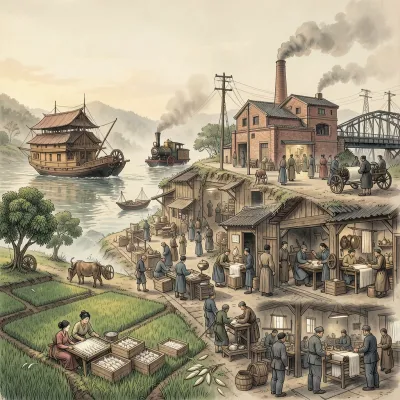
*Seeds of Industry* provides a comprehensive longitudinal study of China’s economic development from 1600 to 1950, tracing the country’s evolution from the silver-monetized commercial expansion of the late Ming to the war-torn industrial landscape of the mid-twentieth century. The book argues that China’s path to modernization was rooted in long-standing patterns of regional specialization, rural handicraft production (proto-industrialization), and sophisticated inland market integration facilitated by the Grand Canal and river networks. Rather than a stagnant agrarian society, the text depicts a dynamic, market-responsive economy where peasant households navigated complex strategies of labor diversification, gendered work, and migration to survive demographic pressures and ecological constraints.
The narrative details the pivotal transition from indigenous commercial institutions—such as the Shanxi bankers and Huizhou merchant networks—to the era of the Treaty Ports and "coastal capitalism" following the Opium Wars. This period saw the emergence of a dual economy where traditional handicraft districts and the rural "putting-out" system began to coexist and compete with modern steam-powered factories, railways, and Western-style banking. The book highlights the rise of Shanghai as an industrial hub and examines the "Self-Strengthening" efforts of Qing and Nationalist officials to build heavy industry and infrastructure, noting the persistent tensions between state-led industrial policy, foreign influence, and private entrepreneurship.
The final chapters document the profound disruptions caused by the mid-nineteenth-century rebellions and the catastrophic impact of the 1931–1945 Japanese occupation, particularly the intensive industrialization of Manchuria as a colonial war machine. The book concludes with the fiscal collapse and hyperinflation of the late 1940s, which signaled the end of the Nationalist era. Ultimately, the work posits that the economic foundations of post-1949 China were not a blank slate but a complex inheritance of three centuries of institutional innovation, market integration, and resilient rural productivity that provided the necessary scaffolding for subsequent socialist industrialization.
What You'll Find Inside:
- The monetization of China's economy through silver inflows from global trade, particularly how the Single Whip Tax reform tied peasant households to market relations by requiring tax payments in silver.
- The Grand Canal's role as China's primary commercial artery that facilitated market integration, regional specialization, and price convergence between the Yangzi Delta and North China.
- The expansion of proto-industrialization through handicraft districts and the putting-out system, which deployed millions of rural households in textile production coordinated by merchant capital.
- The development of sophisticated merchant networks like Huizhou traders and Shanxi bankers that created innovative financial instruments and facilitated long-distance commerce across China.
- The transformation of China's economic geography after 1842 through treaty ports, which accelerated coastal industrialization while creating new dependencies on foreign technology and capital.
Who's It For:
This book is designed for students and scholars of Chinese economic history, comparative development, and the Great Debate. It will particularly benefit researchers interested in long-term economic transformation, institutional evolution, and the interplay between state policy, market forces, and regional diversity in pre-modern and early modern contexts. The combination of quantitative analysis and qualitative case studies makes it suitable for both empirically-oriented economists and historically-informed social scientists.
Table of Contents:
- Introduction
- Chapter 1 Commerce and Silver in the Late Ming, 1600–1644
- Chapter 2 Rebuilding under the Early Qing: Land, Taxes, and Labor Markets, 1644–1720
- Chapter 3 The Grand Canal and Inland Market Integration
- Chapter 4 Rice, Wheat, and Tea: Agrarian Change across Ecological Zones
- Chapter 5 Market Villages and Periodic Fairs: Institutions of Rural Exchange
- Chapter 6 Handicraft Districts: Cotton, Silk, and the Putting-Out System
- Chapter 7 Porcelain, Salt, and the State: Monopoly and Market
- Chapter 8 Merchant Networks: Huizhou Firms and Shanxi Bankers
- Chapter 9 Demography, Household Strategies, and Gendered Work
- Chapter 10 Prices, Wages, and Living Standards in the Long Eighteenth Century
- Chapter 11 Transport Revolutions before Rail: Roads, Rivers, and Junks
- Chapter 12 Frontier Economies: Southwest Mines and Border Trade
- Chapter 13 Crisis and Resilience in the Nineteenth Century: Rebellions and Recovery
- Chapter 14 Treaty Ports and Coastal Capitalism after 1842
- Chapter 15 Machinery, Mills, and the First Factories, 1860–1911
- Chapter 16 Cotton, Silk, and Flour: Industry in Shanghai and Beyond
- Chapter 17 Finance, Credit, and the Rise of Modern Banks
- Chapter 18 Railways, Telegraphs, and the Spatial Reorganization of Markets
- Chapter 19 Law, Property, and Commercial Institutions in Transition
- Chapter 20 Labor, Migration, and Urban Life in the Republican Era
- Chapter 21 Rural Industry and Cooperative Experiments, 1910s–1930s
- Chapter 22 State-Building and Industrial Policy before 1937
- Chapter 23 Manchuria, War, and Occupation Economies, 1931–1945
- Chapter 24 Wartime Mobilization, Inflation, and Scarcity, 1937–1949
- Chapter 25 Legacies and Divergences on the Eve of 1950
Author:
Published By:
Date Published:
May 14, 2026
Type:
Nonfiction
Language:
English
Word Count:
76,383 words
Reading Time:
5 hours 21 minutes
Sample:
Order:
Order Seeds of Industry: China's Economic Transformations from 1600 to 1950 (Paperback) on MixCache.com:
Buy NowPrint copy is made to order and ships worldwide. Includes the ebook free, ready to read instantly.
$5 account credit for all new MixCache.com accounts, usable toward any ebook purchase!*