
Browse by Category
Fiction
- Action & Adventure
- African American
- Anthologies
- Children's Fiction
- Classics
- Comics & Graphic Novels
- Coming of Age
- Contemporary
- Cultural & Regional
- Drama
- Erotica
- Fantasy
- General
- Historical Fiction
- Horror
- Humor & Satire
- Literary Fiction
- Mystery, Thriller & Suspense
- Poetry
- Religious & Inspirational
- Romance
- Science Fiction
- Short Stories
- War & Military
- Westerns
- Women's Fiction
- Young Adult
Non-Fiction
- Antiques & Collectibles
- Arts & Photography
- Biographies & Memoirs
- Business & Money
- Children's Non-Fiction
-
Computers & Technology
- Artificial Intelligence
- Computer Science
- Cybersecurity & Cryptography
- Data Science & Analytics
- Databases & Big Data
- Game Development & Design
- General
- Hardware & DIY
- Mobile App Development
- Networking & Cloud Computing
- Operating Systems
- Programming
- Robotics
- Software
- Software Engineering
- User Experience (UX) & Design
- Web Development & Design
- Cooking, Food & Wine
- Crafts, Hobbies & Home
- Education & Teaching
- Engineering
- General
- Health, Fitness & Dieting
-
History
- African History
- African History - North Africa
- African History - Sub-Saharan Africa
- American History
- American History - 20th Century
- American History - Civil War
- American History - Colonial Period
- Ancient History
- Asian History
- Asian History - China
- Asian History - India
- Asian History - Japan
- Asian History - Southeast Asia
- European History
- European History - Ancient Greece
- European History - Ancient Rome
- European History - Medieval
- European History - Modern
- European History - Renaissance
- General
- Middle Eastern History
- Military History
- Military History - Aviation
- Military History - Naval
- Social & Cultural History
- World History
- Humor & Entertainment
- Industrial Technology
- Language Learning
- Law
- LGBTQ+ Non-Fiction
- Literary Criticism
- Medical Books
- Parenting & Relationships
- Philosophy
- Politics & Social Sciences
- Reference
- Religion & Spirituality
-
Science & Math
- Agricultural Sciences
- Astronomy & Space Science
- Behavioral Sciences
- Biological Sciences
- Botany & Plant Science
- Chemistry
- Earth Sciences
- Engineering - Chemical
- Engineering - Civil
- Engineering - Electrical
- Engineering - Mechanical
- Environment
- General
- Geology
- Mathematics
- Nature & Ecology
- Oceanography
- Paleontology
- Physics
- Statistics
- Self-Help
- Sports & Outdoors
- Study Aids
- Sustainability & Green Living
- Textbooks
- Transportation
- Travel
- True Crime
- Urban Planning & Development
- Veterinary Medicine
- Writing & Publishing
Jump to Section
MixCache.com Total Access
Unlimited reading and audiobooks for every book published by MixCache.com.
Included titles carry the MTA badge.
Learn more →
Walls and Cities: Urbanization, Architecture, and Daily Life in Historical China
MTA
An architectural and social guide to Chinese cities from early walled towns to treaty ports
About this book:
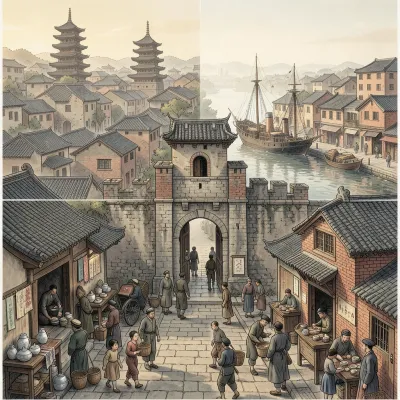
*Walls and Cities* provides a comprehensive interdisciplinary analysis of the architectural and social evolution of Chinese urban centers, tracing their development from early rammed-earth settlements to the complex treaty ports of the nineteenth century. The book argues that the city wall was more than a defensive structure; it was a fundamental instrument of state power, cosmic order, and administrative jurisdiction. By examining case studies such as the regimented ward systems of Tang-era Chang’an and the commercially porous streetscapes of Song-era Kaifeng, the text illustrates a historical tension between the state's desire for spatial control and the organic, centrifugal pressures of trade and daily social life.
The narrative expands beyond the imperial capitals to explore the unique urban morphologies of regional centers, particularly the water-based urbanism of the Jiangnan region. In cities like Suzhou, canals and stone bridges replaced the rigid grids of the north, fostering a "literati urbanism" where private gardens and merchant guilds became the primary anchors of civic life. The book also details the internal social fabric of these cities, highlighting the gendered nature of courtyard domesticity, the vital role of the City God temple as a spiritual counterpart to the magistrate’s yamen, and the vibrant nightlife and market cultures that defined the urban experience for the common resident.
As the chronology moves into the late imperial and modern eras, the book examines the radical transformations brought about by the arrival of Western powers and the establishment of treaty ports like Shanghai. These enclaves introduced extraterritorial legal regimes and modern municipal infrastructures—such as professional policing and public health systems—that fundamentally challenged the traditional walled-city paradigm. The text concludes by reflecting on the enduring legacies of these historical models, suggesting that the ancient lessons of water management, social permeability, and institutional governance remain deeply relevant to the challenges of contemporary urban planning in China and across the globe.
What You'll Find Inside:
- How Chinese city walls served as political, social, and economic infrastructure that defined jurisdictional boundaries, regulated movement, and shaped daily life from ancient settlements to treaty ports
- The evolution of urban planning from cosmological grid systems in imperial capitals like Chang'an to the porous, commerce-driven cities of Song dynasty Kaifeng and water-based Jiangnan cities like Suzhou
- Daily life in Chinese cities explored through residential fabrics (hutongs, lilongs, canal-side lanes), markets and nightlife, religious institutions, and gendered spaces in courtyards and public areas
- The role of civic institutions including yamens, City God temples, guilds, and neighborhood associations in maintaining urban order and mediating between state authority and community life
- Historical lessons for contemporary urban planning regarding water management strategies, balancing enclosure with openness, and adapting urban form to changing social and economic realities
Who's It For:
This book is intended for urban historians, architects, city planners, and students of Chinese history and urban studies. It will also benefit professionals and policymakers interested in historical precedents for contemporary urban challenges such as flood resilience, market-street hierarchies, neighborhood governance, and multicultural port districts, offering insights into how spatial design mediates social life across centuries.
Table of Contents:
- Introduction
- Chapter 1 Walls, Power, and the Chinese City
- Chapter 2 From Palisades to Rammed Earth: Early Walled Towns
- Chapter 3 Grid and Cosmology: Planning the Imperial Capital
- Chapter 4 Chang’an in the Tang: Ward Cities, Markets, and Monasteries
- Chapter 5 Kaifeng in the Song: Commerce and the Porous City
- Chapter 6 Water and Stone: Canals, Bridges, and the Life of Jiangnan Cities
- Chapter 7 Suzhou: Gardens, Guilds, and Literati Urbanism
- Chapter 8 Dadu to Beijing: Mongol and Ming Reconfigurations
- Chapter 9 City God Temples, Yamens, and Civic Order
- Chapter 10 Streets, Lanes, and Lilongs: Residential Fabrics and Everyday Life
- Chapter 11 Markets and Nightlife: Bazaars, Teahouses, and Theaters
- Chapter 12 Crafts, Guilds, and Urban Labor
- Chapter 13 Walls as Infrastructure: Gates, Towers, and Military Urbanism
- Chapter 14 Ritual Pathways: Processions, Festivals, and Urban Time
- Chapter 15 Water Management: Moats, Floods, and Hygiene
- Chapter 16 Gendered Spaces: Courtyards, Domesticity, and Mobility
- Chapter 17 Frontiers and Garrison Towns
- Chapter 18 Maritime Gateways before the Treaties: Quanzhou, Guangzhou, and Beyond
- Chapter 19 Treaty Ports and Concessions: Shanghai and the Port Enclave
- Chapter 20 Policing, Public Health, and the Modern Municipality
- Chapter 21 Printing, Mapping, and the Urban Imagination
- Chapter 22 Disaster and Rebuilding: Fire, Flood, and Siege
- Chapter 23 Religious Landscapes: Temples, Mosques, Churches, and Shrines
- Chapter 24 Comparative Horizons: Chinese and Global Walled Cities
- Chapter 25 Legacies and Futures: Planning Lessons from Historical China
Author:
Published By:
Date Published:
May 14, 2026
Type:
Nonfiction
Language:
English
Word Count:
73,752 words
Reading Time:
5 hours 10 minutes
Sample:
MixCache.com Total Access
Get unlimited access to this book + all books published by MixCache.com for $11.99/month
Subscribe to MTAOr purchase this book individually below
Order:
Buy the Walls and Cities: Urbanization, Architecture, and Daily Life in Historical China ebook on MixCache.com:
Buy Now
Full ebook will be available immediately
- read online or download as a PDF file.
$5 account credit for all new MixCache.com accounts, usable toward any ebook purchase!*





Ratings & Reviews
Ask Questions About This Book
Have a question about the content? Ask our AI assistant!
Start by asking a question about "Walls and Cities: Urbanization, Architecture, and Daily Life in Historical China"
Example: "Does this book mention William Shakespeare?"
Thinking...