Browse by Category
Fiction
- Action & Adventure
- African American
- Anthologies
- Children's Fiction
- Classics
- Comics & Graphic Novels
- Coming of Age
- Contemporary
- Cultural & Regional
- Drama
- Erotica
- Fantasy
- General
- Historical Fiction
- Horror
- Humor & Satire
- Literary Fiction
- Mystery, Thriller & Suspense
- Poetry
- Religious & Inspirational
- Romance
- Science Fiction
- Short Stories
- War & Military
- Westerns
- Women's Fiction
- Young Adult
Non-Fiction
- Antiques & Collectibles
- Arts & Photography
- Biographies & Memoirs
- Business & Money
- Children's Non-Fiction
-
Computers & Technology
- Artificial Intelligence
- Computer Science
- Cybersecurity & Cryptography
- Data Science & Analytics
- Databases & Big Data
- Game Development & Design
- General
- Hardware & DIY
- Mobile App Development
- Networking & Cloud Computing
- Operating Systems
- Programming
- Robotics
- Software
- Software Engineering
- User Experience (UX) & Design
- Web Development & Design
- Cooking, Food & Wine
- Crafts, Hobbies & Home
- Education & Teaching
- Engineering
- General
- Health, Fitness & Dieting
-
History
- African History
- African History - North Africa
- African History - Sub-Saharan Africa
- American History
- American History - 20th Century
- American History - Civil War
- American History - Colonial Period
- Ancient History
- Asian History
- Asian History - China
- Asian History - India
- Asian History - Japan
- Asian History - Southeast Asia
- European History
- European History - Ancient Greece
- European History - Ancient Rome
- European History - Medieval
- European History - Modern
- European History - Renaissance
- General
- Middle Eastern History
- Military History
- Military History - Aviation
- Military History - Naval
- Social & Cultural History
- World History
- Humor & Entertainment
- Industrial Technology
- Language Learning
- Law
- LGBTQ+ Non-Fiction
- Literary Criticism
- Medical Books
- Parenting & Relationships
- Philosophy
- Politics & Social Sciences
- Reference
- Religion & Spirituality
-
Science & Math
- Agricultural Sciences
- Astronomy & Space Science
- Behavioral Sciences
- Biological Sciences
- Botany & Plant Science
- Chemistry
- Earth Sciences
- Engineering - Chemical
- Engineering - Civil
- Engineering - Electrical
- Engineering - Mechanical
- Environment
- General
- Geology
- Mathematics
- Nature & Ecology
- Oceanography
- Paleontology
- Physics
- Statistics
- Self-Help
- Sports & Outdoors
- Study Aids
- Sustainability & Green Living
- Textbooks
- Transportation
- Travel
- True Crime
- Urban Planning & Development
- Veterinary Medicine
- Writing & Publishing
Jump to Section
MixCache.com Total Access
Unlimited reading and audiobooks for every book published by MixCache.com.
Included titles carry the MTA badge.
Learn more →
Red Revolution, Long Shadow: The Rise of the Communist Party in Republican China
MTA
A political and social history of CCP emergence, strategies, and local bases, 1919–1949
About this book:
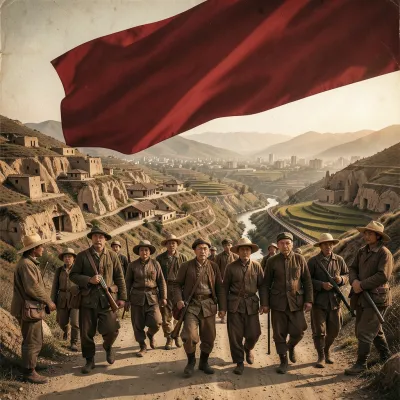
"Red Revolution, Long Shadow" chronicles the tumultuous rise of the Chinese Communist Party (CCP) from its intellectual origins in the May Fourth Movement of 1919 to its triumph in 1949 and the subsequent establishment of the People's Republic of China. The book argues that the CCP's success stemmed from its institutional learning, adaptability, and ability to forge local bases and strategies under duress, contrasting this with the Nationalist government's failures in state capacity, factionalism, and economic credibility. It emphasizes that the revolution was a contingent process, shaped by strategic choices, organizational innovations, and significant setbacks, rather than an inevitable march to victory.
The narrative traces the CCP's initial formation in Shanghai in 1921, its early efforts in urban labor and student organizing, and the complexities of the First United Front with the Kuomintang (KMT) under Comintern guidance. The pivotal year 1927 saw the KMT's brutal repression of urban communists, forcing the CCP to abandon its city-centric strategy and "turn to the countryside." This strategic shift led to the creation of the first rural revolutionary bases, such as Jinggangshan, where guerrilla warfare tactics and rudimentary governance structures were developed, culminating in the establishment of the Jiangxi Soviet. Here, the party experimented with land revolution, taxation, and social policies, while simultaneously fending off increasingly aggressive Nationalist encirclement campaigns, leading to the arduous Long March.
The Long March, though a catastrophic loss of life, served as a crucible that forged a hardened leadership, consolidated Mao Zedong's strategic vision at the Zunyi Conference, and instilled critical lessons in mobile warfare and self-reliance. The outbreak of war with Japan in 1937 prompted a Second United Front, allowing the CCP to expand its influence by establishing vast base areas behind enemy lines. In Yan'an, the party underwent internal "Rectification" to solidify ideological unity around Mao Zedong Thought and refined the "mass line" approach, emphasizing deep engagement with and mobilization of the rural population. These years also saw the party build robust administrative structures, including legal systems, tax collection mechanisms, and educational programs, while integrating women more actively into the revolutionary effort.
The immediate post-war period (1945-1946) saw a tense struggle for Manchuria and the breakdown of peace talks, leading to full-scale civil war. The CCP, leveraging its deep rural networks and captured Japanese armaments, transformed its military doctrine from guerrilla mobility to large-scale conventional warfare, culminating in decisive victories like the Liaoshen and Huaihai campaigns. Simultaneously, radical land reform campaigns in liberated areas deepened peasant support, often involving significant violence, and the party developed strategies for taking and governing major cities. The book concludes by analyzing the international context of the emerging Cold War, noting the inconsistent Soviet aid and the ultimately ineffective U.S. support for the Nationalists, highlighting how the CCP's decades of institutional learning and strategic adaptation ultimately propelled it to national power in 1949, leaving a "long shadow" that would define the People's Republic for decades to come.
What You'll Find Inside:
- The CCP's rise resulted from institutional learning and adaptation through repeated setbacks, not ideological rigidity or foreign sponsorship alone
- The strategic pivot to rural base areas beginning with Jinggangshan created sustainable mobilization through land reform, governance experimentation, and mass line methodology
- The Long March tested and refined CCP military doctrine, selecting for resilient leaders who embraced mobile warfare and peasant mobilization over positional defense
- Land reform campaigns (1946-1948) secured peasant loyalty by dismantling landlord power, though implementation varied from moderate to violent across regions
- CCP victory stemmed from superior grassroots organizational capacity and political mobilization, contrasting with Nationalist state weakness in fiscal management, factionalism, and inflation
Who's It For:
This book is intended for students, scholars, and general readers interested in modern Chinese history, revolutionary movements, and political strategy. It provides a detailed political and social history of the CCP's rise from 1919-1949, making it valuable for those studying the origins of the People's Republic of China, comparative revolutionary movements, or the development of communist governance. The work balances accessibility with scholarly rigor, offering insights for both newcomers to the subject and specialists seeking a synthetic framework for understanding the CCP's triumph.
Table of Contents:
- Introduction
- Chapter 1 Sparks of 1919: May Fourth and the New Culture Crucible
- Chapter 2 Founding a Party: Shanghai, 1921
- Chapter 3 Workers, Students, and the Early Underground, 1921–1923
- Chapter 4 The First United Front and Comintern Guidance, 1923–1926
- Chapter 5 The Northern Expedition and Urban Insurrections
- Chapter 6 1927 in Shanghai: Rupture, Repression, and Realignment
- Chapter 7 Turning to the Countryside: Hunan Experiments and the Autumn Harvest
- Chapter 8 Jinggangshan: Creating a Mountain Base
- Chapter 9 The Jiangxi Soviet: Governance and Land Revolution
- Chapter 10 Beating Encirclement: Red Army Innovation and Survival
- Chapter 11 The Long March: Flight, Loss, and Legend
- Chapter 12 Zunyi: Strategy, Leadership, and the Rise of Mao
- Chapter 13 A Second United Front: War with Japan and Strategic Repositioning
- Chapter 14 Yan’an: Rectification, Mass Line, and Party-Building
- Chapter 15 Governing the Base Areas: Law, Tax, Gender, and Schooling
- Chapter 16 Intelligence, Liaison, and United Front Work behind Enemy Lines
- Chapter 17 Culture as Mobilization: Literature, Theater, and Propaganda
- Chapter 18 Wartime Political Economy: Markets, Cooperatives, and Supply
- Chapter 19 From Victory to Stalemate: 1945–1946 and the Struggle for Manchuria
- Chapter 20 Civil War Doctrine: From Mobile to Conventional Warfare, 1946–1948
- Chapter 21 Land Reform Revisited: Policy, Violence, and Village Politics, 1946–1948
- Chapter 22 Taking the Cities: Urban Strategy, Cadres, and Transition, 1948–1949
- Chapter 23 International Winds: Soviet Aid, U.S. Policy, and the Emerging Cold War
- Chapter 24 Why the Nationalists Lost: State Capacity, Factionalism, and Inflation
- Chapter 25 1949 and After: Victory, State-Building, and the Long Shadow
Author:
Published By:
Date Published:
May 14, 2026
Type:
Nonfiction
Language:
English
Word Count:
77,825 words
Reading Time:
5 hours 27 minutes
Sample:
Order:
Order Red Revolution, Long Shadow: The Rise of the Communist Party in Republican China (Paperback) on MixCache.com:
Buy NowPrint copy is made to order and ships worldwide. Includes the ebook free, ready to read instantly.
$5 account credit for all new MixCache.com accounts, usable toward any ebook purchase!*