Browse by Category
Fiction
- Action & Adventure
- African American
- Anthologies
- Children's Fiction
- Classics
- Comics & Graphic Novels
- Coming of Age
- Contemporary
- Cultural & Regional
- Drama
- Erotica
- Fantasy
- General
- Historical Fiction
- Horror
- Humor & Satire
- Literary Fiction
- Mystery, Thriller & Suspense
- Poetry
- Religious & Inspirational
- Romance
- Science Fiction
- Short Stories
- War & Military
- Westerns
- Women's Fiction
- Young Adult
Non-Fiction
- Antiques & Collectibles
- Arts & Photography
- Biographies & Memoirs
- Business & Money
- Children's Non-Fiction
-
Computers & Technology
- Artificial Intelligence
- Computer Science
- Cybersecurity & Cryptography
- Data Science & Analytics
- Databases & Big Data
- Game Development & Design
- General
- Hardware & DIY
- Mobile App Development
- Networking & Cloud Computing
- Operating Systems
- Programming
- Robotics
- Software
- Software Engineering
- User Experience (UX) & Design
- Web Development & Design
- Cooking, Food & Wine
- Crafts, Hobbies & Home
- Education & Teaching
- Engineering
- General
- Health, Fitness & Dieting
-
History
- African History
- African History - North Africa
- African History - Sub-Saharan Africa
- American History
- American History - 20th Century
- American History - Civil War
- American History - Colonial Period
- Ancient History
- Asian History
- Asian History - China
- Asian History - India
- Asian History - Japan
- Asian History - Southeast Asia
- European History
- European History - Ancient Greece
- European History - Ancient Rome
- European History - Medieval
- European History - Modern
- European History - Renaissance
- General
- Middle Eastern History
- Military History
- Military History - Aviation
- Military History - Naval
- Social & Cultural History
- World History
- Humor & Entertainment
- Industrial Technology
- Language Learning
- Law
- LGBTQ+ Non-Fiction
- Literary Criticism
- Medical Books
- Parenting & Relationships
- Philosophy
- Politics & Social Sciences
- Reference
- Religion & Spirituality
-
Science & Math
- Agricultural Sciences
- Astronomy & Space Science
- Behavioral Sciences
- Biological Sciences
- Botany & Plant Science
- Chemistry
- Earth Sciences
- Engineering - Chemical
- Engineering - Civil
- Engineering - Electrical
- Engineering - Mechanical
- Environment
- General
- Geology
- Mathematics
- Nature & Ecology
- Oceanography
- Paleontology
- Physics
- Statistics
- Self-Help
- Sports & Outdoors
- Study Aids
- Sustainability & Green Living
- Textbooks
- Transportation
- Travel
- True Crime
- Urban Planning & Development
- Veterinary Medicine
- Writing & Publishing
Jump to Section

Want unlimited access to all books published by MixCache.com (plus their audiobooks)? Try MixCache.com Total Access. Look for the MTA badge on book covers to identify included titles.
Access to infinite ebooks: Don't see the book you want? Suggest it and we'll create it (free!) for you from scratch with our powerful AI book writer. Then read it with MTA - besides profiting from any sales it makes!
The Long Renaissance: Art, Science, and Society Across Europe
MTA
A pan-European reappraisal of Renaissance change beyond Italy's masterpieces
About this book:
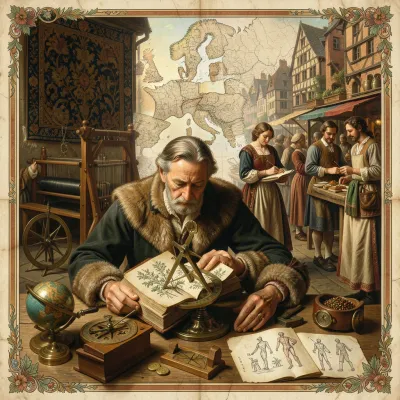
*The Long Renaissance* provides a comprehensive reappraisal of the era’s transformation, arguing that the period was a polycentric, pan-European phenomenon rather than a movement strictly radiating from Italy. By extending the timeline into the 17th century, the book examines how the exchange of people, books, pigments, and scientific instruments created a "constellation of centers" across the continent. From the trading hubs of Lisbon and Seville to the intellectual laboratories of Kraków and Prague, the text illustrates how urban patronage, maritime expansion, and the printing revolution interconnected disparate regions, allowing local traditions to reshape shared innovations in art and science.
The narrative emphasizes that the Renaissance was deeply embedded in the material and social structures of daily life, connecting the high culture of royal courts to the practical labor of rural producers. It explores the "science of the studio," where artists and instrument makers collaborated to master optics and perspective, and details how the mining and engineering feats of Central and Northern Europe fueled economic growth. By highlighting the roles of often-marginalized actors—including women patrons, migrant artisans, and indigenous informants in colonial circuits—the book presents the era as a profoundly collaborative effort that blurred the boundaries between craft, science, and governance.
The book also grapples with the crises and resilience of the age, documenting how war, famine, and the recurring shadow of the plague impacted cultural production. The Reformation is depicted as a pivotal force that both destroyed and created visual cultures, as seen in the fierce debates over religious imagery and the rise of vernacular literatures across Germany, Scandinavia, and Poland-Lithuania. These confessional shifts forced a redefinition of sacred space and accelerated the democratization of knowledge through the proliferation of printed bibles, almanacs, and theatrical performances.
Ultimately, the book positions the Renaissance as the foundational infrastructure for the modern world. The institutional legacy of universities, guilds, and the "Republic of Letters" provided the framework for the subsequent Scientific Revolution and the Enlightenment. By tracing the "afterlives" of Renaissance innovations—such as the evolution of the *Wunderkammer* into the modern museum and the persistence of artisanal craft in global trade—the text concludes that the Renaissance was a long, transformative negotiation with history that redefined European identity and its place in a global context.
What You'll Find Inside:
- The Renaissance was a pan-European phenomenon extending beyond Italy, with artistic, scientific, and social innovations emerging from interconnected regional centers from Lisbon to Kraków and Seville to Prague.
- Change was driven by networks of people, objects, and ideas—artists migrating between cities, printing presses spreading knowledge, and trade routes carrying materials and techniques that transformed local traditions into new hybrid forms.
- Regional innovations often surpassed Italian influences, such as Low Countries' oil painting techniques, Iberian navigation science, Baltic timber engineering, and Central European mining technologies that reshaped European capabilities.
- Institutions like universities, guilds, courts, and printing houses acted as active agents of Renaissance culture, mediating between theoretical knowledge and practical application while enabling collaboration across linguistic and confessional boundaries.
- Women, migrants, rural workers, and marginalized groups played essential but overlooked roles as patrons, workshop managers, printers, and knowledge transmitters, contributing to the period's cultural vitality despite systemic barriers to recognition.
Who's It For:
This book is designed for scholars, graduate students, and advanced undergraduates in history, art history, and cultural studies who seek a comprehensive reevaluation of the Renaissance beyond traditional Italian-centric narratives. It will particularly benefit readers interested in European interconnectedness, the social history of knowledge production, and how regional innovations contributed to continental transformation. Educated general readers with a strong background in early modern European history will also find value in its challenging of established myths and its emphasis on collaborative, polycentric change.
Author:
Published By:
Date Published:
May 14, 2026
Type:
Nonfiction
Language:
English
Word Count:
92,763 words
Reading Time:
6 hours 30 minutes
Sample:
Order:
Order The Long Renaissance: Art, Science, and Society Across Europe (Paperback) on MixCache.com:
Buy NowPrint copy is made to order and ships worldwide. Includes the ebook free, ready to read instantly.
$5 account credit for all new MixCache.com accounts, usable toward any ebook purchase!*