Browse by Category
Fiction
- Action & Adventure
- African American
- Anthologies
- Children's Fiction
- Classics
- Comics & Graphic Novels
- Coming of Age
- Contemporary
- Cultural & Regional
- Drama
- Erotica
- Fantasy
- General
- Historical Fiction
- Horror
- Humor & Satire
- Literary Fiction
- Mystery, Thriller & Suspense
- Poetry
- Religious & Inspirational
- Romance
- Science Fiction
- Short Stories
- War & Military
- Westerns
- Women's Fiction
- Young Adult
Non-Fiction
- Antiques & Collectibles
- Arts & Photography
- Biographies & Memoirs
- Business & Money
- Children's Non-Fiction
-
Computers & Technology
- Artificial Intelligence
- Computer Science
- Cybersecurity & Cryptography
- Data Science & Analytics
- Databases & Big Data
- Game Development & Design
- General
- Hardware & DIY
- Mobile App Development
- Networking & Cloud Computing
- Operating Systems
- Programming
- Robotics
- Software
- Software Engineering
- User Experience (UX) & Design
- Web Development & Design
- Cooking, Food & Wine
- Crafts, Hobbies & Home
- Education & Teaching
- Engineering
- General
- Health, Fitness & Dieting
-
History
- African History
- African History - North Africa
- African History - Sub-Saharan Africa
- American History
- American History - 20th Century
- American History - Civil War
- American History - Colonial Period
- Ancient History
- Asian History
- Asian History - China
- Asian History - India
- Asian History - Japan
- Asian History - Southeast Asia
- European History
- European History - Ancient Greece
- European History - Ancient Rome
- European History - Medieval
- European History - Modern
- European History - Renaissance
- General
- Middle Eastern History
- Military History
- Military History - Aviation
- Military History - Naval
- Social & Cultural History
- World History
- Humor & Entertainment
- Industrial Technology
- Language Learning
- Law
- LGBTQ+ Non-Fiction
- Literary Criticism
- Medical Books
- Parenting & Relationships
- Philosophy
- Politics & Social Sciences
- Reference
- Religion & Spirituality
-
Science & Math
- Agricultural Sciences
- Astronomy & Space Science
- Behavioral Sciences
- Biological Sciences
- Botany & Plant Science
- Chemistry
- Earth Sciences
- Engineering - Chemical
- Engineering - Civil
- Engineering - Electrical
- Engineering - Mechanical
- Environment
- General
- Geology
- Mathematics
- Nature & Ecology
- Oceanography
- Paleontology
- Physics
- Statistics
- Self-Help
- Sports & Outdoors
- Study Aids
- Sustainability & Green Living
- Textbooks
- Transportation
- Travel
- True Crime
- Urban Planning & Development
- Veterinary Medicine
- Writing & Publishing
Jump to Section
MixCache.com Total Access
Unlimited reading and audiobooks for every book published by MixCache.com.
Included titles carry the MTA badge.
Learn more →
Silk and Spice: The Overland Silk Road and Cultural Exchange in Eurasia
MTA
A narrative reconstruction of trade, religion, and migration along the Silk Road with a Chinese focus
About this book:
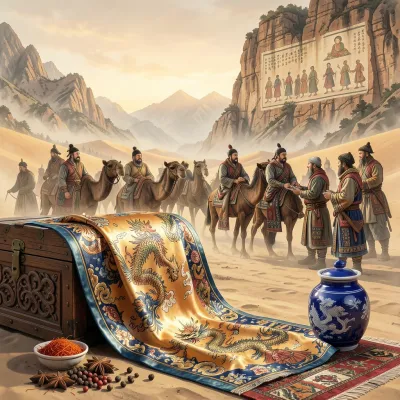
*Silk and Spice: The Overland Silk Road and Cultural Exchange in Eurasia* provides a comprehensive narrative reconstruction of the ancient trade networks connecting China to the broader Eurasian continent. The book reframes the Silk Road not as a single path, but as a shifting, resilient web of "braided" tracks where the movement of goods like silk, horses, and spices was inseparable from the transmission of technologies, artistic motifs, and religious beliefs. Centering China as a key participant rather than an isolated origin, the text explores how the Han and Tang dynasties interacted with nomadic confederations, such as the Xiongnu and Uyghurs, and established diplomatic and economic frameworks that reshaped both the Chinese heartland and the distant oasis states of the Tarim Basin.
A significant portion of the work is dedicated to the human actors who facilitated this exchange, particularly the Sogdian merchant diasporas who served as the indispensable middlemen of Central Asian commerce. The book details the "Buddhist Turn," tracing the migration of faith through the labor of pilgrims like Xuanzang and translators like Kumarajiva, whose work at sites like Dunhuang and Kucha created a shared spiritual and intellectual vocabulary across languages. Beyond religion, the narrative examines the "Great Acceleration" of connectivity under the Mongol Empire and the subsequent shift in global trade toward maritime corridors, which transformed the overland routes into specialized niches while globalizing technologies like papermaking and gunpowder.
The book also delves into the material and social realities of life in transit, highlighting the roles of women in silk production, the sophisticated gift economies of imperial courts, and the constant risks of disease and political instability. By synthesizing archaeological evidence, such as the Tarim mummies and the "Library Cave" manuscripts, with the historical accounts of famous travelers, the text underscores the fragility and adaptability of these ancient networks. Ultimately, the work reflects on the modern legacy of the Silk Road, illustrating how its history continues to be contested and reimagined in contemporary geopolitics and national identities, serving as a enduring lens for understanding human connectivity across distance.
What You'll Find Inside:
- The Silk Road functioned as a shifting, multidirectional network of routes that facilitated the exchange of goods, ideas, peoples, and technologies across Eurasia over two millennia.
- Chinese dynasties leveraged silk as a strategic diplomatic and economic commodity, using it to acquire horses, spices, and foreign innovations while projecting cultural influence westward.
- Sogdian merchant diasporas served as indispensable intermediaries, establishing trust-based credit systems, spreading languages and religions, and linking markets from Chang'an to the Byzantine world.
- Religious traditions—including Buddhism, Manichaeism, Zoroastrianism, and Christianity—traveled with monks and merchants, prompting translation, syncretism, and the creation of monastic and mercantile hubs along the route.
- Technological and agricultural innovations such as paper, glassmaking, metallurgy, and crops like grapes and tea moved in both directions, transforming material culture and daily life far beyond their points of origin.
Who's It For:
This book is ideal for undergraduate and graduate students of world history, Asian studies, or archaeology seeking a comprehensive, evidence‑based narrative of the Silk Road’s economic, cultural, and religious dimensions. It will also appeal to general readers interested in Eurasian exchange, the history of globalization, and the interactions between Chinese civilization and the societies of Central Asia, India, Persia, and the Mediterranean. Scholars focusing on trans‑regional trade, diaspora networks, or the transmission of technologies and ideas will find the detailed synthesis of archaeological, textual, and material evidence particularly valuable.
Table of Contents:
- Introduction
- Chapter 1 Mapping the Overland Silk Road
- Chapter 2 Silk, State, and Steppe in Early China
- Chapter 3 Zhang Qian’s Missions and the First Horizons
- Chapter 4 Oasis States of the Tarim Basin
- Chapter 5 Sogdian Networks and Merchant Diasporas
- Chapter 6 Empires in Contact: Han, Kushan, Parthia, and Rome
- Chapter 7 The Buddhist Turn: Pilgrims, Sutras, and Translation
- Chapter 8 Monasteries, Markets, and the Caravan Economy
- Chapter 9 Art on the Move: Dunhuang, Kucha, and Beyond
- Chapter 10 Tongues of the Road: Scripts and Multilingualism
- Chapter 11 Technologies in Transit: Paper, Glass, and Metallurgy
- Chapter 12 Horses, Silk, and Spices: The Political Economy of Exchange
- Chapter 13 Soundscapes: Instruments, Dances, and Court Culture
- Chapter 14 Tastes and Crops: Grapes, Tea, and Culinary Migrations
- Chapter 15 Chang’an and Luoyang: Tang China as a Cosmopolis
- Chapter 16 Zoroastrians, Manichaeans, and Christians in China
- Chapter 17 Women, Households, and Everyday Life in Transit
- Chapter 18 Turks, Uyghurs, and the Power of the Steppe
- Chapter 19 Risk, Disease, and the Fragility of Networks
- Chapter 20 Diplomacy, Tribute, and Gift Economies
- Chapter 21 Mongol Eurasia and the Great Acceleration
- Chapter 22 Shifting Routes: From Overland to Maritime Corridors
- Chapter 23 Travelers’ Voices: Faxian, Xuanzang, and Marco Polo
- Chapter 24 Archaeology and Manuscripts: Rediscovering the Road
- Chapter 25 Legacies and Debates: The Silk Road in Modern Imagination
Author:
Published By:
Date Published:
May 14, 2026
Type:
Nonfiction
Language:
English
Word Count:
71,086 words
Reading Time:
4 hours 59 minutes
Sample:
Order:
Order Silk and Spice: The Overland Silk Road and Cultural Exchange in Eurasia (Hardcover) on MixCache.com:
Buy NowPrint copy is made to order and ships worldwide. Includes the ebook free, ready to read instantly.
$5 account credit for all new MixCache.com accounts, usable toward any ebook purchase!*