Browse by Category
Fiction
- Action & Adventure
- African American
- Anthologies
- Children's Fiction
- Classics
- Comics & Graphic Novels
- Coming of Age
- Contemporary
- Cultural & Regional
- Drama
- Erotica
- Fantasy
- General
- Historical Fiction
- Horror
- Humor & Satire
- Literary Fiction
- Mystery, Thriller & Suspense
- Poetry
- Religious & Inspirational
- Romance
- Science Fiction
- Short Stories
- War & Military
- Westerns
- Women's Fiction
- Young Adult
Non-Fiction
- Antiques & Collectibles
- Arts & Photography
- Biographies & Memoirs
- Business & Money
- Children's Non-Fiction
-
Computers & Technology
- Artificial Intelligence
- Computer Science
- Cybersecurity & Cryptography
- Data Science & Analytics
- Databases & Big Data
- Game Development & Design
- General
- Hardware & DIY
- Mobile App Development
- Networking & Cloud Computing
- Operating Systems
- Programming
- Robotics
- Software
- Software Engineering
- User Experience (UX) & Design
- Web Development & Design
- Cooking, Food & Wine
- Crafts, Hobbies & Home
- Education & Teaching
- Engineering
- General
- Health, Fitness & Dieting
-
History
- African History
- African History - North Africa
- African History - Sub-Saharan Africa
- American History
- American History - 20th Century
- American History - Civil War
- American History - Colonial Period
- Ancient History
- Asian History
- Asian History - China
- Asian History - India
- Asian History - Japan
- Asian History - Southeast Asia
- European History
- European History - Ancient Greece
- European History - Ancient Rome
- European History - Medieval
- European History - Modern
- European History - Renaissance
- General
- Middle Eastern History
- Military History
- Military History - Aviation
- Military History - Naval
- Social & Cultural History
- World History
- Humor & Entertainment
- Industrial Technology
- Language Learning
- Law
- LGBTQ+ Non-Fiction
- Literary Criticism
- Medical Books
- Parenting & Relationships
- Philosophy
- Politics & Social Sciences
- Reference
- Religion & Spirituality
-
Science & Math
- Agricultural Sciences
- Astronomy & Space Science
- Behavioral Sciences
- Biological Sciences
- Botany & Plant Science
- Chemistry
- Earth Sciences
- Engineering - Chemical
- Engineering - Civil
- Engineering - Electrical
- Engineering - Mechanical
- Environment
- General
- Geology
- Mathematics
- Nature & Ecology
- Oceanography
- Paleontology
- Physics
- Statistics
- Self-Help
- Sports & Outdoors
- Study Aids
- Sustainability & Green Living
- Textbooks
- Transportation
- Travel
- True Crime
- Urban Planning & Development
- Veterinary Medicine
- Writing & Publishing
Jump to Section
MixCache.com Total Access
Unlimited reading and audiobooks for every book published by MixCache.com.
Included titles carry the MTA badge.
Learn more →
The EU Story: From Coal and Steel to a Contested Union
MTA
A policy and political history of European integration, institutions, and crises
About this book:
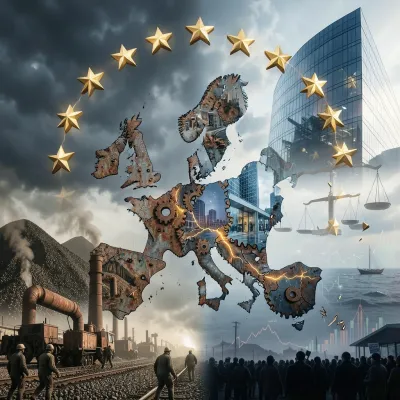
*The EU Story: From Coal and Steel to a Contested Union* provides a comprehensive political and policy history of the European Union, tracing its evolution from the 1951 European Coal and Steel Community to the complex, 27-member geopolitical actor of the 2020s. The book details the foundational "functionalist" logic of Jean Monnet and Robert Schuman, who sought to make war impossible through economic interdependence. It follows the expansion of the single market through the Treaty of Rome and the Single European Act, the creation of the euro via the Maastricht Treaty, and the institutional reforms of the Lisbon Treaty. Central to this narrative is the unique institutional "triangle" of the Commission, Council, and Parliament, overseen by a Court of Justice that established the supremacy of European law over national statutes.
The text candidly examines the "polycrisis" that has defined the Union in the 21st century. It analyzes the structural flaws of the Eurozone that led to the sovereign debt crisis, the internal fractures exposed by the 2015–2016 migration emergency, and the unprecedented institutional trauma of Brexit. The book highlights how these events shifted the EU from a project of technocratic "permissive consensus" to one of intense political contestation. This is further evidenced by internal challenges to the rule of law in member states like Hungary and Poland, where the EU has struggled to enforce its foundational democratic values through mechanisms like Article 7 and budget conditionality.
In its later chapters, the book explores the EU’s pivot toward "strategic autonomy" in response to global shifts. It details the ambitious European Green Deal and the Digital Single Market as efforts to set global regulatory standards. Significant attention is given to the impact of Russia’s invasion of Ukraine, which forced an abrupt decoupling from Russian energy and a renewed emphasis on common security and defense industrial policy. These developments represent a move away from pure market liberalism toward a more pragmatic, state-led industrial strategy designed to navigate the geoeconomic rivalry between the United States and China.
The book concludes by evaluating future paths for the Union: deepening into a federal core, decoupling into a loose free-trade area, or settling into a permanent model of "differentiated integration." It argues that while the EU has shown remarkable resilience and adaptive capacity, it remains plagued by an unresolved democratic deficit and a mismatch between its economic scope and its cultural coherence. Ultimately, the work portrays the EU as a living, contested experiment that must continually renegotiate the balance between national sovereignty and supranational necessity to remain relevant in a multipolar world.
What You'll Find Inside:
- The historical evolution of European integration from the Coal and Steel Community to a complex political union facing 21st-century challenges
- How EU institutions function and interact, including the Commission's right of initiative, Council voting procedures, Parliament's legislative powers, and the Court's jurisprudential impact
- Major treaty reforms from Rome to Lisbon that reshaped sovereignty, decision-making, and the balance between supranational and intergovernmental elements
- How crises like the eurozone sovereign debt crisis, the 2015-2016 migration emergency, and Brexit have tested and transformed European integration
- Current debates about the EU's future regarding deepening integration, strategic autonomy, and differentiated approaches to climate, defense, and digital policy
Who's It For:
This book is ideal for students and scholars of European politics, international relations, or EU studies who need a comprehensive understanding of the Union's historical development and institutional mechanics. It will also benefit professionals working in EU institutions, national governments dealing with EU affairs, international organizations, and policy analysts seeking contextual knowledge for contemporary European challenges. Journalists covering EU affairs and informed citizens interested in the origins and future trajectory of European integration will find valuable insights into how the Union functions as both a historical project and a living system continuously shaped by crises and political bargains.
Table of Contents:
- Introduction
- Chapter 1 Coal and Steel: The ECSC and the Postwar Bargain
- Chapter 2 From Rome to Brussels: Building the Common Market
- Chapter 3 Institutions That Govern: Commission, Council, Parliament, Court
- Chapter 4 Democratic Deficit or Design? Legitimacy Debates
- Chapter 5 Widening the Circle: First Enlargements and Their Impact
- Chapter 6 Schengen and the Four Freedoms: Mobility and Markets
- Chapter 7 The Single European Act: Completing the Internal Market
- Chapter 8 Maastricht and Monetary Union: Birth of the Euro
- Chapter 9 Central Banking and Fiscal Rules: ECB, SGP, and EMU Governance
- Chapter 10 Eastern Enlargement: Reunifying Europe
- Chapter 11 Constitutional Moments: Treaty Reform from Amsterdam to Lisbon
- Chapter 12 The Eurozone Crisis: Sovereign Debt and Solidarity
- Chapter 13 Migration and Borders: The 2015–2016 Stress Test
- Chapter 14 Brexit: Disintegration, Negotiation, and Reinvention
- Chapter 15 Rule of Law and Article 7: Contestation Inside the Union
- Chapter 16 The Green Deal and Climate Leadership
- Chapter 17 Digital Single Market and Tech Regulation: From GDPR to AI Acts
- Chapter 18 Energy Security and Russia’s War: Rewiring Dependence
- Chapter 19 Trade Policy and Geoeconomics: Between Washington and Beijing
- Chapter 20 Security and Defense: From CSDP to Strategic Autonomy
- Chapter 21 Budget Battles: MFFs, Own Resources, and Cohesion
- Chapter 22 Interest Groups, Parties, and Public Opinion in the EU
- Chapter 23 Policy-Making in Practice: Agriculture, Competition, and Industrial Strategy
- Chapter 24 Populism and Polarization: Narratives, Media, and Backlash
- Chapter 25 Future Scenarios: Deepening, Decoupling, or Differentiation?
Author:
Published By:
Date Published:
May 14, 2026
Type:
Nonfiction
Language:
English
Word Count:
83,395 words
Reading Time:
5 hours 50 minutes
Sample:
Order:
Order The EU Story: From Coal and Steel to a Contested Union (Hardcover) on MixCache.com:
Buy NowPrint copy is made to order and ships worldwide. Includes the ebook free, ready to read instantly.
$5 account credit for all new MixCache.com accounts, usable toward any ebook purchase!*