Browse by Category
Fiction
- Action & Adventure
- African American
- Anthologies
- Children's Fiction
- Classics
- Comics & Graphic Novels
- Coming of Age
- Contemporary
- Cultural & Regional
- Drama
- Erotica
- Fantasy
- General
- Historical Fiction
- Horror
- Humor & Satire
- Literary Fiction
- Mystery, Thriller & Suspense
- Poetry
- Religious & Inspirational
- Romance
- Science Fiction
- Short Stories
- War & Military
- Westerns
- Women's Fiction
- Young Adult
Non-Fiction
- Antiques & Collectibles
- Arts & Photography
- Biographies & Memoirs
- Business & Money
- Children's Non-Fiction
-
Computers & Technology
- Artificial Intelligence
- Computer Science
- Cybersecurity & Cryptography
- Data Science & Analytics
- Databases & Big Data
- Game Development & Design
- General
- Hardware & DIY
- Mobile App Development
- Networking & Cloud Computing
- Operating Systems
- Programming
- Robotics
- Software
- Software Engineering
- User Experience (UX) & Design
- Web Development & Design
- Cooking, Food & Wine
- Crafts, Hobbies & Home
- Education & Teaching
- Engineering
- General
- Health, Fitness & Dieting
-
History
- African History
- African History - North Africa
- African History - Sub-Saharan Africa
- American History
- American History - 20th Century
- American History - Civil War
- American History - Colonial Period
- Ancient History
- Asian History
- Asian History - China
- Asian History - India
- Asian History - Japan
- Asian History - Southeast Asia
- European History
- European History - Ancient Greece
- European History - Ancient Rome
- European History - Medieval
- European History - Modern
- European History - Renaissance
- General
- Middle Eastern History
- Military History
- Military History - Aviation
- Military History - Naval
- Social & Cultural History
- World History
- Humor & Entertainment
- Industrial Technology
- Language Learning
- Law
- LGBTQ+ Non-Fiction
- Literary Criticism
- Medical Books
- Parenting & Relationships
- Philosophy
- Politics & Social Sciences
- Reference
- Religion & Spirituality
-
Science & Math
- Agricultural Sciences
- Astronomy & Space Science
- Behavioral Sciences
- Biological Sciences
- Botany & Plant Science
- Chemistry
- Earth Sciences
- Engineering - Chemical
- Engineering - Civil
- Engineering - Electrical
- Engineering - Mechanical
- Environment
- General
- Geology
- Mathematics
- Nature & Ecology
- Oceanography
- Paleontology
- Physics
- Statistics
- Self-Help
- Sports & Outdoors
- Study Aids
- Sustainability & Green Living
- Textbooks
- Transportation
- Travel
- True Crime
- Urban Planning & Development
- Veterinary Medicine
- Writing & Publishing
Jump to Section
MixCache.com Total Access
Unlimited reading and audiobooks for every book published by MixCache.com.
Included titles carry the MTA badge.
Learn more →
Artisans and Markets: The Social History of Craft and Industry in China
MTA
An economic and cultural account of craftsmen, guilds, and urban industries from medieval to modern times
About this book:
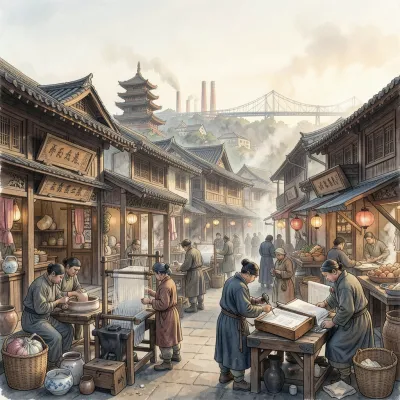
*Artisans and Markets* provides a comprehensive social and economic history of Chinese craftsmanship from the Song dynasty to the digital age. It challenges the notion of craft as a static precursor to industrialization, instead portraying workshops as dynamic institutions capable of sophisticated scaling and technical adaptation. The narrative traces the evolution of specialized sectors—such as the porcelain complex of Jingdezhen, silk and cotton textile production, and metallurgical trades—highlighting how these industries navigated shifting consumer demands, global trade routes, and the persistent presence of state regulation.
The book emphasizes the social structures that sustained artisanal production, particularly the roles of apprenticeship, guilds, and native-place associations. These institutions managed skill transmission and quality standards while providing a framework for solidarity and negotiation against state extraction. The text explores the gendered division of labor, noting how women’s household industry in textiles provided a crucial economic foundation for the empire. It also details the sophisticated "reputation economies" that preceded modern branding, where marks, seals, and broker networks mediated trust in a vast, impersonal market.
As China encountered Western industrialization in the 19th century, the book describes a unique hybridization of craft and factory. Rather than a total displacement of traditional methods, Chinese artisans integrated new machinery into existing skill repertoires during the Self-Strengthening and Republican eras. This trajectory continued through the socialist transformation—which reorganized workshops into state collectives—and into the reform era, where de-collectivization and the rise of township enterprises sparked a craft revival.
In the contemporary era, the book examines how tradition is commodified through heritage tourism and the "intangible cultural heritage" system. It concludes by analyzing the impact of e-commerce and live-streaming platforms, which have created new digital paths for ancient crafts. By placing Chinese development in a global comparative perspective, the work argues that China’s industrial story is a braided history where hand-skills and high technology continually inform and reshape one another.
What You'll Find Inside:
- The book traces how Chinese artisans adapted craft production from medieval hand tools to modern mechanization and digital platforms while preserving skill-based traditions across dynasties.
- It examines the evolving relationship between state power and craft industries, including regulations, monopolies, taxation, and the shifting balance between state control and market freedom.
- It analyzes guilds and craft associations as institutions that provided solidarity, regulated quality, controlled apprenticeship, and negotiated with authorities.
- It explores the gendered division of labor in textile production, highlighting women's dominant role in household-based silk and cotton industries from Song to modern times.
- It discusses the contemporary revival of traditional crafts through e-commerce platforms, heritage tourism, and cultural preservation efforts in the digital age.
Who's It For:
This book is essential reading for economic historians, scholars of Chinese history and culture, anthropologists studying craft traditions, and anyone interested in the global history of industrialization. It will particularly benefit readers seeking to understand how artisan communities navigated technological change, state regulation, and market forces across centuries, offering valuable comparative perspectives on China's unique path from workshop to factory.
Table of Contents:
- Introduction
- Chapter 1 Markets and Workshops in the Song: Urban Artisans and the Rise of Commerce
- Chapter 2 Mongol Rule and Mobility: Crafts under the Yuan
- Chapter 3 The Ming Artisan State: Regulations, Registrations, and Obligations
- Chapter 4 Jingdezhen and the Porcelain Complex: Scale, Skill, and World Demand
- Chapter 5 Silk and Cotton: Household Industry and the Gendered Division of Labor
- Chapter 6 Carpentry, Joinery, and the Built City: Timber, Temples, and Trades
- Chapter 7 Metal, Mint, and Forge: Metallurgical Crafts and Monetary Flows
- Chapter 8 Guilds and Halls: Institutions of Solidarity, Discipline, and Negotiation
- Chapter 9 Apprenticeship and Skill Transmission: Pedagogy, Secrecy, and Innovation
- Chapter 10 Tools, Techniques, and Technological Change: From Hand to Wheel, Loom, and Lathe
- Chapter 11 Credit, Brokers, and Trust: The Social Foundations of Market Exchange
- Chapter 12 Measuring Quality: Standards, Brands, and Reputation Economies
- Chapter 13 Taxes, Monopolies, and the State: Regulation at the Market Edge
- Chapter 14 Mobility and Migration: Journeymen, Itinerants, and Regional Specialization
- Chapter 15 Waterways, Caravans, and Ports: Logistics of Craft Supply Chains
- Chapter 16 Encountering the West: Treaty Ports, Machines, and the Late Qing Workshop
- Chapter 17 Self-Strengthening to New Industry: Hybrids of Craft and Factory
- Chapter 18 Labor, Protest, and Politics: Workers, Guilds, and Urban Movements
- Chapter 19 Republican Corporatism and Chambers of Commerce: Reorganizing Industry
- Chapter 20 Socialist Transformation: Handicraft Collectives and the Planned Economy
- Chapter 21 Reform and Opening: De-collectivization, Township Enterprises, and the Craft Revival
- Chapter 22 Design, Heritage, and Tourism: The Commodification of Tradition
- Chapter 23 E-commerce, Platforms, and New Markets: Digital Paths for Old Crafts
- Chapter 24 Environmental Constraints and Sustainability: Materials, Waste, and Ethics
- Chapter 25 Comparative Perspectives and Theories: China in the Global History of Craft and Industry
Author:
Published By:
Date Published:
May 14, 2026
Type:
Nonfiction
Language:
English
Word Count:
70,820 words
Reading Time:
4 hours 58 minutes
Sample:
Order:
Order Artisans and Markets: The Social History of Craft and Industry in China (Paperback) on MixCache.com:
Buy NowPrint copy is made to order and ships worldwide. Includes the ebook free, ready to read instantly.
$5 account credit for all new MixCache.com accounts, usable toward any ebook purchase!*