
Browse by Category
Fiction
- Action & Adventure
- African American
- Anthologies
- Children's Fiction
- Classics
- Comics & Graphic Novels
- Coming of Age
- Contemporary
- Cultural & Regional
- Drama
- Erotica
- Fantasy
- General
- Historical Fiction
- Horror
- Humor & Satire
- Literary Fiction
- Mystery, Thriller & Suspense
- Poetry
- Religious & Inspirational
- Romance
- Science Fiction
- Short Stories
- War & Military
- Westerns
- Women's Fiction
- Young Adult
Non-Fiction
- Antiques & Collectibles
- Arts & Photography
- Biographies & Memoirs
- Business & Money
- Children's Non-Fiction
-
Computers & Technology
- Artificial Intelligence
- Computer Science
- Cybersecurity & Cryptography
- Data Science & Analytics
- Databases & Big Data
- Game Development & Design
- General
- Hardware & DIY
- Mobile App Development
- Networking & Cloud Computing
- Operating Systems
- Programming
- Robotics
- Software
- Software Engineering
- User Experience (UX) & Design
- Web Development & Design
- Cooking, Food & Wine
- Crafts, Hobbies & Home
- Education & Teaching
- Engineering
- General
- Health, Fitness & Dieting
-
History
- African History
- African History - North Africa
- African History - Sub-Saharan Africa
- American History
- American History - 20th Century
- American History - Civil War
- American History - Colonial Period
- Ancient History
- Asian History
- Asian History - China
- Asian History - India
- Asian History - Japan
- Asian History - Southeast Asia
- European History
- European History - Ancient Greece
- European History - Ancient Rome
- European History - Medieval
- European History - Modern
- European History - Renaissance
- General
- Middle Eastern History
- Military History
- Military History - Aviation
- Military History - Naval
- Social & Cultural History
- World History
- Humor & Entertainment
- Industrial Technology
- Language Learning
- Law
- LGBTQ+ Non-Fiction
- Literary Criticism
- Medical Books
- Parenting & Relationships
- Philosophy
- Politics & Social Sciences
- Reference
- Religion & Spirituality
-
Science & Math
- Agricultural Sciences
- Astronomy & Space Science
- Behavioral Sciences
- Biological Sciences
- Botany & Plant Science
- Chemistry
- Earth Sciences
- Engineering - Chemical
- Engineering - Civil
- Engineering - Electrical
- Engineering - Mechanical
- Environment
- General
- Geology
- Mathematics
- Nature & Ecology
- Oceanography
- Paleontology
- Physics
- Statistics
- Self-Help
- Sports & Outdoors
- Study Aids
- Sustainability & Green Living
- Textbooks
- Transportation
- Travel
- True Crime
- Urban Planning & Development
- Veterinary Medicine
- Writing & Publishing
Jump to Section

Want unlimited access to all books published by MixCache.com (plus their audiobooks)? Try MixCache.com Total Access. Look for the MTA badge on book covers to identify included titles.
Access to infinite ebooks: Don't see the book you want? Suggest it and we'll create it (free!) for you from scratch with our powerful AI book writer. Then read it with MTA - besides profiting from any sales it makes!
Rooftop and Balcony Spice Farming
MTA
Designing Profitable Micro-Farms for Urban Markets
About this book:
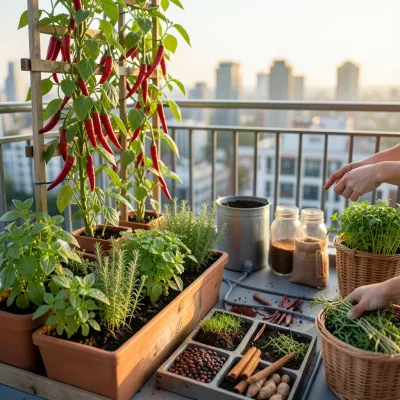
*Rooftop and Balcony Spice Farming* provides a comprehensive blueprint for transforming underutilized urban spaces into high-value micro-farms. The book argues that culinary herbs and spices—such as Thai basil, shiso, ginger, and specialty chilies—are the ideal crops for small-scale urban agriculture because they offer high revenue per square foot, thrive in container systems, and meet the intense demand of local chefs and gourmet consumers. By collapsing the distance between harvest and plate, urban growers can provide a level of freshness and aromatic potency that industrial supply chains cannot replicate.
The technical core of the book emphasizes that urban farming is a feat of engineering and microclimate management. Growers must navigate structural realities, such as load-bearing capacities and wind shear, while designing efficient systems for irrigation, fertigation, and season extension. The text details the importance of using lightweight, "living" soilless media and specialized containers like fabric pots to optimize root health. Success depends on intensive spacing, precise pruning to encourage continuous yields, and a disciplined approach to integrated pest management (IPM) that prioritizes biological controls over chemical interventions.
Beyond cultivation, the book focuses on the business operations required to sustain a profitable enterprise. It outlines the critical nature of postharvest handling—specifically hydrocooling and cold chain maintenance—to preserve crop value. The author highlights value-added products, such as herb salts, infused oils, and dried blends, as essential tools for expanding profit margins and ensuring year-round cash flow. By diversifying sales through restaurant contracts, niche retail, and "spice CSAs," growers can build resilient businesses that mitigate the risks of seasonal fluctuations and urban environmental challenges.
Ultimately, the book frames the urban micro-farm as a data-driven manufacturing process. It encourages growers to track Key Performance Indicators (KPIs) like revenue per square foot and labor efficiency to refine their operations. Through various case studies, the text illustrates that while the physical footprint may be small, the economic and social impact of these farms is significant. The model offers a path toward urban sustainability and entrepreneurship, proving that with the right design and market strategy, even the thinnest margins of the city can be turned into productive, profitable landscapes.
What You'll Find Inside:
- How to transform underutilized urban spaces (rooftops, balconies) into profitable micro-farms specializing in high-value herbs and spices
- Comprehensive guidance on structural safety, load calculations, permitting, and site selection for urban farming operations
- Detailed crop selection strategies for container-friendly herbs, spices, and specialty aromatics with premium market value
- Business systems for pricing, branding, packaging, sales channels (restaurants, CSAs, retail), and financial planning
- Sustainable practices including water harvesting, composting, season extension, and data-driven farm management
Who's It For:
This book is designed for urban entrepreneurs, chefs, building owners, and aspiring farmers who want to create profitable micro-farms in limited urban spaces. It specifically targets renters with balconies, building owners exploring amenity agriculture, chefs seeking hyperlocal ingredients, and beginning farmers interested in high-value herb and spice production. Readers will benefit most if they have access to rooftop or balcony space and are motivated to combine agricultural knowledge with business acumen to create a resilient urban enterprise focused on premium culinary crops.
Author:
Published By:
Date Published:
May 13, 2026
Type:
Nonfiction
Language:
English
Word Count:
73,399 words
Reading Time:
5 hours 8 minutes
Sample:
MixCache.com Total Access
Get unlimited access to this book + all books published by MixCache.com for $11.99/month
Subscribe to MTAOr purchase this book individually below
Order:
Buy the Rooftop and Balcony Spice Farming ebook on MixCache.com:
Buy Now
Full ebook will be available immediately
- read online or download as a PDF file.
$5 account credit for all new MixCache.com accounts, usable toward any ebook purchase!*


Ratings & Reviews
Ask Questions About This Book
Have a question about the content? Ask our AI assistant!
Start by asking a question about "Rooftop and Balcony Spice Farming"
Example: "Does this book mention William Shakespeare?"
Thinking...