Browse by Category
Fiction
- Action & Adventure
- African American
- Anthologies
- Children's Fiction
- Classics
- Comics & Graphic Novels
- Coming of Age
- Contemporary
- Cultural & Regional
- Drama
- Erotica
- Fantasy
- General
- Historical Fiction
- Horror
- Humor & Satire
- Literary Fiction
- Mystery, Thriller & Suspense
- Poetry
- Religious & Inspirational
- Romance
- Science Fiction
- Short Stories
- War & Military
- Westerns
- Women's Fiction
- Young Adult
Non-Fiction
- Antiques & Collectibles
- Arts & Photography
- Biographies & Memoirs
- Business & Money
- Children's Non-Fiction
-
Computers & Technology
- Artificial Intelligence
- Computer Science
- Cybersecurity & Cryptography
- Data Science & Analytics
- Databases & Big Data
- Game Development & Design
- General
- Hardware & DIY
- Mobile App Development
- Networking & Cloud Computing
- Operating Systems
- Programming
- Robotics
- Software
- Software Engineering
- User Experience (UX) & Design
- Web Development & Design
- Cooking, Food & Wine
- Crafts, Hobbies & Home
- Education & Teaching
- Engineering
- General
- Health, Fitness & Dieting
-
History
- African History
- African History - North Africa
- African History - Sub-Saharan Africa
- American History
- American History - 20th Century
- American History - Civil War
- American History - Colonial Period
- Ancient History
- Asian History
- Asian History - China
- Asian History - India
- Asian History - Japan
- Asian History - Southeast Asia
- European History
- European History - Ancient Greece
- European History - Ancient Rome
- European History - Medieval
- European History - Modern
- European History - Renaissance
- General
- Middle Eastern History
- Military History
- Military History - Aviation
- Military History - Naval
- Social & Cultural History
- World History
- Humor & Entertainment
- Industrial Technology
- Language Learning
- Law
- LGBTQ+ Non-Fiction
- Literary Criticism
- Medical Books
- Parenting & Relationships
- Philosophy
- Politics & Social Sciences
- Reference
- Religion & Spirituality
-
Science & Math
- Agricultural Sciences
- Astronomy & Space Science
- Behavioral Sciences
- Biological Sciences
- Botany & Plant Science
- Chemistry
- Earth Sciences
- Engineering - Chemical
- Engineering - Civil
- Engineering - Electrical
- Engineering - Mechanical
- Environment
- General
- Geology
- Mathematics
- Nature & Ecology
- Oceanography
- Paleontology
- Physics
- Statistics
- Self-Help
- Sports & Outdoors
- Study Aids
- Sustainability & Green Living
- Textbooks
- Transportation
- Travel
- True Crime
- Urban Planning & Development
- Veterinary Medicine
- Writing & Publishing
Jump to Section
MixCache.com Total Access
Unlimited reading and audiobooks for every book published by MixCache.com.
Included titles carry the MTA badge.
Learn more →
Walls Under Fire: A Global History of Sieges, Fortifications, and Siegecraft
MTA
Architectural, tactical, and technological responses to the challenge of taking fortresses
About this book:
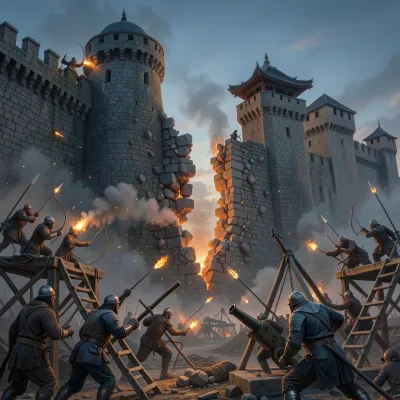
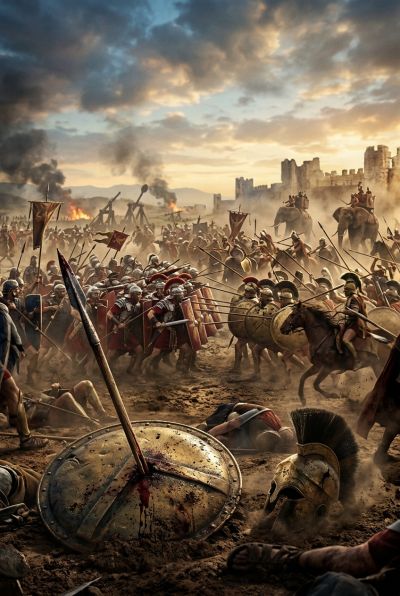
In *Walls Under Fire: A Global History of Sieges, Fortifications, and Siegecraft*, the history of warfare is reframed through the enduring "negotiation of pressure and endurance" at the city wall. Moving beyond traditional battle narratives, the book explores how the architectural evolution of fortifications—from the earthen mounds of Jericho and the massive mudbrick of Assyria to the geometric perfection of the *trace italienne*—was driven by a constant technological arms race with the tools of assault. It traces a global trajectory of innovation where Greek torsion artillery, Chinese traction trebuchets, and Islamic mining techniques cross-pollinated to create a sophisticated science of "poliorcetics," eventually forced into radical adaptation by the transformative arrival of gunpowder and heavy artillery.
The narrative emphasizes that the outcome of a siege was rarely determined by weaponry alone but by the "hidden battles" of logistics, engineering, and human psychology. Detailed case studies—including Rome’s methodical circumvallation at Alesia, the vertical challenges of Indian hill forts, and the bureaucratic precision of Chinese defense—illustrate how time, water, and grain were weaponized as effectively as battering rams. The book highlights the professionalization of the craft through figures like Vauban, whose systematized approach to trenches and parallels turned the reduction of a fortress into a predictable, mathematical certainty, while simultaneously making the cost of war a burden that only centralized states could sustain.
In its later chapters, the book examines the transition into the industrial and modern eras, where the scale of destruction expanded to include entire urban populations. From the grueling trench warfare of World War I to the total-war crucibles of Leningrad, Sevastopol, and Malta in World War II, the city is depicted as a living system where infrastructure becomes as vital as masonry. The study concludes with modern urban sieges in Beirut, Sarajevo, Aleppo, and Mariupol, revealing that despite the advent of drones, satellite intelligence, and precision munitions, the ancient logic of the siege remains constant. Today’s urban centers continue to be tested by the same fundamental equations of hunger, morale, and the agonizing arithmetic of survival.
What You'll Find Inside:
- Siege outcomes depend more on logistics and supply chains than on weapon size or wall thickness - moving food, water, powder, and information efficiently determines who endures longer.
- Siegecraft evolved through continuous cross-cultural exchange, with techniques perfected in one region (like Greek torsion engines or Chinese mining) spreading globally via mercenaries, traders, and conquered engineers.
- Psychological factors - morale, fear, hope, and endurance - are as decisive as physical fortifications, with leaders managing emotions through signals, rituals, and information control.
- Fortifications constantly adapted to new threats, from ancient earthworks to trace italienne bastions to modern urban infrastructure, each innovation prompting offensive countermeasures in an endless technological dialogue.
- Despite technological advances from catapults to precision-guided munitions, the core siege calculus remains unchanged: victory goes to the side that best manages time, resources, and the human will to endure under pressure.
Who's It For:
This book will appeal to students and scholars of military history, international relations, and the history of technology, as well as professionals in defense, engineering, and urban planning. Its global comparative approach makes it valuable for anyone interested in how societies have solved similar problems across time and space. General readers with a serious interest in how warfare shapes cities, cultures, and human endurance will also find the engaging case studies and accessible analysis rewarding.
Table of Contents:
- Introduction
- Chapter 1 Why Sieges Matter: War at the Wall
- Chapter 2 Origins of Siegecraft: Jericho to Assyria
- Chapter 3 Engines of Assault: From Rams and Torsion to Gunpowder
- Chapter 4 Underground War: Mining, Sapping, and the Countermine
- Chapter 5 Greek and Hellenistic Poliorcetics: Demetrius to Rhodes
- Chapter 6 Rome’s Lines: Circumvallation, Starvation, and Storm
- Chapter 7 China’s Siege Traditions: Ladders, Towers, Fire, and Bureaucracy
- Chapter 8 India’s Forts and Water Wars: Rajputana and the Deccan
- Chapter 9 The Islamic Synthesis: Trebuchets, Tunnels, and Texts
- Chapter 10 Castles and Concentric Defense in Medieval Europe
- Chapter 11 Crusader and Mongol Sieges: Contact, Shock, and Transfer
- Chapter 12 The Gunpowder Turn: Artillery Versus Masonry
- Chapter 13 Trace Italienne: Geometry, Bastions, and the New Science
- Chapter 14 Vauban and the Systematized Siege
- Chapter 15 The Ottoman Crucible: Constantinople to Vienna
- Chapter 16 Japan’s Sengoku Castles and the Siege of Osaka
- Chapter 17 Africa’s Walls and Gateways: Benin, Gondar, and the Swahili Coast
- Chapter 18 Maritime and Colonial Forts: The Global Littoral
- Chapter 19 The Americas Under Siege: Tenochtitlan, St. Augustine, and the Frontier
- Chapter 20 Napoleonic Tempests: Zaragoza, Badajoz, and Torres Vedras
- Chapter 21 Industrial-Era Sieges: Sevastopol, Paris, and the American Civil War
- Chapter 22 Engineers, Logistics, Disease, and Morale: The Hidden Battles
- Chapter 23 World War I: Fortresses and Artillery Worlds
- Chapter 24 World War II: Cities Besieged—Leningrad, Sevastopol, Malta
- Chapter 25 Modern Urban Sieges: Beirut to Sarajevo, Grozny to Aleppo and Mariupol
Author:
Published By:
Date Published:
May 7, 2026
Type:
Nonfiction
Language:
English
Word Count:
66,403 words
Reading Time:
4 hours 39 minutes
Sample:
Order:
Order Walls Under Fire: A Global History of Sieges, Fortifications, and Siegecraft (Paperback) on MixCache.com:
Buy NowPrint copy is made to order and ships worldwide. Includes the ebook free, ready to read instantly.
$5 account credit for all new MixCache.com accounts, usable toward any ebook purchase!*