
Browse by Category
Fiction
- Action & Adventure
- African American
- Anthologies
- Children's Fiction
- Classics
- Comics & Graphic Novels
- Coming of Age
- Contemporary
- Cultural & Regional
- Drama
- Erotica
- Fantasy
- General
- Historical Fiction
- Horror
- Humor & Satire
- Literary Fiction
- Mystery, Thriller & Suspense
- Poetry
- Religious & Inspirational
- Romance
- Science Fiction
- Short Stories
- War & Military
- Westerns
- Women's Fiction
- Young Adult
Non-Fiction
- Antiques & Collectibles
- Arts & Photography
- Biographies & Memoirs
- Business & Money
- Children's Non-Fiction
-
Computers & Technology
- Artificial Intelligence
- Computer Science
- Cybersecurity & Cryptography
- Data Science & Analytics
- Databases & Big Data
- Game Development & Design
- General
- Hardware & DIY
- Mobile App Development
- Networking & Cloud Computing
- Operating Systems
- Programming
- Robotics
- Software
- Software Engineering
- User Experience (UX) & Design
- Web Development & Design
- Cooking, Food & Wine
- Crafts, Hobbies & Home
- Education & Teaching
- Engineering
- General
- Health, Fitness & Dieting
-
History
- African History
- African History - North Africa
- African History - Sub-Saharan Africa
- American History
- American History - 20th Century
- American History - Civil War
- American History - Colonial Period
- Ancient History
- Asian History
- Asian History - China
- Asian History - India
- Asian History - Japan
- Asian History - Southeast Asia
- European History
- European History - Ancient Greece
- European History - Ancient Rome
- European History - Medieval
- European History - Modern
- European History - Renaissance
- General
- Middle Eastern History
- Military History
- Military History - Aviation
- Military History - Naval
- Social & Cultural History
- World History
- Humor & Entertainment
- Industrial Technology
- Language Learning
- Law
- LGBTQ+ Non-Fiction
- Literary Criticism
- Medical Books
- Parenting & Relationships
- Philosophy
- Politics & Social Sciences
- Reference
- Religion & Spirituality
-
Science & Math
- Agricultural Sciences
- Astronomy & Space Science
- Behavioral Sciences
- Biological Sciences
- Botany & Plant Science
- Chemistry
- Earth Sciences
- Engineering - Chemical
- Engineering - Civil
- Engineering - Electrical
- Engineering - Mechanical
- Environment
- General
- Geology
- Mathematics
- Nature & Ecology
- Oceanography
- Paleontology
- Physics
- Statistics
- Self-Help
- Sports & Outdoors
- Study Aids
- Sustainability & Green Living
- Textbooks
- Transportation
- Travel
- True Crime
- Urban Planning & Development
- Veterinary Medicine
- Writing & Publishing
Jump to Section
MixCache.com Total Access
Unlimited reading and audiobooks for every book published by MixCache.com.
Included titles carry the MTA badge.
Learn more →
Battlefield Archaeology: Unearthing the Material History of Warfare
MTA
Methods, discoveries, and what artifacts reveal about tactics and soldiers' lives
About this book:
**Summary: Battlefield Archaeology: Unearthing the Material History of Warfare**
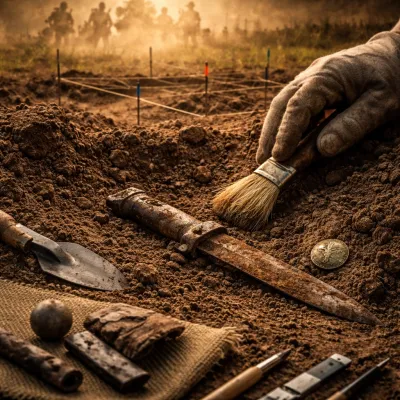
*Battlefield Archaeology: Unearthing the Material History of Warfare* explores the interdisciplinary methods used to recover and interpret the physical remains of conflict. Moving beyond traditional historical narratives, the book argues that the "material record"—including ballistics, uniform fragments, and human remains—serves as a primary source that can confirm or overturn written accounts. By integrating archaeological excavation with forensic science and military history, researchers can reconstruct tactical decisions, logistical constraints, and the visceral lived experiences of soldiers and civilians at a granular level.
The text details a comprehensive suite of survey and analytical strategies, ranging from traditional walkover grids and metal detecting to advanced remote sensing technologies like LiDAR, magnetometry, and drone photogrammetry. These tools allow archaeologists to visualize hidden earthworks and map artifact scatters that reflect the "geometry of violence," such as volley fire patterns or retreat routes. The book emphasizes the importance of taphonomy—the study of how environmental processes like erosion, frost heave, and later land use disturb and rearrange evidence—stressing that understanding these post-battle transformations is essential for accurate historical reconstruction.
Specialized chapters address diverse combat environments, including siege works, underwater shipwrecks, aerial crash sites, and colonial encounter zones. The analysis extends to the social and medical dimensions of war, examining the material culture of encampments, field hospitals, and mass graves. These findings illuminate the "human cost" of conflict, revealing how soldiers improvised tools for survival, how triage was managed under fire, and how identity was maintained through personal insignia. Ethical stewardship and collaboration with descendant communities are highlighted as foundational to the discipline, particularly when handling human remains.
The book concludes with several case studies—spanning from the Bronze Age to the industrial warfare of the 20th century—demonstrating how integrated material evidence reshapes historical understanding. By treating the battlefield as a dynamic palimpsest rather than a static museum, the text shows how archaeology recovers the specific, often messy realities of combat that official chronicles frequently omit. Ultimately, the work asserts that the ground remembers the stubborn physics of violence more reliably than human memory, offering a textured, often contradictory, and deeply human perspective on the history of war.
What You'll Find Inside:
- Battlefield archaeology integrates archaeological methods, forensic science, and military history to recover tactical decisions and personal experiences from combat landscapes.
- Material evidence from battlefields can confirm, complicate, or overturn written historical accounts by providing direct physical proof of events often missing from texts.
- The book covers a full range of methodologies from non-invasive survey (walkover, metal detecting, remote sensing) to excavation strategies and laboratory analysis techniques.
- Artifacts reveal not only weapons and tactics but also soldiers' identities, daily lives, adaptations, and the wider conflict landscape including civilians and encampments.
- Ethical considerations and stewardship are central to the discipline, requiring collaboration with descendant communities and careful treatment of human remains and sensitive artifacts.
Who's It For:
This book is essential for archaeology students and professionals specializing in conflict or military sites, military historians seeking to integrate material evidence into their research, and cultural resource managers responsible for battlefield preservation. It will also benefit forensic anthropologists working with conflict-related human remains and serious practitioners interested in proper survey and excavation methodologies for combat landscapes.
Table of Contents:
- Introduction
- Chapter 1 What Is Battlefield Archaeology?
- Chapter 2 Sources and Theory: From Chronicles to Material Culture
- Chapter 3 Finding Battlefields: Archives, Landscapes, and Local Memory
- Chapter 4 Survey Strategies: Walkover, Grids, and Metal Detecting Protocols
- Chapter 5 Remote Sensing and GIS: LiDAR, Magnetometry, and Drones
- Chapter 6 Excavating Combat Zones: Stratigraphy and Context in Disturbed Ground
- Chapter 7 Taphonomy of Battle: Weathering, Scavenging, and Post‑Battle Processes
- Chapter 8 Dating the Fight: Typology, Ballistics, and Scientific Chronologies
- Chapter 9 Reading Fire: Ballistics, Trajectory Modeling, and Isotopes
- Chapter 10 Artifact Scatters and Formations: Spatial Analysis of Tactics
- Chapter 11 Arms and Armor: Evolution, Use‑Wear, and Repair
- Chapter 12 Uniforms, Insignia, and Identity: What Clothes Reveal
- Chapter 13 Logistics and Encampments: Supply, Camp Life, and Movement
- Chapter 14 Field Medicine and Mortality: Hospitals, Trauma, and Casualty Patterns
- Chapter 15 Captivity and Aftermath: POWs, Surrenders, and Mass Graves
- Chapter 16 Fortifications and Siegeworks: Engineering the Battlefield
- Chapter 17 Naval and Underwater Battlefields: Wrecks, Crossings, and Harbors
- Chapter 18 Aerial Warfare and Crash Sites: From Balloons to Jets
- Chapter 19 Colonial and Indigenous Battlefields: Conflict, Contact, and Memory
- Chapter 20 Civilians, Looting, and the Wider Conflict Landscape
- Chapter 21 Case Study I: Reconstructing a Bronze Age Clash
- Chapter 22 Case Study II: A Medieval Battle Reconsidered
- Chapter 23 Case Study III: Gunpowder, Lines, and Global Warfare
- Chapter 24 Case Study IV: Industrial War—Trenches, Shellfire, and Mechanization
- Chapter 25 Reconstructing Narratives: Integrating Evidence and Changing Histories
Author:
Published By:
Date Published:
May 7, 2026
Type:
Nonfiction
Language:
English
Word Count:
63,488 words
Reading Time:
4 hours 27 minutes
Sample:
MixCache.com Total Access
Get unlimited access to this book + all books published by MixCache.com for $11.99/month
Subscribe to MTAOr purchase this book individually below
Order:
Buy the Battlefield Archaeology: Unearthing the Material History of Warfare ebook on MixCache.com:
Buy Now
Full ebook will be available immediately
- read online or download as a PDF file.
$5 account credit for all new MixCache.com accounts, usable toward any ebook purchase!*






Ratings & Reviews
Ask Questions About This Book
Have a question about the content? Ask our AI assistant!
Start by asking a question about "Battlefield Archaeology: Unearthing the Material History of Warfare"
Example: "Does this book mention William Shakespeare?"
Thinking...