
Browse by Category
Fiction
- Action & Adventure
- African American
- Anthologies
- Children's Fiction
- Classics
- Comics & Graphic Novels
- Coming of Age
- Contemporary
- Cultural & Regional
- Drama
- Erotica
- Fantasy
- General
- Historical Fiction
- Horror
- Humor & Satire
- Literary Fiction
- Mystery, Thriller & Suspense
- Poetry
- Religious & Inspirational
- Romance
- Science Fiction
- Short Stories
- War & Military
- Westerns
- Women's Fiction
- Young Adult
Non-Fiction
- Antiques & Collectibles
- Arts & Photography
- Biographies & Memoirs
- Business & Money
- Children's Non-Fiction
-
Computers & Technology
- Artificial Intelligence
- Computer Science
- Cybersecurity & Cryptography
- Data Science & Analytics
- Databases & Big Data
- Game Development & Design
- General
- Hardware & DIY
- Mobile App Development
- Networking & Cloud Computing
- Operating Systems
- Programming
- Robotics
- Software
- Software Engineering
- User Experience (UX) & Design
- Web Development & Design
- Cooking, Food & Wine
- Crafts, Hobbies & Home
- Education & Teaching
- Engineering
- General
- Health, Fitness & Dieting
-
History
- African History
- African History - North Africa
- African History - Sub-Saharan Africa
- American History
- American History - 20th Century
- American History - Civil War
- American History - Colonial Period
- Ancient History
- Asian History
- Asian History - China
- Asian History - India
- Asian History - Japan
- Asian History - Southeast Asia
- European History
- European History - Ancient Greece
- European History - Ancient Rome
- European History - Medieval
- European History - Modern
- European History - Renaissance
- General
- Middle Eastern History
- Military History
- Military History - Aviation
- Military History - Naval
- Social & Cultural History
- World History
- Humor & Entertainment
- Industrial Technology
- Language Learning
- Law
- LGBTQ+ Non-Fiction
- Literary Criticism
- Medical Books
- Parenting & Relationships
- Philosophy
- Politics & Social Sciences
- Reference
- Religion & Spirituality
-
Science & Math
- Agricultural Sciences
- Astronomy & Space Science
- Behavioral Sciences
- Biological Sciences
- Botany & Plant Science
- Chemistry
- Earth Sciences
- Engineering - Chemical
- Engineering - Civil
- Engineering - Electrical
- Engineering - Mechanical
- Environment
- General
- Geology
- Mathematics
- Nature & Ecology
- Oceanography
- Paleontology
- Physics
- Statistics
- Self-Help
- Sports & Outdoors
- Study Aids
- Sustainability & Green Living
- Textbooks
- Transportation
- Travel
- True Crime
- Urban Planning & Development
- Veterinary Medicine
- Writing & Publishing
Jump to Section
MixCache.com Total Access
Unlimited reading and audiobooks for every book published by MixCache.com.
Included titles carry the MTA badge.
Learn more →
Railways, Rivers, and Rubber: Infrastructure and Economic Development in the Americas
MTA
Transport, extractive booms, and the networks that integrated continental markets, 1850–1950
About this book:
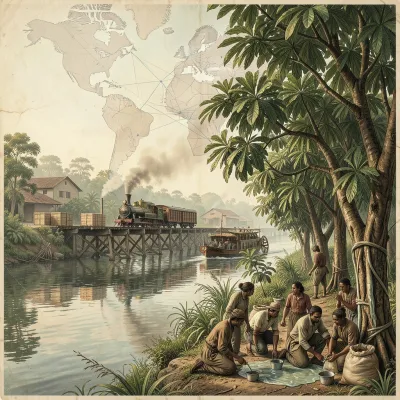
Between 1850 and 1950, the Americas underwent a profound economic and spatial transformation driven by the expansion of railways, steam navigation, and extractive commodity booms in rubber, sugar, and oil. Infrastructure was deployed as a primary tool of statecraft and capitalist expansion, utilizing foreign finance—largely from Britain and the United States—to knit together distant hinterlands with global maritime ports. This period saw the rise of continental rail networks in the U.S., Mexico, and the Southern Cone, as well as the intensive engineering of major river systems like the Mississippi, Amazon, and Magdalena to facilitate the high-volume movement of raw materials.
This integration was never a neutral or purely technical process; it was a deeply political and social project that prioritized export-led growth over local needs. The construction and maintenance of these networks relied on massive labor migrations characterized by a spectrum of contracting and coercion, from indentured Caribbean workers to seasonal migrants in the Amazon. As these corridors solidified, they created a new urban hierarchy, favoring "gateway cities" like Manaus, Belém, Tampico, and Chicago, while simultaneously marginalizing regions bypassed by the new steel and water arteries. These hubs became centers of concentrated capital and administrative power, standardizing time, gauges, and tariffs to reduce the friction of trade.
The human and environmental costs of this connectivity were immense. The expansion of infrastructure frequently led to the dispossession of indigenous lands and the violation of traditional river rights, sparking persistent cycles of resistance and sabotage. Ecologically, the relentless drive for efficiency resulted in widespread deforestation, altered hydrological regimes, and the rapid spread of epidemics and industrial accidents along transport lines. These "frictions" and externalized costs were often masked by the optimistic rhetoric of progress and the narrow metrics of price arbitrage and market convergence.
By 1950, the basic architecture of American economic geography was firmly established, leaving a legacy of path dependencies that continue to shape development today. While newer technologies like highways and pipelines eventually challenged the dominance of rails and rivers, the historical corridors remained the scaffolding for modern market integration. The century of "Railways, Rivers, and Rubber" ultimately bequeathed a hemisphere that was more interconnected yet more unequal, characterized by durable dependencies on volatile commodity markets and a physical landscape permanently reshaped by the pursuit of industrial velocity.
What You'll Find Inside:
- Infrastructure decisions were political acts that shaped power dynamics, determining which places prospered while others were marginalized through choices about railway routes, river improvements, and resource extraction.
- British and American financial capital drove transport infrastructure development across the hemisphere, creating patterns of dependency and influence that persisted long after initial investments.
- Falling transport costs, standardization of gauges and timetables, and reliable through-routes enabled market integration, arbitrage, and altered urban hierarchies between 1850-1950.
- Commodity booms in rubber, sugar, and oil were tightly coupled with transport systems, where infrastructure chased resources and vice versa, creating distinctive economic geographies.
- Infrastructure development produced uneven benefits and costs, concentrating power in port cities and export corridors while distributing ecological, fiscal, and human costs disproportionately across regions, classes, and ethnicities.
Who's It For:
This book is ideal for students and scholars of economic history, Latin American studies, and infrastructure development who seek to understand how transport networks shaped the Americas between 1850 and 1950. It will particularly benefit researchers interested in the political economy of commodity booms, the role of foreign finance in regional development, and the uneven distribution of infrastructure's benefits and costs. Policy makers and urban planners looking for historical perspectives on contemporary infrastructure debates will also find valuable insights into the long-term legacies of transport investments.
Table of Contents:
- Introduction
- Chapter 1 Networks and Nations: Infrastructure as Statecraft, 1850–1950
- Chapter 2 Rails, Rivers, and Market Integration: Concepts and Methods
- Chapter 3 Capital on the Move: British and American Finance in Transport
- Chapter 4 Building the Continental Rails: The U.S., Mexico, and the Southern Cone
- Chapter 5 Andean Crossings: Engineering Altitude and Access
- Chapter 6 The Mississippi System: Grain, Cotton, and the River Economy
- Chapter 7 Steam on the Amazon: Navigating Forest Empires
- Chapter 8 Orinoco and Magdalena Waterways: Colombia and Venezuela Afloat
- Chapter 9 Sugar Frontiers: Caribbean Plantations and Port Logistics
- Chapter 10 Sugar and Steam in Northeast Brazil: Pernambuco to Bahia
- Chapter 11 Rubber Fever: The Amazon Boom and Bust
- Chapter 12 Manaus and Belém: Urban Gateways of Latex
- Chapter 13 Labor on the Move: Migration, Contracting, and Coercion
- Chapter 14 Oil in Mexico: Tampico, Veracruz, and the Pipeline Age
- Chapter 15 Venezuela’s Lake Maracaibo: Rigs, Rivers, and Refineries
- Chapter 16 The Panama Canal: Shortcut to Empire and Commerce
- Chapter 17 Standardizing Space: Gauges, Schedules, and Tariffs
- Chapter 18 Company Towns and Camps: Social Worlds of Extraction
- Chapter 19 Indigenous Lands and River Rights: Contesting the Channels
- Chapter 20 Ecologies of Steel and Water: Landscapes Transformed
- Chapter 21 Epidemics, Accidents, and Risk: The Human Cost of Connectivity
- Chapter 22 Smugglers, Strikes, and Sabotage: Frictions in the Networks
- Chapter 23 Prices, Arbitrage, and the Business Cycle: Measuring Integration
- Chapter 24 From Regional to Continental: Market Corridors and Urban Hierarchies
- Chapter 25 Legacies after 1950: Development Pathways and Dependencies
Author:
Published By:
Date Published:
May 5, 2026
Type:
Nonfiction
Language:
English
Word Count:
66,058 words
Reading Time:
4 hours 38 minutes
Sample:
Order:
Order Railways, Rivers, and Rubber: Infrastructure and Economic Development in the Americas (Hardcover) on MixCache.com:
Buy NowPrint copy is made to order and ships worldwide. Includes the ebook free, ready to read instantly.
$5 account credit for all new MixCache.com accounts, usable toward any ebook purchase!*


