
Browse by Category
Fiction
- Action & Adventure
- African American
- Anthologies
- Children's Fiction
- Classics
- Comics & Graphic Novels
- Coming of Age
- Contemporary
- Cultural & Regional
- Drama
- Erotica
- Fantasy
- General
- Historical Fiction
- Horror
- Humor & Satire
- Literary Fiction
- Mystery, Thriller & Suspense
- Poetry
- Religious & Inspirational
- Romance
- Science Fiction
- Short Stories
- War & Military
- Westerns
- Women's Fiction
- Young Adult
Non-Fiction
- Antiques & Collectibles
- Arts & Photography
- Biographies & Memoirs
- Business & Money
- Children's Non-Fiction
-
Computers & Technology
- Artificial Intelligence
- Computer Science
- Cybersecurity & Cryptography
- Data Science & Analytics
- Databases & Big Data
- Game Development & Design
- General
- Hardware & DIY
- Mobile App Development
- Networking & Cloud Computing
- Operating Systems
- Programming
- Robotics
- Software
- Software Engineering
- User Experience (UX) & Design
- Web Development & Design
- Cooking, Food & Wine
- Crafts, Hobbies & Home
- Education & Teaching
- Engineering
- General
- Health, Fitness & Dieting
-
History
- African History
- African History - North Africa
- African History - Sub-Saharan Africa
- American History
- American History - 20th Century
- American History - Civil War
- American History - Colonial Period
- Ancient History
- Asian History
- Asian History - China
- Asian History - India
- Asian History - Japan
- Asian History - Southeast Asia
- European History
- European History - Ancient Greece
- European History - Ancient Rome
- European History - Medieval
- European History - Modern
- European History - Renaissance
- General
- Middle Eastern History
- Military History
- Military History - Aviation
- Military History - Naval
- Social & Cultural History
- World History
- Humor & Entertainment
- Industrial Technology
- Language Learning
- Law
- LGBTQ+ Non-Fiction
- Literary Criticism
- Medical Books
- Parenting & Relationships
- Philosophy
- Politics & Social Sciences
- Reference
- Religion & Spirituality
-
Science & Math
- Agricultural Sciences
- Astronomy & Space Science
- Behavioral Sciences
- Biological Sciences
- Botany & Plant Science
- Chemistry
- Earth Sciences
- Engineering - Chemical
- Engineering - Civil
- Engineering - Electrical
- Engineering - Mechanical
- Environment
- General
- Geology
- Mathematics
- Nature & Ecology
- Oceanography
- Paleontology
- Physics
- Statistics
- Self-Help
- Sports & Outdoors
- Study Aids
- Sustainability & Green Living
- Textbooks
- Transportation
- Travel
- True Crime
- Urban Planning & Development
- Veterinary Medicine
- Writing & Publishing
Jump to Section

Want unlimited access to all books published by MixCache.com (plus their audiobooks)? Try MixCache.com Total Access. Look for the MTA badge on book covers to identify included titles.
Access to infinite ebooks: Don't see the book you want? Suggest it and we'll create it (free!) for you from scratch with our powerful AI book writer. Then read it with MTA - besides profiting from any sales it makes!
A Comparative History of North American Independence
MTA
From thirteen colonies to federations: divergent paths to statehood in the United States and Canada
About this book:
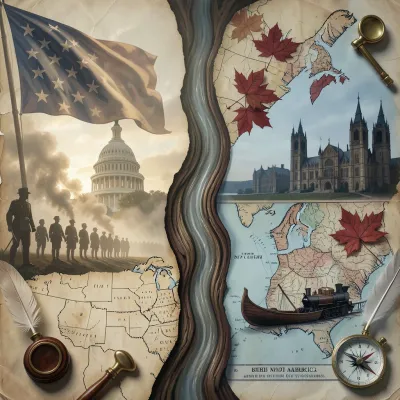
This book provides a comprehensive comparative history of state-building in the United States and Canada, tracing their divergence from British colonial origins into two distinct federal models. It frames independence not as a solitary event but as an ongoing series of political, economic, and social processes. By juxtaposing the American revolutionary break with the gradual, evolutionary path of Canadian Confederation, the text explores how different political cultures—one rooted in republicanism and individual rights, the other in constitutional monarchy and managed pluralism—developed in response to shared continental challenges.
Central to the narrative is the role of settler colonialism and the systematic displacement of Indigenous nations. The book foregrounds Indigenous sovereignty, examining how treaties, residential schools, and legal frameworks like the *Indian Act* and the reservation system functioned as institutional tools of the state. It also situates the history of slavery, abolition, and the Underground Railroad within a continental perspective, showing how the struggle for human rights bypassed and redefined national borders long before modern human rights frameworks were established.
Political economy and constitutional law serve as the book’s backbone, detailing how resource frontiers, railways, and trade agreements like NAFTA knit the continent together even as political identities remained separate. The text compares the "founding" moments of the U.S. Constitution with the "re-founding" moments of Canadian history, such as the 1867 Confederation and the 1982 patriation of the Constitution. By analyzing the evolution of judicial review and federalism, the author illustrates how each nation navigated the balance between central authority and regional or provincial autonomy.
Ultimately, the book examines how national identities are curated through monuments, textbooks, and public memory. It concludes that while the United States and Canada have followed different paths—one born of revolution and the other of reform—both remain deeply entangled through shared geography, economic interdependence, and the persistent efforts of Indigenous and marginalized communities to redefine the meaning of independence. The work emphasizes that the two federations are not static entities but evolving experiments that continue to negotiate the tensions between unity and diversity.
What You'll Find Inside:
- The book compares how the U.S. pursued revolutionary independence as a republic while Canada evolved gradually toward federation under the Crown, treating independence as an ongoing process rather than a single event.
- It centers Indigenous nations as active diplomatic and legal actors, examining how treaties, removals, and residential schools shaped power dynamics and how Indigenous resistance has influenced constitutional debates into the twenty-first century.
- It analyzes settler colonialism's institutionalization through land policies, residential schools, and legal frameworks that converted Indigenous sovereignty into settler property across both nations.
- It traces political economy as a recurring thread, showing how mercantilism, war finance, infrastructure projects, and industrialization created economic incentives that shaped constitutional and territorial developments.
- It compares key constitutional moments—from the Articles of Confederation and U.S. Constitution to the Constitutional Act of 1791, responsible government, and the Charter of Rights—highlighting divergent paths to federalism.
Who's It For:
This book serves students and scholars of North American history who seek a comparative understanding of U.S. and Canadian paths to statehood. It will be especially valuable for those researching Indigenous-settler relations, settler colonialism, constitutional development, and political economy across the border. Readers interested in how historical processes like slavery abolition, immigration, and rights movements unfolded in a continental context will find meaningful analysis. The work's accessible yet scholarly approach suits advanced undergraduate courses, graduate seminars, and informed general readers.
Author:
Published By:
Date Published:
May 5, 2026
Type:
Nonfiction
Language:
English
Word Count:
66,915 words
Reading Time:
4 hours 41 minutes
Sample:
Order:
Order A Comparative History of North American Independence (Hardcover) on MixCache.com:
Buy NowPrint copy is made to order and ships worldwide. Includes the ebook free, ready to read instantly.
$5 account credit for all new MixCache.com accounts, usable toward any ebook purchase!*


