
Browse by Category
Fiction
- Action & Adventure
- African American
- Anthologies
- Children's Fiction
- Classics
- Comics & Graphic Novels
- Coming of Age
- Contemporary
- Cultural & Regional
- Drama
- Erotica
- Fantasy
- General
- Historical Fiction
- Horror
- Humor & Satire
- Literary Fiction
- Mystery, Thriller & Suspense
- Poetry
- Religious & Inspirational
- Romance
- Science Fiction
- Short Stories
- War & Military
- Westerns
- Women's Fiction
- Young Adult
Non-Fiction
- Antiques & Collectibles
- Arts & Photography
- Biographies & Memoirs
- Business & Money
- Children's Non-Fiction
-
Computers & Technology
- Artificial Intelligence
- Computer Science
- Cybersecurity & Cryptography
- Data Science & Analytics
- Databases & Big Data
- Game Development & Design
- General
- Hardware & DIY
- Mobile App Development
- Networking & Cloud Computing
- Operating Systems
- Programming
- Robotics
- Software
- Software Engineering
- User Experience (UX) & Design
- Web Development & Design
- Cooking, Food & Wine
- Crafts, Hobbies & Home
- Education & Teaching
- Engineering
- General
- Health, Fitness & Dieting
-
History
- African History
- African History - North Africa
- African History - Sub-Saharan Africa
- American History
- American History - 20th Century
- American History - Civil War
- American History - Colonial Period
- Ancient History
- Asian History
- Asian History - China
- Asian History - India
- Asian History - Japan
- Asian History - Southeast Asia
- European History
- European History - Ancient Greece
- European History - Ancient Rome
- European History - Medieval
- European History - Modern
- European History - Renaissance
- General
- Middle Eastern History
- Military History
- Military History - Aviation
- Military History - Naval
- Social & Cultural History
- World History
- Humor & Entertainment
- Industrial Technology
- Language Learning
- Law
- LGBTQ+ Non-Fiction
- Literary Criticism
- Medical Books
- Parenting & Relationships
- Philosophy
- Politics & Social Sciences
- Reference
- Religion & Spirituality
-
Science & Math
- Agricultural Sciences
- Astronomy & Space Science
- Behavioral Sciences
- Biological Sciences
- Botany & Plant Science
- Chemistry
- Earth Sciences
- Engineering - Chemical
- Engineering - Civil
- Engineering - Electrical
- Engineering - Mechanical
- Environment
- General
- Geology
- Mathematics
- Nature & Ecology
- Oceanography
- Paleontology
- Physics
- Statistics
- Self-Help
- Sports & Outdoors
- Study Aids
- Sustainability & Green Living
- Textbooks
- Transportation
- Travel
- True Crime
- Urban Planning & Development
- Veterinary Medicine
- Writing & Publishing
Jump to Section
MixCache.com Total Access
Unlimited reading and audiobooks for every book published by MixCache.com.
Included titles carry the MTA badge.
Learn more →
Women of the Americas: Gender, Work, and Political Change
MTA
Feminist movements, labor histories, and female leadership from colonial times to the 21st century
About this book:
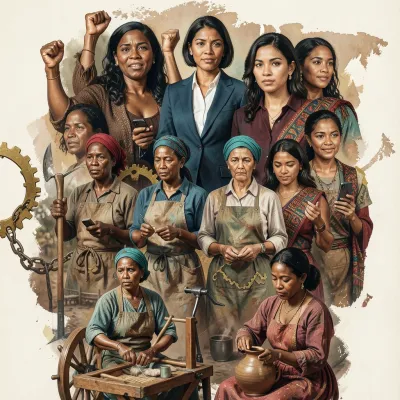
*Women of the Americas: Gender, Work, and Political Change* is a transnational exploration of how women—across lines of race, class, and ethnicity—have shaped the economic and political landscapes of the Western Hemisphere from the colonial era to the 21st century. The book centers on labor as the primary driver of historical change, redefining "work" to include not only formal employment but also unpaid domestic labor, coerced plantation toil, subsistence farming, and the modern platform economy. By tracing these entangled histories, the text illustrates how women’s struggles for livelihood have consistently remade the concepts of citizenship and power.
The narrative spans from the "gendered geography" of colonial missions and enslavement to the revolutionary independence movements of the 18th and 19th centuries. It highlights how Indigenous and Afro-descendant women navigated oppressive colonial orders through kinship, market trade, and legal petitioning, often creating informal economies that sustained their communities. As the Americas moved toward nation-building, the book examines the transition into industrialization and the rise of suffrage movements, where women leveraged their roles as "republican mothers" and factory workers to demand political inclusion and labor protections.
In the 20th century, the text analyzes the impact of populism, welfare states, and Cold War geopolitics on women’s lives. It documents the harrowing resistance of women during military dictatorships—turning mourning into a form of political mobilization—and the subsequent push for legislative quotas and parity. The later chapters address contemporary challenges, including the "feminization of migration," the rise of the maquiladora system, and the digital and platform economies. These sections explore how "algorithmic bosses" and transnational care chains have created new forms of precarity while also offering new tools for digital feminist solidarity.
The book concludes by looking toward the future of feminist politics, emphasizing decolonial thought and intersectional policy. It frames environmental justice, reproductive rights, and the right to the city as the primary battlegrounds of the current era. Ultimately, the work presents the Americas not as a collection of separate nations, but as a field of connected struggles where women’s labor and leadership continue to challenge the status quo and imagine alternative ways of organizing work and care in a globalized world.
What You'll Find Inside:
- Traces how women's labor—from subsistence farming and coerced plantation work to factory jobs and platform-mediated gigs—has shaped economic and political structures across the Americas from colonial times to present.
- Examines intersectional struggles through Indigenous, Afro-descendant, immigrant, and class perspectives, showing how feminism in the hemisphere has always been shaped by race, ethnicity, and colonial legacies.
- Documents women's political organizing across centuries—from independence movements and suffrage campaigns to Ni Una Menos, #MeToo, and digital activism—revealing both victories and persistent barriers.
- Explores how care work, migration, and environmental justice form interconnected frontiers of contemporary feminist struggle, linking bodily autonomy to territorial sovereignty.
- Analyzes quotas, parity laws, and evolving strategies for political representation while critiquing the limits of formal inclusion without economic and social transformation.
Who's It For:
This book is ideal for undergraduate and graduate students in history, gender studies, sociology, and political science seeking a transnational, intersectional framework for understanding women's roles in shaping the Americas. It will also benefit activists, community organizers, and policymakers looking for historical insights to inform contemporary struggles for labor rights, reproductive justice, and political representation, as well as educators searching for accessible yet rigorous materials to connect past movements with current events.
Table of Contents:
- Introduction
- Chapter 1 Mapping the Americas: Concepts, Borders, and Methods
- Chapter 2 Indigenous Women and Colonial Orders: Power, Kinship, and Survival
- Chapter 3 Conquest, Conversion, and Labor: Missions, Encomiendas, and Gendered Control
- Chapter 4 Enslavement and Freedom Dreams: Afro-Descendant Women in Plantation Economies
- Chapter 5 Markets and Households: Women’s Work in Colonial Cities and Countrysides
- Chapter 6 Revolutions and Republics: Women in Independence Struggles (1770–1830)
- Chapter 7 Nation-Building and Citizenship: Motherhood, Education, and Rights (1830–1900)
- Chapter 8 Migration and Industrialization: Factories, Domestic Service, and Borderlands (1880–1930)
- Chapter 9 Votes and Voices: Suffrage Across the Americas (1890–1960)
- Chapter 10 Populism, Welfare States, and the Politics of Care (1930–1970)
- Chapter 11 Rural Women, Land, and Agrarian Reform
- Chapter 12 Dictatorships, Civil Wars, and Memory: Mourning as Mobilization
- Chapter 13 Labor Feminisms in the Cold War Americas
- Chapter 14 The Informal Economy, Maquiladoras, and Export Processing Zones
- Chapter 15 Health, Reproductive Rights, and the Politics of the Body
- Chapter 16 Indigenous and Afro-Latin Feminisms: Decolonial Thought and Practice
- Chapter 17 Education, Media, and Cultural Production: Making Publics
- Chapter 18 Transnational Households: Migration, Remittances, and Care Chains
- Chapter 19 Women, Environment, and Extractivism: From the Amazon to the Arctic
- Chapter 20 From Quotas to Parity: Women’s Political Representation and Leadership
- Chapter 21 Urban Movements and the Right to the City: Housing, Transport, and Safety
- Chapter 22 Digital Feminisms: Hashtags, Networks, and New Solidarities
- Chapter 23 Work in the Platform Economy: Gigs, Care Apps, and Algorithmic Bosses
- Chapter 24 Intersectionality in Policy: Race, Class, Citizenship, and the State
- Chapter 25 Futures of Feminist Politics in the Americas
Author:
Published By:
Date Published:
May 5, 2026
Type:
Nonfiction
Language:
English
Word Count:
70,738 words
Reading Time:
4 hours 57 minutes
Sample:
MixCache.com Total Access
Get unlimited access to this book + all books published by MixCache.com for $11.99/month
Subscribe to MTAOr purchase this book individually below
Order:
Buy the Women of the Americas: Gender, Work, and Political Change ebook on MixCache.com:
Buy Now
Full ebook will be available immediately
- read online or download as a PDF file.
$5 account credit for all new MixCache.com accounts, usable toward any ebook purchase!*



Ratings & Reviews
Ask Questions About This Book
Have a question about the content? Ask our AI assistant!
Start by asking a question about "Women of the Americas: Gender, Work, and Political Change"
Example: "Does this book mention William Shakespeare?"
Thinking...