
Browse by Category
Fiction
- Action & Adventure
- African American
- Anthologies
- Children's Fiction
- Classics
- Comics & Graphic Novels
- Coming of Age
- Contemporary
- Cultural & Regional
- Drama
- Erotica
- Fantasy
- General
- Historical Fiction
- Horror
- Humor & Satire
- Literary Fiction
- Mystery, Thriller & Suspense
- Poetry
- Religious & Inspirational
- Romance
- Science Fiction
- Short Stories
- War & Military
- Westerns
- Women's Fiction
- Young Adult
Non-Fiction
- Antiques & Collectibles
- Arts & Photography
- Biographies & Memoirs
- Business & Money
- Children's Non-Fiction
-
Computers & Technology
- Artificial Intelligence
- Computer Science
- Cybersecurity & Cryptography
- Data Science & Analytics
- Databases & Big Data
- Game Development & Design
- General
- Hardware & DIY
- Mobile App Development
- Networking & Cloud Computing
- Operating Systems
- Programming
- Robotics
- Software
- Software Engineering
- User Experience (UX) & Design
- Web Development & Design
- Cooking, Food & Wine
- Crafts, Hobbies & Home
- Education & Teaching
- Engineering
- General
- Health, Fitness & Dieting
-
History
- African History
- African History - North Africa
- African History - Sub-Saharan Africa
- American History
- American History - 20th Century
- American History - Civil War
- American History - Colonial Period
- Ancient History
- Asian History
- Asian History - China
- Asian History - India
- Asian History - Japan
- Asian History - Southeast Asia
- European History
- European History - Ancient Greece
- European History - Ancient Rome
- European History - Medieval
- European History - Modern
- European History - Renaissance
- General
- Middle Eastern History
- Military History
- Military History - Aviation
- Military History - Naval
- Social & Cultural History
- World History
- Humor & Entertainment
- Industrial Technology
- Language Learning
- Law
- LGBTQ+ Non-Fiction
- Literary Criticism
- Medical Books
- Parenting & Relationships
- Philosophy
- Politics & Social Sciences
- Reference
- Religion & Spirituality
-
Science & Math
- Agricultural Sciences
- Astronomy & Space Science
- Behavioral Sciences
- Biological Sciences
- Botany & Plant Science
- Chemistry
- Earth Sciences
- Engineering - Chemical
- Engineering - Civil
- Engineering - Electrical
- Engineering - Mechanical
- Environment
- General
- Geology
- Mathematics
- Nature & Ecology
- Oceanography
- Paleontology
- Physics
- Statistics
- Self-Help
- Sports & Outdoors
- Study Aids
- Sustainability & Green Living
- Textbooks
- Transportation
- Travel
- True Crime
- Urban Planning & Development
- Veterinary Medicine
- Writing & Publishing
Jump to Section
MixCache.com Total Access
Unlimited reading and audiobooks for every book published by MixCache.com.
Included titles carry the MTA badge.
Learn more →
Plastics, Pollutants, and the Anthropocene Ocean
MTA
Sources, transport, impacts, and remediation of marine pollution in the 21st century
About this book:
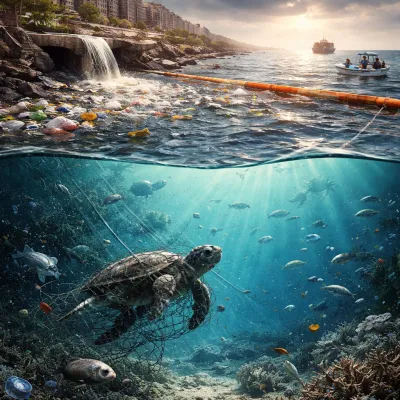
*Plastics, Pollutants, and the Anthropocene Ocean* investigates the global crisis of marine contamination, tracing the life cycle of synthetic materials from fossil fuel extraction to their accumulation in the deepest reaches of the sea. The book explains how modern plastics are engineered for durability but used with a mindset of disposability, creating a fundamental mismatch that results in millions of tons of leakage annually. It details the complex transport pathways—including riverine systems, wastewater effluent, and ocean currents—that redistribute macroplastics, microplastics, and persistent chemical additives like PFAS across the globe.
The text examines the severe ecological and economic consequences of this pollution, highlighting wildlife impacts such as ingestion and entanglement, as well as the toxicological risks to marine food webs and human food security. It explores the "plastisphere"—the unique microbial communities that colonize floating debris—and explains how fragmentation continuously breaks larger items into nearly invisible nanoplastics that can cross biological membranes. Beyond the physical presence of debris, the book discusses the synergistic relationship between plastic pollution and climate change, noting how production emissions and altered carbon cycling create dangerous feedback loops.
To address these challenges, the book evaluates a spectrum of remediation and prevention strategies. It critiques large-scale ocean cleanup technologies, suggesting that while robotics and interceptors have a role, they cannot substitute for upstream interventions. The authors advocate for a "circular ocean economy" grounded in better product design, extended producer responsibility, and improved waste management infrastructure. They emphasize that technical solutions must be paired with international legal frameworks, such as the global plastics treaty, and a commitment to environmental justice for communities disproportionately affected by industrial waste.
Ultimately, the book presents a series of scenarios leading to 2050, ranging from continued ecological degradation to a coordinated global transition toward material circularity. It concludes that while the legacy of existing pollution will persist for decades, the future of the Anthropocene Ocean depends on aligning human industrial systems with the biological limits of the sea. By integrating citizen science, policy reform, and chemical innovation, the text argues that society can still mitigate the most catastrophic outcomes and steward a more resilient marine environment.
What You'll Find Inside:
- Traces the complete life cycle of plastics from fossil fuel extraction through production, use, disposal, and ocean transport to final impacts and fates in marine environments.
- Examines the complex interplay between plastics and chemical pollutants, including additives, PFAS, and persistent organic pollutants that leach from plastics or adsorb to their surfaces.
- Details how plastics fragment into microplastics and nanoplastics through sunlight, wave action, and biological processes, creating pervasive and hard-to-remediate contamination.
- Explains how human activities have transformed the ocean into the 'Anthropocene Ocean' through acidification, warming, sea level rise, and pollution accumulation.
- Evaluates solutions across the plastic life cycle including prevention strategies, circular economy approaches, policy frameworks, and remediation technologies.
Who's It For:
This book is designed for environmental scientists, policymakers, students, and practitioners working on marine pollution, waste management, or circular economy initiatives. It will particularly benefit those seeking a comprehensive understanding of plastic pollution from source to solution, including researchers needing scientific synthesis, professionals designing interventions, and advocates requiring evidence-based insights for policy and public engagement.
Table of Contents:
- Introduction
- Chapter 1 The Anthropocene Ocean
- Chapter 2 From Wellhead to Warehouse: The Plastic Production Pipeline
- Chapter 3 Additives, PFAS, and Persistent Chemicals
- Chapter 4 Mapping Sources: Land, Sea, and Sky
- Chapter 5 Rivers, Stormwater, and Wastewater Pathways
- Chapter 6 Fishing Gear, Shipping, and Offshore Inputs
- Chapter 7 Ocean Transport: Currents, Eddies, and Gyres
- Chapter 8 Fragmentation: Microplastics and Nanoplastics
- Chapter 9 Sinks and Reservoirs: Beaches, Sediments, Sea Ice, Deep Sea
- Chapter 10 Biological Vectors: Biofouling, Rafting, and Trophic Transfer
- Chapter 11 Wildlife Impacts: Ingestion, Entanglement, Habitat Change
- Chapter 12 Toxicology and Mixtures: How Pollutants Act
- Chapter 13 Food Security and Human Health
- Chapter 14 Economic Consequences for Coasts and Fisheries
- Chapter 15 Plastics and Climate: Emissions, Feedbacks, and Risks
- Chapter 16 Measuring the Problem: Sampling, Statistics, and Uncertainty
- Chapter 17 Models, Remote Sensing, and Big Data
- Chapter 18 Prevention on Land: Waste Systems and Design for Circularity
- Chapter 19 Capture at Sea: Booms, Skimmers, and Robotics
- Chapter 20 Materials and Methods: Biodegradation and Advanced Recycling
- Chapter 21 Rules that Matter: Laws, Treaties, and Enforcement
- Chapter 22 Justice and Inequity Across the Plastics Life Cycle
- Chapter 23 Citizen Science, Media, and Behavior Change
- Chapter 24 Building a Circular Ocean Economy
- Chapter 25 Scenarios to 2050: Trade-offs, Pathways, and the Road Ahead
Author:
Published By:
Date Published:
May 4, 2026
Type:
Nonfiction
Language:
English
Word Count:
61,212 words
Reading Time:
4 hours 17 minutes
Sample:
MixCache.com Total Access
Get unlimited access to this book + all books published by MixCache.com for $11.99/month
Subscribe to MTAOr purchase this book individually below
Order:
Buy the Plastics, Pollutants, and the Anthropocene Ocean ebook on MixCache.com:
Buy Now
Full ebook will be available immediately
- read online or download as a PDF file.
$5 account credit for all new MixCache.com accounts, usable toward any ebook purchase!*


Ratings & Reviews
Ask Questions About This Book
Have a question about the content? Ask our AI assistant!
Start by asking a question about "Plastics, Pollutants, and the Anthropocene Ocean"
Example: "Does this book mention William Shakespeare?"
Thinking...