
Browse by Category
Fiction
- Action & Adventure
- African American
- Anthologies
- Children's Fiction
- Classics
- Comics & Graphic Novels
- Coming of Age
- Contemporary
- Cultural & Regional
- Drama
- Erotica
- Fantasy
- General
- Historical Fiction
- Horror
- Humor & Satire
- Literary Fiction
- Mystery, Thriller & Suspense
- Poetry
- Religious & Inspirational
- Romance
- Science Fiction
- Short Stories
- War & Military
- Westerns
- Women's Fiction
- Young Adult
Non-Fiction
- Antiques & Collectibles
- Arts & Photography
- Biographies & Memoirs
- Business & Money
- Children's Non-Fiction
-
Computers & Technology
- Artificial Intelligence
- Computer Science
- Cybersecurity & Cryptography
- Data Science & Analytics
- Databases & Big Data
- Game Development & Design
- General
- Hardware & DIY
- Mobile App Development
- Networking & Cloud Computing
- Operating Systems
- Programming
- Robotics
- Software
- Software Engineering
- User Experience (UX) & Design
- Web Development & Design
- Cooking, Food & Wine
- Crafts, Hobbies & Home
- Education & Teaching
- Engineering
- General
- Health, Fitness & Dieting
-
History
- African History
- African History - North Africa
- African History - Sub-Saharan Africa
- American History
- American History - 20th Century
- American History - Civil War
- American History - Colonial Period
- Ancient History
- Asian History
- Asian History - China
- Asian History - India
- Asian History - Japan
- Asian History - Southeast Asia
- European History
- European History - Ancient Greece
- European History - Ancient Rome
- European History - Medieval
- European History - Modern
- European History - Renaissance
- General
- Middle Eastern History
- Military History
- Military History - Aviation
- Military History - Naval
- Social & Cultural History
- World History
- Humor & Entertainment
- Industrial Technology
- Language Learning
- Law
- LGBTQ+ Non-Fiction
- Literary Criticism
- Medical Books
- Parenting & Relationships
- Philosophy
- Politics & Social Sciences
- Reference
- Religion & Spirituality
-
Science & Math
- Agricultural Sciences
- Astronomy & Space Science
- Behavioral Sciences
- Biological Sciences
- Botany & Plant Science
- Chemistry
- Earth Sciences
- Engineering - Chemical
- Engineering - Civil
- Engineering - Electrical
- Engineering - Mechanical
- Environment
- General
- Geology
- Mathematics
- Nature & Ecology
- Oceanography
- Paleontology
- Physics
- Statistics
- Self-Help
- Sports & Outdoors
- Study Aids
- Sustainability & Green Living
- Textbooks
- Transportation
- Travel
- True Crime
- Urban Planning & Development
- Veterinary Medicine
- Writing & Publishing
Jump to Section

Want unlimited access to all books published by MixCache.com (plus their audiobooks)? Try MixCache.com Total Access. Look for the MTA badge on book covers to identify included titles.
Access to infinite ebooks: Don't see the book you want? Suggest it and we'll create it (free!) for you from scratch with our powerful AI book writer. Then read it with MTA - besides profiting from any sales it makes!
From V-2 to Falcon Heavy: A History of Modern Rocketry
MTA
How 20th and 21st century rockets transformed exploration, defense, and commerce
About this book:
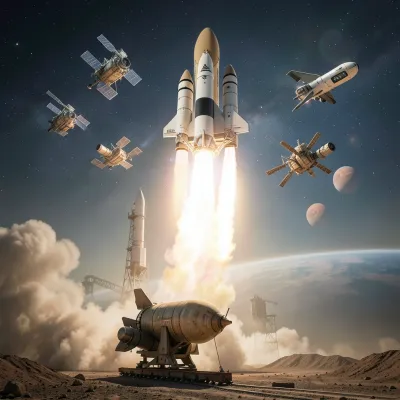
"From V-2 to Falcon Heavy: A History of Modern Rocketry" meticulously traces the evolution of rocket technology from its origins as a weapon to its current role in exploration, defense, and commerce. The book begins with the V-2, developed at Peenemünde during World War II, highlighting its technical prowess as the first ballistic missile and its dark legacy of destruction. Post-war, the V-2's German engineers and designs were dispersed to the United States and the Soviet Union, initiating a Cold War arms race that rapidly transformed rocketry. This period saw the development of early ballistic missiles like the Redstone, R-7, Atlas, and Thor, which laid the groundwork for the space age, famously ignited by the launch of Sputnik and the American response with Explorer. The relentless pursuit of deterrence drove innovations in guidance, control, and engine technology, leading to the development of ICBMs and MIRVs.
The narrative then shifts to the monumental effort of the "moonshot engines" that powered the Saturn V, showcasing the F-1 and J-2 as pinnacles of expendable performance and complex systems engineering. Alongside American triumphs, the book explores the Soviet Union's parallel, yet ultimately failed, N1 moon rocket program, offering crucial lessons in the challenges of clustered engines and fragmented leadership. As the focus moved beyond the moon, the Space Shuttle introduced partial reusability, a revolutionary concept that, despite its technical achievements and tragic failures, revealed the high costs and complexities of routine space access. Simultaneously, Europe's Ariane family rose to dominate the commercial launch market, demonstrating how international cooperation and a focus on reliability could secure a significant share of global satellite launches.
The latter half of the book chronicles the globalization of launch, with Russia's Proton, Ukraine's Zenit, Japan's H-II, and the ambitious Sea Launch venture diversifying the market. It delves into China's Long March family, tracing its evolution from military roots to a robust international launch provider, and India's pragmatic, cost-conscious journey with the PSLV and GSLV, and its quest for cryogenic independence. Throughout this history, the book emphasizes the profound lessons learned from failures and disasters, underscoring how these setbacks have driven cultural changes and improved safety protocols across the industry. The narrative highlights the satellite revolution's impact, as smaller, cheaper payloads reshaped demand for launch services, setting the stage for the "entrepreneurial turn."
The final chapters focus on the rise of NewSpace, spearheaded by the Ansari XPRIZE and Elon Musk's SpaceX. SpaceX's Falcon 1 demonstrated a new business model built on vertical integration, rapid iteration, and a relentless drive for cost reduction. This approach culminated in the Falcon 9, which revolutionized the industry by making first-stage reusability routine, challenging established players like ULA and inspiring new ventures like Blue Origin with its methalox engines. The book concludes by examining the ultimate heavy lifters—Falcon Heavy, with its "triple-core triumph" of synchronized landings, and the ambitious visions of Starship and NASA's SLS—and their implications for future exploration, defense, and commerce, arguing that the future of rocketry lies in balancing unprecedented ambition with the enduring lessons of physics, policy, and market realities.
What You'll Find Inside:
- The transformation of rocketry from Nazi Germany's V-2 weapon to today's commercial launch systems, showing how military technology evolved into tools for exploration and commerce.
- Key engineering breakthroughs that enabled heavier payloads and greater reliability, including the F-1 and J-2 engines, inertial guidance systems, and reusable first-stage technology.
- The global development of launch capabilities across nations—from American and Soviet programs to European Ariane, Chinese Long March, and Indian PSLV/GSLV vehicles—each shaped by distinct industrial and political contexts.
- How entrepreneurial companies like SpaceX disrupted traditional aerospace through vertical integration, rapid iteration, and booster reusability, fundamentally altering launch economics and market dynamics.
- The critical interplay between technology, policy, safety culture, and market forces, demonstrated through lessons from failures like Challenger and Columbia and the influence of regulations like ITAR on innovation.
Who's It For:
This book is ideal for aerospace engineers seeking historical context on design tradeoffs and failure modes that recur across programs, policymakers needing to understand how incentives and regulations shape supply chains and development timelines, and space industry investors or operators who must evaluate reliability, cost, and cadence decisions in today's competitive launch market. It also offers valuable insights for historians of technology and space enthusiasts interested in the co-evolution of rocketry with geopolitics and commerce.
Author:
Published By:
Date Published:
May 3, 2026
Type:
Nonfiction
Language:
English
Word Count:
61,946 words
Reading Time:
4 hours 20 minutes
Sample:
Order:
Order From V-2 to Falcon Heavy: A History of Modern Rocketry (Paperback) on MixCache.com:
Buy NowPrint copy is made to order and ships worldwide. Includes the ebook free, ready to read instantly.
$5 account credit for all new MixCache.com accounts, usable toward any ebook purchase!*


