Browse by Category
Fiction
- Action & Adventure
- African American
- Anthologies
- Children's Fiction
- Classics
- Comics & Graphic Novels
- Coming of Age
- Contemporary
- Cultural & Regional
- Drama
- Erotica
- Fantasy
- General
- Historical Fiction
- Horror
- Humor & Satire
- Literary Fiction
- Mystery, Thriller & Suspense
- Poetry
- Religious & Inspirational
- Romance
- Science Fiction
- Short Stories
- War & Military
- Westerns
- Women's Fiction
- Young Adult
Non-Fiction
- Antiques & Collectibles
- Arts & Photography
- Biographies & Memoirs
- Business & Money
- Children's Non-Fiction
-
Computers & Technology
- Artificial Intelligence
- Computer Science
- Cybersecurity & Cryptography
- Data Science & Analytics
- Databases & Big Data
- Game Development & Design
- General
- Hardware & DIY
- Mobile App Development
- Networking & Cloud Computing
- Operating Systems
- Programming
- Robotics
- Software
- Software Engineering
- User Experience (UX) & Design
- Web Development & Design
- Cooking, Food & Wine
- Crafts, Hobbies & Home
- Education & Teaching
- Engineering
- General
- Health, Fitness & Dieting
-
History
- African History
- African History - North Africa
- African History - Sub-Saharan Africa
- American History
- American History - 20th Century
- American History - Civil War
- American History - Colonial Period
- Ancient History
- Asian History
- Asian History - China
- Asian History - India
- Asian History - Japan
- Asian History - Southeast Asia
- European History
- European History - Ancient Greece
- European History - Ancient Rome
- European History - Medieval
- European History - Modern
- European History - Renaissance
- General
- Middle Eastern History
- Military History
- Military History - Aviation
- Military History - Naval
- Social & Cultural History
- World History
- Humor & Entertainment
- Industrial Technology
- Language Learning
- Law
- LGBTQ+ Non-Fiction
- Literary Criticism
- Medical Books
- Parenting & Relationships
- Philosophy
- Politics & Social Sciences
- Reference
- Religion & Spirituality
-
Science & Math
- Agricultural Sciences
- Astronomy & Space Science
- Behavioral Sciences
- Biological Sciences
- Botany & Plant Science
- Chemistry
- Earth Sciences
- Engineering - Chemical
- Engineering - Civil
- Engineering - Electrical
- Engineering - Mechanical
- Environment
- General
- Geology
- Mathematics
- Nature & Ecology
- Oceanography
- Paleontology
- Physics
- Statistics
- Self-Help
- Sports & Outdoors
- Study Aids
- Sustainability & Green Living
- Textbooks
- Transportation
- Travel
- True Crime
- Urban Planning & Development
- Veterinary Medicine
- Writing & Publishing
Jump to Section
MixCache.com Total Access
Unlimited reading and audiobooks for every book published by MixCache.com.
Included titles carry the MTA badge.
Learn more →
The History of Ocean Exploration: Voyages, Instruments, and Ideas That Shaped the Sea
MTA
A narrative history linking early navigation, scientific voyages, and modern research expeditions
About this book:
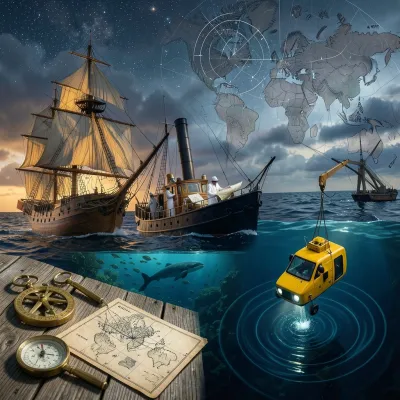
"The History of Ocean Exploration: Voyages, Instruments, and Ideas That Shaped the Sea" provides a comprehensive narrative of humanity's evolving relationship with the ocean, from ancient mariners to modern scientific research. The book begins by detailing the earliest forms of navigation, emphasizing how Indigenous peoples like the Polynesians used an intricate understanding of stars, swells, and environmental cues to traverse vast distances, establishing "blue highways" long before formal maps. It then moves through classical civilizations, highlighting the Phoenicians and Greeks' contributions to geometry-based navigation, the Indian Ocean's monsoon-driven trade routes, and China's monumental maritime expeditions led by Zheng He. Early European exploration, particularly the Portuguese opening of the Atlantic and the first circumnavigations by Columbus and Magellan, marks a shift towards global mapping, driven by imperial ambition and nascent scientific curiosity.
The narrative progresses to the Enlightenment, where voyages like those of James Cook, accompanied by naturalists like Joseph Banks, transformed exploration into systematic scientific inquiry, aided by crucial inventions like the chronometer and sextant. The 19th century saw the emergence of "oceanography" as a distinct science, championed by figures like Matthew Fontaine Maury who systematically mapped currents and winds using aggregated logbook data. The laying of transatlantic telegraph cables simultaneously spurred the first comprehensive mapping of the deep seafloor. This culminated in the HMS Challenger expedition, a foundational scientific circumnavigation that systematically sampled the global ocean's depths, chemistry, and biology, effectively naming and defining the field of oceanography.
The 20th century introduces how conflict, particularly the World Wars and the Cold War, inadvertently accelerated oceanographic research through the development of submarines and sonar, revealing the ocean's three-dimensional nature. The ability to "breathe underwater" with SCUBA gear and the rise of cinematography democratized access to shallow marine environments, fostering public engagement with marine biodiversity. Simultaneously, the discovery of mid-ocean ridges and hydrothermal vents revolutionized geology and biology, proving the seafloor was dynamic and hosted unique, chemosynthetic ecosystems. The late 20th and early 21st centuries mark a transition to global, networked observation through satellites, autonomous floats (Argo), gliders, genomics, and artificial intelligence, providing a continuous, multi-layered view of the ocean's physical, chemical, and biological processes.
The book concludes by addressing contemporary challenges and future directions, emphasizing how the "changing ocean" is inextricably linked to climate, carbon chemistry, and the urgent imperative of conservation amidst threats to marine biodiversity and fisheries. It highlights the critical role of Indigenous science and the growing importance of co-production of knowledge, advocating for ethical and policy frameworks that balance resource use with ecological protection. Ultimately, the history of ocean exploration is presented as a continuous negotiation between human ambition and the ocean's inherent complexity, moving from a quest for passage and resources to a profound, interconnected understanding of Earth's most vital system.
What You'll Find Inside:
- Explores the evolution of ocean navigation from traditional methods (Polynesian star/swell reading, Phoenician coastal pilots) to modern technological systems (satellites, autonomous vehicles).
- Details how scientific oceanography emerged through pivotal expeditions like HMS Challenger, establishing systematic observation and measurement as the foundation of the discipline.
- Examines how wartime innovations (sonar, submarines, magnetic detection) were transformed into peacetime oceanographic tools that revealed seafloor topography and ocean dynamics.
- Addresses contemporary ocean challenges including climate change impacts, biodiversity conservation, and the growing integration of Indigenous knowledge with Western scientific approaches.
- Looks ahead to future ocean exploration through emerging technologies (AI, genomics, networked sensors) and the ethical/policy frameworks needed for sustainable ocean stewardship.
Who's It For:
This book is ideal for students and scholars in oceanography, marine sciences, history of science, and environmental studies; professionals in marine research, conservation, and policy; and general readers interested in the history of exploration, scientific discovery, and humanity's relationship with the ocean. It provides both academic depth and accessible narrative for anyone seeking to understand how ocean knowledge has evolved from ancient wayfinding to modern global observing systems.
Table of Contents:
- Introduction
- Chapter 1 The First Blue Highways: Myths, Memory, and the Earliest Mariners
- Chapter 2 Polynesian Wayfinding: Stars, Swell, and Stick Charts
- Chapter 3 The Classical Sea: Phoenicians, Greeks, and the Geometry of Navigation
- Chapter 4 Monsoons and Merchants: Indian Ocean Routes and Early Cartography
- Chapter 5 China’s Maritime Science: Zheng He and the Treasure Fleets
- Chapter 6 Into the North: Vikings, Currents, and Seafaring Sagas
- Chapter 7 Opening the Atlantic: Portuguese Padrões and Ocean Gyres
- Chapter 8 Circumnavigation: Columbus, Magellan, and the Making of a Global Ocean
- Chapter 9 Measuring Motion: Lead Lines, Logbooks, Latitude and Longitude
- Chapter 10 Enlightenment at Sea: Cook, Banks, and the Scientific Sailor
- Chapter 11 Mapping Currents: Maury, Humboldt, and the First “Oceanographies”
- Chapter 12 Cables Across the Deep: Telegraphy, Bathymetry, and Seafloor Maps
- Chapter 13 HMS Challenger: The Expedition that Named an Ocean Science
- Chapter 14 Polar Frontiers: Drift, Ice, and the Science of the High Latitudes
- Chapter 15 War and Water: Submarines, Sonar, and the Politics of the Sea
- Chapter 16 Breathing Underwater: SCUBA, Cinematography, and the Human Ocean
- Chapter 17 Tectonic Revolutions: Mid-Ocean Ridges and Seafloor Spreading
- Chapter 18 Ships of Discovery: Research Vessels, Winches, and CTDs
- Chapter 19 Eyes in the Abyss: ROVs, HOVs, and Hydrothermal Vents
- Chapter 20 Space to Sea: Satellites, Altimetry, and Global Observations
- Chapter 21 The Changing Ocean: Carbon, Chemistry, and Climate
- Chapter 22 Life in the Blue: Fisheries, Biodiversity, and Conservation
- Chapter 23 Knowledge from Shorelines: Indigenous Science and Co-Production
- Chapter 24 Networks of the Deep: Argo, Gliders, Genomics, and AI
- Chapter 25 Horizons Ahead: Ethics, Policy, and the Next Voyages
Author:
Published By:
Date Published:
May 3, 2026
Type:
Nonfiction
Language:
English
Word Count:
59,481 words
Reading Time:
4 hours 10 minutes
Sample:
Order:
Order The History of Ocean Exploration: Voyages, Instruments, and Ideas That Shaped the Sea (Hardcover) on MixCache.com:
Buy NowPrint copy is made to order and ships worldwide. Includes the ebook free, ready to read instantly.
$5 account credit for all new MixCache.com accounts, usable toward any ebook purchase!*