Browse by Category
Fiction
- Action & Adventure
- African American
- Anthologies
- Children's Fiction
- Classics
- Comics & Graphic Novels
- Coming of Age
- Contemporary
- Cultural & Regional
- Drama
- Erotica
- Fantasy
- General
- Historical Fiction
- Horror
- Humor & Satire
- Literary Fiction
- Mystery, Thriller & Suspense
- Poetry
- Religious & Inspirational
- Romance
- Science Fiction
- Short Stories
- War & Military
- Westerns
- Women's Fiction
- Young Adult
Non-Fiction
- Antiques & Collectibles
- Arts & Photography
- Biographies & Memoirs
- Business & Money
- Children's Non-Fiction
-
Computers & Technology
- Artificial Intelligence
- Computer Science
- Cybersecurity & Cryptography
- Data Science & Analytics
- Databases & Big Data
- Game Development & Design
- General
- Hardware & DIY
- Mobile App Development
- Networking & Cloud Computing
- Operating Systems
- Programming
- Robotics
- Software
- Software Engineering
- User Experience (UX) & Design
- Web Development & Design
- Cooking, Food & Wine
- Crafts, Hobbies & Home
- Education & Teaching
- Engineering
- General
- Health, Fitness & Dieting
-
History
- African History
- African History - North Africa
- African History - Sub-Saharan Africa
- American History
- American History - 20th Century
- American History - Civil War
- American History - Colonial Period
- Ancient History
- Asian History
- Asian History - China
- Asian History - India
- Asian History - Japan
- Asian History - Southeast Asia
- European History
- European History - Ancient Greece
- European History - Ancient Rome
- European History - Medieval
- European History - Modern
- European History - Renaissance
- General
- Middle Eastern History
- Military History
- Military History - Aviation
- Military History - Naval
- Social & Cultural History
- World History
- Humor & Entertainment
- Industrial Technology
- Language Learning
- Law
- LGBTQ+ Non-Fiction
- Literary Criticism
- Medical Books
- Parenting & Relationships
- Philosophy
- Politics & Social Sciences
- Reference
- Religion & Spirituality
-
Science & Math
- Agricultural Sciences
- Astronomy & Space Science
- Behavioral Sciences
- Biological Sciences
- Botany & Plant Science
- Chemistry
- Earth Sciences
- Engineering - Chemical
- Engineering - Civil
- Engineering - Electrical
- Engineering - Mechanical
- Environment
- General
- Geology
- Mathematics
- Nature & Ecology
- Oceanography
- Paleontology
- Physics
- Statistics
- Self-Help
- Sports & Outdoors
- Study Aids
- Sustainability & Green Living
- Textbooks
- Transportation
- Travel
- True Crime
- Urban Planning & Development
- Veterinary Medicine
- Writing & Publishing
Jump to Section
MixCache.com Total Access
Unlimited reading and audiobooks for every book published by MixCache.com.
Included titles carry the MTA badge.
Learn more →
Closed-Loop Living: Regenerative Life Support for Long-Duration Missions
MTA
Designing water, air, and food systems for months- and years-long space travel
About this book:
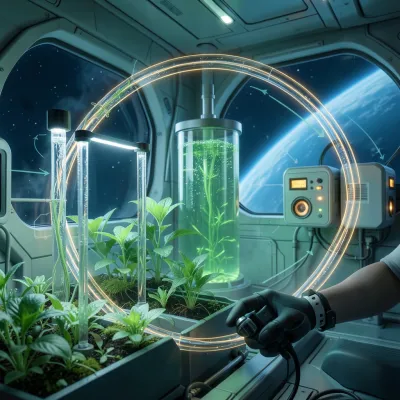
"Closed-Loop Living: Regenerative Life Support for Long-Duration Missions" delves into the intricate engineering and biological challenges of sustaining human life in space for extended periods, where resupply is minimal or nonexistent. The book systematically breaks down life support into three fundamental "loops": water, air, and food, emphasizing the imperative of regenerative systems to minimize launch mass and maximize mission endurance. It argues that closed-loop living transforms consumables into circulating resources, shifting the paradigm from rationing scarcity to cultivating abundance, critical for distant destinations like Mars.
The text details the physicochemical and bioregenerative approaches within each loop. For water, it covers filtration, distillation, and catalysis for purification, along with the architecture for managing hygiene, potable, urine, and condensate streams in microgravity. The air loop explores carbon dioxide removal using sorbents, oxygen generation via electrolysis, and trace contaminant control, often integrating with Sabatier reactors to reclaim water and carbon. Food systems introduce controlled environment agriculture, including crop selection, lighting, and soilless cultivation techniques, alongside microbial and algal bioprocesses for waste stabilization, nutrient recovery, and supplementary oxygen production. Each chapter highlights the unique challenges posed by microgravity, radiation, and contamination risks, and the need for robust, reliable, and maintainable solutions.
A significant focus is placed on the overarching systems engineering framework, including requirements definition, trade studies, and multiobjective optimization, using metrics like Equivalent System Mass (ESM) to compare diverse technological options. The book also addresses crucial cross-cutting themes such as thermal control and humidity management, solid waste handling and resource recovery, microbial safety and planetary protection, and the integration of In-Situ Resource Utilization (ISRU) for harvesting local resources on planetary surfaces. Human factors, operations, crew workload, and the development of sensors, autonomy, and digital twins are explored as essential components for ensuring crew well-being and operational efficiency in environments far from Earth.
Finally, the book examines scaling strategies and phased deployment, recognizing that life support systems must evolve from compact transit architectures to larger, more biologically integrated surface habitats. It concludes by discussing programmatics, risk management, and roadmaps for future exploration, underscoring that the success of long-duration missions hinges on a holistic, adaptive approach that balances ambition with engineering rigor, ensuring that these complex, interdependent systems can reliably sustain human presence across the vast and unforgiving expanse of space.
What You'll Find Inside:
- The necessity of closing water, air, and food loops to sustain crews on missions where resupply is impossible or prohibitively expensive.
- How physicochemical processes (filtration, distillation, sorbents, electrolysis) provide reliable, high‑density core functions while biological systems add buffering, waste recycling, and psychological benefits.
- Integration strategies that couple loops through thermal control, humidity recovery, and nutrient cycling to achieve system‑wide stability and resilience.
- Reliability engineering approaches: redundancy, graceful degradation, spares logistics, and fault‑tolerant control to maintain function despite component failures.
- Scaling from compact transit habitats to larger surface habitats, leveraging in‑situ resources and phased deployment to evolve from physicochemical cores to higher‑closure bioregenerative systems.
Who's It For:
This book is intended for aerospace engineers, life support systems designers, mission planners, and graduate students working on deep‑space habitat design. It provides the technical foundation, trade‑study tools, and integrated modeling approaches needed to develop reliable, mass‑efficient water, air, and food loops for long‑duration missions where resupply is limited or unavailable.
Table of Contents:
- Introduction
- Chapter 1 The Imperative for Closed-Loop Life Support
- Chapter 2 Mission Profiles and Environmental Constraints
- Chapter 3 Systems Engineering Framework and Requirements
- Chapter 4 Mass, Power, Volume, and Reliability Metrics (ESM and Beyond)
- Chapter 5 Water Loop Architecture and Storage
- Chapter 6 Physicochemical Water Processing: Filtration, Distillation, Catalysis
- Chapter 7 Air Loop Architecture: CO2, O2, and Trace Contaminants
- Chapter 8 Physicochemical Air Revitalization: Sorbents, Electrolysis, and Sabatier
- Chapter 9 Thermal Control, Humidity, and Condensate Management
- Chapter 10 Solid Waste Handling and Resource Recovery
- Chapter 11 Microbial Safety, Biosecurity, and Planetary Protection
- Chapter 12 Foundations of Bioregenerative Life Support
- Chapter 13 Controlled Environment Agriculture: Crops, Lighting, and Yields
- Chapter 14 Microbial and Algal Bioprocesses for Waste and Oxygen
- Chapter 15 Soilless Cultivation: Hydroponics, Aeroponics, and Substrates
- Chapter 16 Nutrition, Menu Design, and Food Processing in Space
- Chapter 17 Sensors, Autonomy, and Control: From FDIR to MPC
- Chapter 18 Reliability Engineering: Redundancy, Spares, and Logistics
- Chapter 19 Modeling, Simulation, and Digital Twins
- Chapter 20 Trade Studies and Multiobjective Optimization
- Chapter 21 Human Factors, Operations, and Crew Workload
- Chapter 22 Interfaces and Integration: Bridging Transit and Surface Habitats
- Chapter 23 ISRU Coupling: Water, Oxygen, and Carbon Pathways
- Chapter 24 Scaling Strategies and Phased Deployment
- Chapter 25 Programmatics, Risk, and Roadmaps for Exploration and Beyond
Author:
Published By:
Date Published:
May 3, 2026
Type:
Nonfiction
Language:
English
Word Count:
61,108 words
Reading Time:
4 hours 17 minutes
Sample:
Order:
Order Closed-Loop Living: Regenerative Life Support for Long-Duration Missions (Paperback) on MixCache.com:
Buy NowPrint copy is made to order and ships worldwide. Includes the ebook free, ready to read instantly.
$5 account credit for all new MixCache.com accounts, usable toward any ebook purchase!*