
Browse by Category
Fiction
- Action & Adventure
- African American
- Anthologies
- Children's Fiction
- Classics
- Comics & Graphic Novels
- Coming of Age
- Contemporary
- Cultural & Regional
- Drama
- Erotica
- Fantasy
- General
- Historical Fiction
- Horror
- Humor & Satire
- Literary Fiction
- Mystery, Thriller & Suspense
- Poetry
- Religious & Inspirational
- Romance
- Science Fiction
- Short Stories
- War & Military
- Westerns
- Women's Fiction
- Young Adult
Non-Fiction
- Antiques & Collectibles
- Arts & Photography
- Biographies & Memoirs
- Business & Money
- Children's Non-Fiction
-
Computers & Technology
- Artificial Intelligence
- Computer Science
- Cybersecurity & Cryptography
- Data Science & Analytics
- Databases & Big Data
- Game Development & Design
- General
- Hardware & DIY
- Mobile App Development
- Networking & Cloud Computing
- Operating Systems
- Programming
- Robotics
- Software
- Software Engineering
- User Experience (UX) & Design
- Web Development & Design
- Cooking, Food & Wine
- Crafts, Hobbies & Home
- Education & Teaching
- Engineering
- General
- Health, Fitness & Dieting
-
History
- African History
- African History - North Africa
- African History - Sub-Saharan Africa
- American History
- American History - 20th Century
- American History - Civil War
- American History - Colonial Period
- Ancient History
- Asian History
- Asian History - China
- Asian History - India
- Asian History - Japan
- Asian History - Southeast Asia
- European History
- European History - Ancient Greece
- European History - Ancient Rome
- European History - Medieval
- European History - Modern
- European History - Renaissance
- General
- Middle Eastern History
- Military History
- Military History - Aviation
- Military History - Naval
- Social & Cultural History
- World History
- Humor & Entertainment
- Industrial Technology
- Language Learning
- Law
- LGBTQ+ Non-Fiction
- Literary Criticism
- Medical Books
- Parenting & Relationships
- Philosophy
- Politics & Social Sciences
- Reference
- Religion & Spirituality
-
Science & Math
- Agricultural Sciences
- Astronomy & Space Science
- Behavioral Sciences
- Biological Sciences
- Botany & Plant Science
- Chemistry
- Earth Sciences
- Engineering - Chemical
- Engineering - Civil
- Engineering - Electrical
- Engineering - Mechanical
- Environment
- General
- Geology
- Mathematics
- Nature & Ecology
- Oceanography
- Paleontology
- Physics
- Statistics
- Self-Help
- Sports & Outdoors
- Study Aids
- Sustainability & Green Living
- Textbooks
- Transportation
- Travel
- True Crime
- Urban Planning & Development
- Veterinary Medicine
- Writing & Publishing
Jump to Section

Want unlimited access to all books published by MixCache.com (plus their audiobooks)? Try MixCache.com Total Access. Look for the MTA badge on book covers to identify included titles.
Access to infinite ebooks: Don't see the book you want? Suggest it and we'll create it (free!) for you from scratch with our powerful AI book writer. Then read it with MTA - besides profiting from any sales it makes!
Life Aboard: Human Factors in Space Missions
MTA
Designing habitats, schedules, and workflows to keep crews healthy and productive in space
About this book:
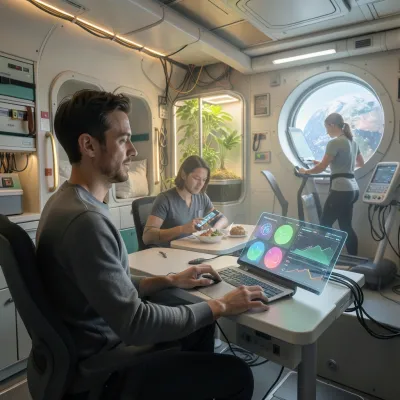
*Life Aboard: Human Factors in Space Missions* argues that the success of long-duration space exploration depends on a fundamental shift from viewing crews as mere payloads to integrating human needs into the core of mission architecture. The text emphasizes that sustained productivity and health far from Earth are not just engineering triumphs but results of designing habitats, workflows, and schedules that respect human physiological and psychological limits. By bridging the gap between rigorous engineering and behavioral science, the book provides a roadmap for creating environments that support resilience in the face of isolation, microgravity, and extreme confinement.
The book details the practical application of human factors across several critical pillars: ergonomics, physiology, and group dynamics. It examines how physical design—such as zoning for privacy, managing acoustic and thermal comfort, and optimizing lighting for circadian health—directly impacts crew performance and sleep. Furthermore, it connects hardware to operational protocols, discussing the necessity of rigorous exercise countermeasures to prevent bone and muscle atrophy, the social importance of mealtime as "social glue," and the requirement for intuitive life support interfaces to ensure human-in-the-loop reliability during emergencies.
A significant portion of the work is dedicated to the social and psychological complexities of small-group isolation. It explores the challenges of multinational crew composition, where cultural nuances and communication latencies can create friction if not managed through proactive leadership and inclusive design. The text highlights the evolving role of robotics and automation, suggesting that future missions must foster a collaborative partnership between humans and machines. It also addresses the necessity of medical autonomy, as crews moving toward Mars or the Moon will have to function as self-sufficient units capable of managing their own health and behavioral well-being without real-time support from Earth.
Finally, the book looks toward the future of spaceflight, including the transition to commercial destinations and surface operations on the Moon and Mars. It calls for evolving standards that balance safety with the innovation brought by commercial actors, advocating for "performance-based" metrics that allow for faster iteration. As humanity moves from temporary expeditions to permanent habitation, the book concludes that we must treat the "human factor" as a mission-critical system. Only by designing for human dignity and resilience can we ensure that life aboard a spacecraft is not merely about survival, but about thriving in the cosmos.
What You'll Find Inside:
- Human factors must be integrated as core mission architecture from the earliest design phases, not treated as an afterthought, to ensure crew health, productivity, and mission success over long durations.
- Habitability design principles including optimal volume allocation, functional zoning, environmental control (atmosphere, thermal, acoustic), and lighting systems that support circadian rhythms are fundamental to crew well-being and performance.
- Behavioral health strategies addressing stress, mood, team dynamics, leadership, and cultural inclusion are critical for maintaining crew cohesion and psychological resilience in isolated, confined environments.
- Physiological countermeasures including exercise hardware/protocols, nutrition systems, and medical autonomy approaches are essential for mitigating the deleterious effects of microgravity and partial gravity on the human body.
- Operational workflows must account for communication constraints, timekeeping challenges, and human-robot collaboration while ensuring usability of procedures and interfaces under stress and in microgravity/partial gravity conditions.
Who's It For:
This book is essential for mission planners, habitat designers, biomedical engineers, human factors specialists, and psychologists involved in long-duration space exploration. It serves as a practical reference for integrating human factors into mission architecture, providing evidence-based design principles and operational strategies that bridge engineering and behavioral disciplines. Professionals working on government, commercial, or international space missions will find actionable guidance for creating habitats, schedules, and workflows that keep crews healthy, resilient, and productive far from Earth.
Author:
Published By:
Date Published:
May 3, 2026
Type:
Nonfiction
Language:
English
Word Count:
57,418 words
Reading Time:
4 hours 1 minutes
Sample:
Order:
Order Life Aboard: Human Factors in Space Missions (Paperback) on MixCache.com:
Buy NowPrint copy is made to order and ships worldwide. Includes the ebook free, ready to read instantly.
$5 account credit for all new MixCache.com accounts, usable toward any ebook purchase!*


