Browse by Category
Fiction
- Action & Adventure
- African American
- Anthologies
- Children's Fiction
- Classics
- Comics & Graphic Novels
- Coming of Age
- Contemporary
- Cultural & Regional
- Drama
- Erotica
- Fantasy
- General
- Historical Fiction
- Horror
- Humor & Satire
- Literary Fiction
- Mystery, Thriller & Suspense
- Poetry
- Religious & Inspirational
- Romance
- Science Fiction
- Short Stories
- War & Military
- Westerns
- Women's Fiction
- Young Adult
Non-Fiction
- Antiques & Collectibles
- Arts & Photography
- Biographies & Memoirs
- Business & Money
- Children's Non-Fiction
-
Computers & Technology
- Artificial Intelligence
- Computer Science
- Cybersecurity & Cryptography
- Data Science & Analytics
- Databases & Big Data
- Game Development & Design
- General
- Hardware & DIY
- Mobile App Development
- Networking & Cloud Computing
- Operating Systems
- Programming
- Robotics
- Software
- Software Engineering
- User Experience (UX) & Design
- Web Development & Design
- Cooking, Food & Wine
- Crafts, Hobbies & Home
- Education & Teaching
- Engineering
- General
- Health, Fitness & Dieting
-
History
- African History
- African History - North Africa
- African History - Sub-Saharan Africa
- American History
- American History - 20th Century
- American History - Civil War
- American History - Colonial Period
- Ancient History
- Asian History
- Asian History - China
- Asian History - India
- Asian History - Japan
- Asian History - Southeast Asia
- European History
- European History - Ancient Greece
- European History - Ancient Rome
- European History - Medieval
- European History - Modern
- European History - Renaissance
- General
- Middle Eastern History
- Military History
- Military History - Aviation
- Military History - Naval
- Social & Cultural History
- World History
- Humor & Entertainment
- Industrial Technology
- Language Learning
- Law
- LGBTQ+ Non-Fiction
- Literary Criticism
- Medical Books
- Parenting & Relationships
- Philosophy
- Politics & Social Sciences
- Reference
- Religion & Spirituality
-
Science & Math
- Agricultural Sciences
- Astronomy & Space Science
- Behavioral Sciences
- Biological Sciences
- Botany & Plant Science
- Chemistry
- Earth Sciences
- Engineering - Chemical
- Engineering - Civil
- Engineering - Electrical
- Engineering - Mechanical
- Environment
- General
- Geology
- Mathematics
- Nature & Ecology
- Oceanography
- Paleontology
- Physics
- Statistics
- Self-Help
- Sports & Outdoors
- Study Aids
- Sustainability & Green Living
- Textbooks
- Transportation
- Travel
- True Crime
- Urban Planning & Development
- Veterinary Medicine
- Writing & Publishing
Jump to Section
MixCache.com Total Access
Unlimited reading and audiobooks for every book published by MixCache.com.
Included titles carry the MTA badge.
Learn more →
Soviet Film Industry Unscripted
MTA
Studio Politics, Censorship Battles, and Iconic Directors
About this book:
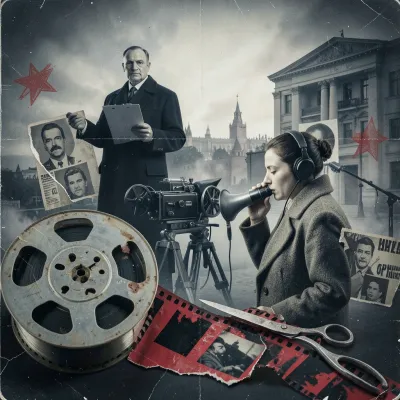
"Soviet Film Industry Unscripted" offers a comprehensive exploration of Soviet cinema, moving beyond typical narratives of state control to reveal the complex interplay of artistic ambition, bureaucratic demands, and cultural context. The book traces the industry's evolution from its revolutionary origins and the montage experiments of the 1920s with figures like Eisenstein and Vertov, through the consolidation of Socialist Realism, the challenges of war, and periods of creative "Thaw," up to the turbulence of Perestroika and the post-Soviet afterlife of its films. It argues that while the state dictated policy, the actual practice of filmmaking involved constant negotiation, circumvention, and ingenuity from directors, producers, editors, and screenwriters.
The narrative delves into the specific institutional structures that governed Soviet film, such as Goskino and Sovkino, and the distinct aesthetics fostered by major studios like Mosfilm and Lenfilm, alongside the vibrant contributions of republic studios in Georgia, Armenia, Ukraine, and Central Asia. It highlights the crucial role of producers as intermediaries between artistic vision and state directives, managing budgets, schedules, and personnel under immense pressure. Censorship is presented not merely as outright prohibition but as a pervasive system of calibration, shaping scripts and cuts through subtle suggestions and constant oversight, which paradoxically often led to creative allegories and nuanced storytelling.
Key chapters examine the impact of technological shifts like the advent of sound and color, which introduced new complexities for both artists and censors. The book also profiles iconic directors like Andrei Tarkovsky and Sergei Parajanov, whose intensely personal and allegorical works often challenged the prevailing ideological norms, facing significant delays, cuts, and even personal persecution. It also explores the unexpected freedom found in popular genres like comedy, with directors like Ryazanov and Gaidai using humor to subtly critique everyday life and bureaucracy. Furthermore, the role of women in the industry, often in less visible but essential roles as editors and screenwriters, is highlighted, alongside the unique artistic world of Soyuzmultfilm animation.
Ultimately, "Soviet Film Industry Unscripted" demonstrates that Soviet cinema was a dynamic, often contradictory, enterprise. It reveals how filmmakers learned to navigate constraints, turning limitations into distinctive styles, and how the "unscripted" moments of human creativity and negotiation ultimately defined an industry committed to both art and ideology. The book concludes by examining the enduring legacy of Soviet film in archives, restorations, and its global afterlife, emphasizing the lessons it offers about state involvement in culture, the resilience of artistic vision, and the complex relationship between a film and its audience.
What You'll Find Inside:
- How Soviet cinema was shaped by studio politics, censorship battles, and the constant negotiation between artistic vision and state directives from Goskino to individual producers
- The evolution of film techniques from montage innovation to Socialist Realism and later auteur works, often born from creative responses to scarcity and ideological constraints
- The crucial behind-the-scenes roles of producers, administrators, editors, and censors who translated policy into practice through schedules, budgets, and creative compromises
- How regional studios in Georgia, Armenia, Ukraine, and Central Asia contributed distinct aesthetic voices that refracted official Soviet themes through local languages, folklore, and traditions
- The international dimension of Soviet cinema through festivals, co-productions, and export strategies that functioned as soft power while requiring constant negotiation between domestic control and foreign appeal
Who's It For:
Film students, historians, and scholars interested in Soviet cinema, the intersection of art and politics, and industrial filmmaking practices who seek to understand how films were actually produced, distributed, and received within a state-controlled system rather than analyzing only their on-screen content.
Table of Contents:
- Introduction
- Chapter 1 Origins of a Revolutionary Cinema, 1917–1924
- Chapter 2 Montage as Method: Kuleshov, Eisenstein, Vertov
- Chapter 3 Building the Apparatus: Goskino, Sovkino, and Studio Governance
- Chapter 4 The Making and Meaning of Battleship Potemkin
- Chapter 5 Kino-Eye vs. Narrative: Vertov’s Documentary Revolution
- Chapter 6 Mezhrabpom and the Space of Experiment
- Chapter 7 A Noisy Transition: Sound, Technology, and Control, 1929–1934
- Chapter 8 Decreeing Style: Socialist Realism Takes Hold
- Chapter 9 Inside Mosfilm: Factory of Dreams and Directives
- Chapter 10 Lenfilm’s Leningrad Aesthetics
- Chapter 11 Cinema at War: Patriotism, Trauma, and Myth, 1939–1945
- Chapter 12 The Thaw on Screen: Sincerity, Satire, and Youth
- Chapter 13 Republic Studios: Georgian, Armenian, Ukrainian, and Central Asian Waves
- Chapter 14 Andrei Tarkovsky: Time-Pressure and Spiritual Dissent
- Chapter 15 Sergei Parajanov and the Allegory of Color
- Chapter 16 Laughter under Watch: Ryazanov, Gaidai, and Popular Comedy
- Chapter 17 Drawing the Line: Soyuzmultfilm and Animated Worlds
- Chapter 18 The Censor’s Pen: Shelved Films, Lost Reels, Secret Reports
- Chapter 19 Producers, Plan, and the Art of Negotiation
- Chapter 20 From Studio to Screen: Distribution, Exhibition, and Audiences
- Chapter 21 Festivals and Foreign Windows: Co-Productions and Soft Power
- Chapter 22 Stagnation to Perestroika: Crisis, Glasnost, and New Realisms
- Chapter 23 Women of the Industry: Directors, Editors, Screenwriters
- Chapter 24 Archives, Restorations, and the Global Afterlife of Soviet Cinema
- Chapter 25 Endings and Echoes: What the Soviet Studio System Teaches Today
Author:
Published By:
Date Published:
May 2, 2026
Type:
Nonfiction
Language:
English
Word Count:
74,109 words
Reading Time:
5 hours 11 minutes
Sample:
Order:
Order Soviet Film Industry Unscripted (Paperback) on MixCache.com:
Buy NowPrint copy is made to order and ships worldwide. Includes the ebook free, ready to read instantly.
$5 account credit for all new MixCache.com accounts, usable toward any ebook purchase!*