Browse by Category
Fiction
- Action & Adventure
- African American
- Anthologies
- Children's Fiction
- Classics
- Comics & Graphic Novels
- Coming of Age
- Contemporary
- Cultural & Regional
- Drama
- Erotica
- Fantasy
- General
- Historical Fiction
- Horror
- Humor & Satire
- Literary Fiction
- Mystery, Thriller & Suspense
- Poetry
- Religious & Inspirational
- Romance
- Science Fiction
- Short Stories
- War & Military
- Westerns
- Women's Fiction
- Young Adult
Non-Fiction
- Antiques & Collectibles
- Arts & Photography
- Biographies & Memoirs
- Business & Money
- Children's Non-Fiction
-
Computers & Technology
- Artificial Intelligence
- Computer Science
- Cybersecurity & Cryptography
- Data Science & Analytics
- Databases & Big Data
- Game Development & Design
- General
- Hardware & DIY
- Mobile App Development
- Networking & Cloud Computing
- Operating Systems
- Programming
- Robotics
- Software
- Software Engineering
- User Experience (UX) & Design
- Web Development & Design
- Cooking, Food & Wine
- Crafts, Hobbies & Home
- Education & Teaching
- Engineering
- General
- Health, Fitness & Dieting
-
History
- African History
- African History - North Africa
- African History - Sub-Saharan Africa
- American History
- American History - 20th Century
- American History - Civil War
- American History - Colonial Period
- Ancient History
- Asian History
- Asian History - China
- Asian History - India
- Asian History - Japan
- Asian History - Southeast Asia
- European History
- European History - Ancient Greece
- European History - Ancient Rome
- European History - Medieval
- European History - Modern
- European History - Renaissance
- General
- Middle Eastern History
- Military History
- Military History - Aviation
- Military History - Naval
- Social & Cultural History
- World History
- Humor & Entertainment
- Industrial Technology
- Language Learning
- Law
- LGBTQ+ Non-Fiction
- Literary Criticism
- Medical Books
- Parenting & Relationships
- Philosophy
- Politics & Social Sciences
- Reference
- Religion & Spirituality
-
Science & Math
- Agricultural Sciences
- Astronomy & Space Science
- Behavioral Sciences
- Biological Sciences
- Botany & Plant Science
- Chemistry
- Earth Sciences
- Engineering - Chemical
- Engineering - Civil
- Engineering - Electrical
- Engineering - Mechanical
- Environment
- General
- Geology
- Mathematics
- Nature & Ecology
- Oceanography
- Paleontology
- Physics
- Statistics
- Self-Help
- Sports & Outdoors
- Study Aids
- Sustainability & Green Living
- Textbooks
- Transportation
- Travel
- True Crime
- Urban Planning & Development
- Veterinary Medicine
- Writing & Publishing
Jump to Section
MixCache.com Total Access
Unlimited reading and audiobooks for every book published by MixCache.com.
Included titles carry the MTA badge.
Learn more →
Operation Barbarossa
MTA
A History
About this book:
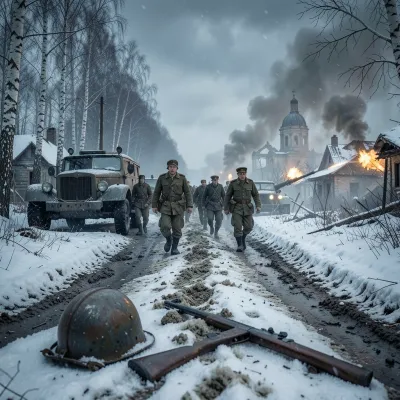
Operation Barbarossa was Nazi Germany's invasion of the Soviet Union in June 1941, conceived not just as a territorial conquest but as an ideological "war of annihilation" against Judeo-Bolshevism. German planners, overconfident from earlier European victories, anticipated a swift, decisive campaign, underestimating the vastness of Soviet territory, its logistical challenges, and the Red Army's capacity for resistance. The initial German onslaught achieved astonishing tactical successes, inflicting immense casualties on the disorganized Soviet forces and encircling millions of soldiers at battles like Minsk and Smolensk. However, the rapid advance stretched German supply lines to their breaking point, and critical resources like fuel and spare parts became increasingly scarce.
The campaign quickly exposed the inherent weaknesses in Germany's strategy and logistics. The "tyranny of distance" meant that supply convoys struggled to keep pace with the mechanized spearheads, while the rudimentary Soviet road and rail networks, coupled with the differing rail gauges, created crippling bottlenecks. The onset of the *rasputitsa* (seasonal mud) in autumn then ground the German advance to a halt, turning roads into impassable quagmires and exacerbating logistical woes. This enforced delay provided the Soviet Union with crucial time to reorganize, reinforce, and relocate its vital industrial capacity eastward beyond the Ural Mountains, ensuring a continued flow of war material.
While the German military pushed deep into Soviet territory, the occupation policy pursued by Nazi Germany was one of systematic brutality and exploitation, characterized by mass killings of Jews, Roma, and political commissars by *Einsatzgruppen* and Wehrmacht units ("Holocaust by bullets"). This genocidal approach, combined with harsh requisitions and collective punishment, fueled growing partisan resistance behind German lines, further tying down valuable resources. By winter, the German advance on Moscow, codenamed "Operation Typhoon," stalled due to exhausted troops, inadequate winter clothing and equipment, and fierce Soviet resistance. The Soviet counteroffensive in December 1941, bolstered by fresh Siberian reserves and a growing tactical proficiency, pushed the Germans back from Moscow, marking the decisive failure of Barbarossa to achieve its objectives.
The failure of Operation Barbarossa transformed the nature of the war on the Eastern Front from a quick blitzkrieg into a prolonged, attritional struggle. Both sides underwent profound institutional learning: the Germans struggled with the limits of their power and Hitler's increasingly rigid directives, while the Soviets, through painful experience and Stavka reforms, developed a more effective and adaptable command structure. Allied aid, particularly Lend-Lease from the United States and Great Britain, though initially modest, proved vital in sustaining the Soviet war effort. The immense human cost, with millions of soldiers and civilians dead, imprisoned, or displaced, left an indelible mark on Eastern Europe. Barbarossa's ultimate failure directly led to Germany's strategic shift south in 1942, culminating in the Battle of Stalingrad, which would definitively turn the tide of World War II.
What You'll Find Inside:
- Operation Barbarossa was driven by Nazi ideology, combining Lebensraum ambitions with a racial war of annihilation that targeted Jews, Roma, Slavs, and political commissars for extermination.
- German planners overestimated the speed and ease of victory, underestimating Soviet logistical resilience, industrial mobilization, and the impact of distance, weather, and partisan resistance.
- Both German and Soviet intelligence services suffered critical failures, interpreting warnings through ideological biases and institutional inertia, which contributed to the strategic surprise of June 22, 1941.
- The Soviet Union countered initial setbacks by evacuating industry east of the Urals, reforming command and control under the Stavka, and adapting tactics to trade space for time while rebuilding its war machine.
- The occupation unleashed systematic violence—including the Holocaust by bullets, reprisals, forced labor, and starvation—that provoked widespread partisan resistance and turned the Eastern Front into a brutal war of attrition.
Who's It For:
This book is suited for students, scholars, and general readers with an interest in World War II military history, particularly the Eastern Front. It offers a detailed operational narrative combined with analysis of ideology, logistics, intelligence, and the human experience of soldiers and civilians, making it valuable for anyone seeking a comprehensive understanding of how Operation Barbarossa unfolded and why it ultimately failed.
Table of Contents:
- Introduction
- Chapter 1 Europe on the Brink: From Molotov–Ribbentrop to Rupture
- Chapter 2 Planning Barbarossa: Ideology, Strategy, and Hubris
- Chapter 3 The Wehrmacht’s Edge? Organization, Doctrine, and Myth
- Chapter 4 The Red Army in 1941: Purges, Plans, and Potentials
- Chapter 5 Intelligence Failures: Warnings Sounded, Warnings Ignored
- Chapter 6 Logistics and the Tyranny of Distance
- Chapter 7 Opening the Gates: 22 June 1941
- Chapter 8 Air War at Dawn: The Destruction and Survival of Soviet Aviation
- Chapter 9 Army Group North: The Road to Leningrad
- Chapter 10 Army Group Center: Smolensk and the Drive East
- Chapter 11 Army Group South: The Battle for Ukraine
- Chapter 12 Kiev Encirclement: Triumph, Delay, and Consequence
- Chapter 13 Occupation and Atrocity: The War of Annihilation
- Chapter 14 The Holocaust by Bullets: Einsatzgruppen and Complicity
- Chapter 15 Partisans and the Rear: Resistance, Reprisal, and Control
- Chapter 16 Industrial Evacuation: The USSR Moves East
- Chapter 17 Leningrad Besieged: Hunger, Courage, and Survival
- Chapter 18 The Rasputitsa: Mud, Mechanization, and Momentum
- Chapter 19 Typhoon Toward Moscow: Ambition Meets Reality
- Chapter 20 General Winter and the Soviet Counteroffensive
- Chapter 21 The Stavka Reforms: Command, Control, and Recovery
- Chapter 22 Allies and Aid: Diplomacy, Lend‑Lease, and the Wider War
- Chapter 23 The Price of Barbarossa: Casualties, Captivity, and Civilians
- Chapter 24 Learning and Unlearning: Operational Lessons of 1941
- Chapter 25 Aftermath and Reckoning: From Failure to Stalingrad
Author:
Published By:
Date Published:
May 2, 2026
Type:
Nonfiction
Language:
English
Word Count:
68,230 words
Reading Time:
4 hours 47 minutes
Sample:
Order:
Order Operation Barbarossa (Hardcover) on MixCache.com:
Buy NowPrint copy is made to order and ships worldwide. Includes the ebook free, ready to read instantly.
$5 account credit for all new MixCache.com accounts, usable toward any ebook purchase!*