Browse by Category
Fiction
- Action & Adventure
- African American
- Anthologies
- Children's Fiction
- Classics
- Comics & Graphic Novels
- Coming of Age
- Contemporary
- Cultural & Regional
- Drama
- Erotica
- Fantasy
- General
- Historical Fiction
- Horror
- Humor & Satire
- Literary Fiction
- Mystery, Thriller & Suspense
- Poetry
- Religious & Inspirational
- Romance
- Science Fiction
- Short Stories
- War & Military
- Westerns
- Women's Fiction
- Young Adult
Non-Fiction
- Antiques & Collectibles
- Arts & Photography
- Biographies & Memoirs
- Business & Money
- Children's Non-Fiction
-
Computers & Technology
- Artificial Intelligence
- Computer Science
- Cybersecurity & Cryptography
- Data Science & Analytics
- Databases & Big Data
- Game Development & Design
- General
- Hardware & DIY
- Mobile App Development
- Networking & Cloud Computing
- Operating Systems
- Programming
- Robotics
- Software
- Software Engineering
- User Experience (UX) & Design
- Web Development & Design
- Cooking, Food & Wine
- Crafts, Hobbies & Home
- Education & Teaching
- Engineering
- General
- Health, Fitness & Dieting
-
History
- African History
- African History - North Africa
- African History - Sub-Saharan Africa
- American History
- American History - 20th Century
- American History - Civil War
- American History - Colonial Period
- Ancient History
- Asian History
- Asian History - China
- Asian History - India
- Asian History - Japan
- Asian History - Southeast Asia
- European History
- European History - Ancient Greece
- European History - Ancient Rome
- European History - Medieval
- European History - Modern
- European History - Renaissance
- General
- Middle Eastern History
- Military History
- Military History - Aviation
- Military History - Naval
- Social & Cultural History
- World History
- Humor & Entertainment
- Industrial Technology
- Language Learning
- Law
- LGBTQ+ Non-Fiction
- Literary Criticism
- Medical Books
- Parenting & Relationships
- Philosophy
- Politics & Social Sciences
- Reference
- Religion & Spirituality
-
Science & Math
- Agricultural Sciences
- Astronomy & Space Science
- Behavioral Sciences
- Biological Sciences
- Botany & Plant Science
- Chemistry
- Earth Sciences
- Engineering - Chemical
- Engineering - Civil
- Engineering - Electrical
- Engineering - Mechanical
- Environment
- General
- Geology
- Mathematics
- Nature & Ecology
- Oceanography
- Paleontology
- Physics
- Statistics
- Self-Help
- Sports & Outdoors
- Study Aids
- Sustainability & Green Living
- Textbooks
- Transportation
- Travel
- True Crime
- Urban Planning & Development
- Veterinary Medicine
- Writing & Publishing
Jump to Section
MixCache.com Total Access
Unlimited reading and audiobooks for every book published by MixCache.com.
Included titles carry the MTA badge.
Learn more →
Imperial China: Dynastic Cycles, Bureaucracy, and Cultural Continuity
MTA
From Qin unification to Qing collapse, the structures that defined Chinese dynasties
About this book:
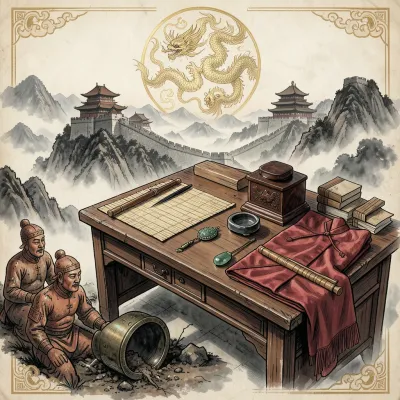
This book provides a structural history of imperial China, tracing the evolution of state institutions from the Qin unification in 221 BCE to the collapse of the Qing in 1912. Rather than a traditional narrative of rulers and battles, it focuses on the resilient administrative templates—specifically the bureaucracy, civil service examination system, land tenure, and fiscal regimes—that allowed the Chinese state to endure across cycles of centralization and fragmentation. The text argues that the longevity of the Chinese empire was rooted in these flexible institutional forms, which were repeatedly recalibrated to address perennial challenges of governance, resource extraction, and legitimacy.
The analysis moves chronologically through the major dynasties, highlighting key moments of innovation and crisis. It examines the Legalist blueprints of the Qin, the Confucian-bureaucratic synthesis of the Han, the fiscal and industrial experiments of the Tang and Song, and the multiethnic "conquest" models developed by the Liao, Jin, Yuan, and Qing. A recurring theme is the balance between central authority and local brokerage; when administrative capacity and revenue fell out of balance with demographic or geopolitical pressures, dynasties collapsed, only to be replaced by new regimes that repurposed the same modular institutional tools to restore order.
In its later chapters, the book explores how the Qing state attempted to adapt these traditional structures to the external shocks of the nineteenth century, including global trade, opium, and Western military pressure. It details the "Self-Strengthening" and "New Policies" eras, where the court tried to graft modern industrial and constitutional forms onto an ancient bureaucratic trunk. Ultimately, the 1911 Revolution is presented as a structural rupture where the abolition of the examination system and the rise of provincial autonomy made the imperial model untenable, leading to a collapse of the dynastic system.
The book concludes by examining the "afterlives" of these imperial institutions in the Republic and the People's Republic of China. It argues that many administrative habits—such as household registration, centralized bureaucracy, and the state’s role in economic management—persisted long after the fall of the throne. By tracing these continuities, the book demonstrates that modern Chinese governance remains deeply influenced by a two-thousand-year-old repertoire of statecraft, illustrating how the fundamental problem of governing a vast and diverse territory continues to be shaped by imperial legacies.
What You'll Find Inside:
- The book reveals how imperial Chinese dynasties repeatedly used and adapted core institutional templates - bureaucracy, civil service examinations, land/fiscal systems, and ritual legitimacy - to solve perennial problems of governance across two millennia.
- It demonstrates that dynastic collapses were rarely due to ideological failure but rather imbalances in administrative capacity, revenue extraction, and coercive force, with renewal coming through institutional redesign rather than ideological replacement.
- The civil service examination system is shown as the heart of imperial continuity, evolving from recommendation systems to written exams that created a national elite with shared administrative culture while adapting to changing social and political needs.
- Land and fiscal regimes are analyzed as the sinews of the state, showing how dynasties shifted from agrarian extraction to monetized revenue systems while constantly balancing central control with local elite cooperation.
- The book traces how imperial institutions persisted beyond dynastic collapse, shaping Republican and PRC governance through continuities in household registration, fiscal extraction, bureaucratic practice, and mediated sovereignty in frontier regions.
Who's It For:
This book is for readers interested in structural explanations of political continuity and change - particularly students, scholars, and educated general readers focused on Chinese history, comparative state formation, or institutional analysis. It will benefit those seeking to understand how administrative systems endure and adapt across regime changes, rather than just memorizing dynastic sequences. The approach assumes some familiarity with Chinese historical terms but explains concepts clearly enough for motivated non-specialists.
Table of Contents:
- Introduction
- Chapter 1 Framing Dynastic Cycles: Continuity, Rupture, and the Problem of the State
- Chapter 2 Qin Unification: Legalist Blueprints for Empire
- Chapter 3 Han Consolidation: Bureaucracy, Ideology, and Imperial Reach
- Chapter 4 From Han to Three Kingdoms: Fragmentation and Frontier Regimes
- Chapter 5 Northern and Southern Dynasties: Experimentation in Land and Office
- Chapter 6 Sui Reunification: Grand Projects and Administrative Integration
- Chapter 7 Tang Institutions: Aristocracy, Examinations, and Fiscal Design
- Chapter 8 Mid-Tang Strains: Fanzhen, Eunuchs, and the Limits of Central Control
- Chapter 9 Five Dynasties and Ten Kingdoms: Warlordism and Enduring Administrative Forms
- Chapter 10 Song Centralization: Civil Primacy and Fiscal Innovation
- Chapter 11 Song Society and Economy: Land Tenure, Local Elites, and Markets
- Chapter 12 Conquest Neighbors: Liao, Western Xia, and Jin as Alternative Models
- Chapter 13 Yuan Rule: Multiethnic Hierarchies and Layered Administration
- Chapter 14 Ming Founding: Neo-Confucian Orthodoxy and Autocratic Tools
- Chapter 15 Ming Fiscal-Military State: Households, Silver, and Service
- Chapter 16 Late Ming Governance: Factions, Eunuchs, and County Society
- Chapter 17 Manchu Conquest: Banners, Bureaucracy, and Ritual Legitimacy
- Chapter 18 High Qing: Population Growth, Land Systems, and Local Mediation
- Chapter 19 The Qing Examination State: Literati, Law, and Orthodoxy
- Chapter 20 Frontier Governance: Tibet, Xinjiang, and the Tributary Order
- Chapter 21 Opium, Treaties, and Fiscal Shock: External Pressures on the State
- Chapter 22 Self-Strengthening: Bureaucratic Reform and Industrial Experiments
- Chapter 23 The New Policies: Constitutionalism and Center–Province Tensions
- Chapter 24 The 1911 Revolution: The End of Exams and Collapse of the Dynasty
- Chapter 25 Afterlives of Empire: Institutional Legacies into the Republic and PRC
Author:
Published By:
Date Published:
May 2, 2026
Type:
Nonfiction
Language:
English
Word Count:
61,969 words
Reading Time:
4 hours 20 minutes
Sample:
Order:
Order Imperial China: Dynastic Cycles, Bureaucracy, and Cultural Continuity (Paperback) on MixCache.com:
Buy NowPrint copy is made to order and ships worldwide. Includes the ebook free, ready to read instantly.
$5 account credit for all new MixCache.com accounts, usable toward any ebook purchase!*