
Browse by Category
Fiction
- Action & Adventure
- African American
- Anthologies
- Children's Fiction
- Classics
- Comics & Graphic Novels
- Coming of Age
- Contemporary
- Cultural & Regional
- Drama
- Erotica
- Fantasy
- General
- Historical Fiction
- Horror
- Humor & Satire
- Literary Fiction
- Mystery, Thriller & Suspense
- Poetry
- Religious & Inspirational
- Romance
- Science Fiction
- Short Stories
- War & Military
- Westerns
- Women's Fiction
- Young Adult
Non-Fiction
- Antiques & Collectibles
- Arts & Photography
- Biographies & Memoirs
- Business & Money
- Children's Non-Fiction
-
Computers & Technology
- Artificial Intelligence
- Computer Science
- Cybersecurity & Cryptography
- Data Science & Analytics
- Databases & Big Data
- Game Development & Design
- General
- Hardware & DIY
- Mobile App Development
- Networking & Cloud Computing
- Operating Systems
- Programming
- Robotics
- Software
- Software Engineering
- User Experience (UX) & Design
- Web Development & Design
- Cooking, Food & Wine
- Crafts, Hobbies & Home
- Education & Teaching
- Engineering
- General
- Health, Fitness & Dieting
-
History
- African History
- African History - North Africa
- African History - Sub-Saharan Africa
- American History
- American History - 20th Century
- American History - Civil War
- American History - Colonial Period
- Ancient History
- Asian History
- Asian History - China
- Asian History - India
- Asian History - Japan
- Asian History - Southeast Asia
- European History
- European History - Ancient Greece
- European History - Ancient Rome
- European History - Medieval
- European History - Modern
- European History - Renaissance
- General
- Middle Eastern History
- Military History
- Military History - Aviation
- Military History - Naval
- Social & Cultural History
- World History
- Humor & Entertainment
- Industrial Technology
- Language Learning
- Law
- LGBTQ+ Non-Fiction
- Literary Criticism
- Medical Books
- Parenting & Relationships
- Philosophy
- Politics & Social Sciences
- Reference
- Religion & Spirituality
-
Science & Math
- Agricultural Sciences
- Astronomy & Space Science
- Behavioral Sciences
- Biological Sciences
- Botany & Plant Science
- Chemistry
- Earth Sciences
- Engineering - Chemical
- Engineering - Civil
- Engineering - Electrical
- Engineering - Mechanical
- Environment
- General
- Geology
- Mathematics
- Nature & Ecology
- Oceanography
- Paleontology
- Physics
- Statistics
- Self-Help
- Sports & Outdoors
- Study Aids
- Sustainability & Green Living
- Textbooks
- Transportation
- Travel
- True Crime
- Urban Planning & Development
- Veterinary Medicine
- Writing & Publishing
Jump to Section
MixCache.com Total Access
Unlimited reading and audiobooks for every book published by MixCache.com.
Included titles carry the MTA badge.
Learn more →
Women and the Public Sphere: Gender Politics in Contemporary Iran
MTA
From legal reforms to grassroots activism — the evolving roles of Iranian women
About this book:
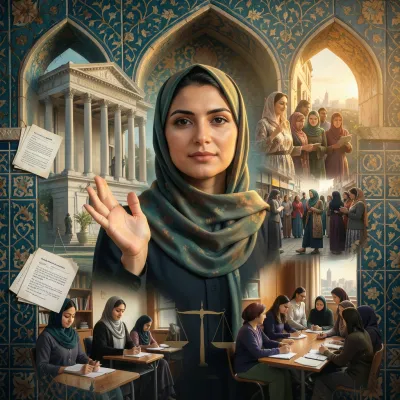
*Women and the Public Sphere* provides a comprehensive analysis of the legal, social, and political landscapes governing the lives of women in contemporary Iran. Tracing the historical arc from the Constitutional Revolution to the Islamic Republic, the book explores how the dual architecture of civil codes and Sharia-based family law creates a bifurcated existence for women—granting them tools for economic transaction while maintaining patriarchal controls over marriage, divorce, and custody. It details how education has served as a primary engine for mobility, producing highly qualified generations of women who nonetheless face systemic barriers in the labor market and political institutions, leading many to navigate the "gray economy" or informal sectors of employment.
The text emphasizes the public sphere as a site of constant negotiation and everyday resistance, particularly regarding the regulation of modesty and the mandatory hijab. It examines the mechanisms of state surveillance and moral policing, contrasting them with the sophisticated repertoires women use to claim visibility, from strategic litigation and digital activism to symbolic presence in sports stadiums. The book highlights the significance of "feminist theology" and the emergence of female religious scholars who challenge traditional interpretations of scripture from within, arguing for gender justice using the state’s own ideological language.
A significant portion of the book focuses on the evolution of collective action, from early petition drives like the One Million Signatures Campaign to the 2022 "Woman, Life, Freedom" movement. These mobilizations are analyzed through the lens of intersectionality, acknowledging how ethnicity, geography, and class shape the varying risks and opportunities for women across the country. The author illustrates how digital platforms have revolutionized dissent, allowing for the rapid circulation of testimony and the creation of transnational networks that bypass traditional state-controlled media.
Ultimately, the book outlines potential futures for Iran, ranging from managed state liberalization to structural realignment. It argues that the measure of social change is found not only in legislative shifts but in the normalized presence of women in classrooms, workplaces, and cultural forums. By synthesizing structural constraints with the ingenuity of grassroots agency, the work concludes that the ongoing renegotiation of the public sphere is a central, defining feature of Iran’s broader political and social evolution.
What You'll Find Inside:
- The book traces how women's presence in Iran's public sphere has evolved from the Constitutional Revolution through the Islamic Republic, revealing patterns of gain, loss, and adaptation in rights claims across generations.
- It examines the complex legal architecture where Sharia, civil codes, and constitutional provisions interact to both enable and restrict women's public participation, with careful attention to gaps between law on paper and in practice.
- Key domains of contestation are analyzed including family law (marriage, divorce, custody), hijab regulations, education access, workforce participation, and political representation, showing how intimate life structures public standing.
- The book documents diverse forms of women's activism from legal campaigns and civil society organizing to digital activism and the 'Woman, Life, Freedom' movement, illustrating how constraints are converted into opportunities for agency.
- It situates Iran's gender politics within regional and global contexts, analyzing how international norms, economic sanctions, and intersectional factors (ethnicity, class, region) shape women's experiences and movement-building.
Who's It For:
This book is essential reading for scholars and students of gender studies, Middle Eastern politics, and human rights who seek a comprehensive understanding of women's evolving roles in contemporary Iran. It will also benefit policymakers, activists, and journalists working on gender equality issues in Muslim-majority contexts, providing historical depth and analysis of legal, social, and political barriers to women's public participation. Researchers interested in intersectional approaches to studying how ethnicity, class, and region compound gender-based disadvantages will find particular value in its nuanced analysis.
Table of Contents:
- Introduction
- Chapter 1 Historical Legacies: From the Constitutional Revolution to the Islamic Republic
- Chapter 2 The Architecture of Law: Sharia, Civil Codes, and the Constitution
- Chapter 3 Family Law and Personal Status: Marriage, Divorce, and Custody
- Chapter 4 Hijab, Modesty, and the Regulation of Public Space
- Chapter 5 Education after 1979: Access, Segregation, and Achievement
- Chapter 6 Women in the Workforce: Employment, Informality, and Entrepreneurship
- Chapter 7 Political Participation: Voting, Candidacy, and Institutional Barriers
- Chapter 8 Civil Society and NGOs: Negotiating Space and Legitimacy
- Chapter 9 Media and the Cultural Public Sphere: Literature, Television, and Platforms
- Chapter 10 Digital Activism: Hashtags, Networks, and Countermeasures
- Chapter 11 Policing Morality: Enforcement, Surveillance, and Everyday Resistance
- Chapter 12 Health and Bodily Autonomy: Reproductive Rights and Public Health
- Chapter 13 Sports and Visibility: Stadiums, Spectatorship, and Symbolic Wins
- Chapter 14 Religion, Reform, and Feminist Theology
- Chapter 15 Courts, Lawyers, and Strategic Litigation
- Chapter 16 The University as a Political Field: Students, Faculty, and Dissent
- Chapter 17 Economic Shocks, Sanctions, and Gendered Precarity
- Chapter 18 Ethnicity, Region, and Intersectional Inequalities
- Chapter 19 Art, Film, and the Aesthetics of Protest
- Chapter 20 Campaigns for Change: From One Million Signatures to New Coalitions
- Chapter 21 The “Woman, Life, Freedom” Movement: Origins, Mobilization, and Afterlives
- Chapter 22 State Responses: Legislation, Policing, and Narrative Control
- Chapter 23 International Norms and Human Rights Mechanisms
- Chapter 24 Comparative Perspectives: Iran in the Middle East and Beyond
- Chapter 25 Prospects for Change: Scenarios, Strategies, and Policy Pathways
Author:
Published By:
Date Published:
April 30, 2026
Type:
Nonfiction
Language:
English
Word Count:
72,784 words
Reading Time:
5 hours 6 minutes
Sample:
MixCache.com Total Access
Get unlimited access to this book + all books published by MixCache.com for $11.99/month
Subscribe to MTAOr purchase this book individually below
Order:
Buy the Women and the Public Sphere: Gender Politics in Contemporary Iran ebook on MixCache.com:
Buy Now
Full ebook will be available immediately
- read online or download as a PDF file.
$5 account credit for all new MixCache.com accounts, usable toward any ebook purchase!*





Ratings & Reviews
Ask Questions About This Book
Have a question about the content? Ask our AI assistant!
Start by asking a question about "Women and the Public Sphere: Gender Politics in Contemporary Iran"
Example: "Does this book mention William Shakespeare?"
Thinking...