
Browse by Category
Fiction
- Action & Adventure
- African American
- Anthologies
- Children's Fiction
- Classics
- Comics & Graphic Novels
- Coming of Age
- Contemporary
- Cultural & Regional
- Drama
- Erotica
- Fantasy
- General
- Historical Fiction
- Horror
- Humor & Satire
- Literary Fiction
- Mystery, Thriller & Suspense
- Poetry
- Religious & Inspirational
- Romance
- Science Fiction
- Short Stories
- War & Military
- Westerns
- Women's Fiction
- Young Adult
Non-Fiction
- Antiques & Collectibles
- Arts & Photography
- Biographies & Memoirs
- Business & Money
- Children's Non-Fiction
-
Computers & Technology
- Artificial Intelligence
- Computer Science
- Cybersecurity & Cryptography
- Data Science & Analytics
- Databases & Big Data
- Game Development & Design
- General
- Hardware & DIY
- Mobile App Development
- Networking & Cloud Computing
- Operating Systems
- Programming
- Robotics
- Software
- Software Engineering
- User Experience (UX) & Design
- Web Development & Design
- Cooking, Food & Wine
- Crafts, Hobbies & Home
- Education & Teaching
- Engineering
- General
- Health, Fitness & Dieting
-
History
- African History
- African History - North Africa
- African History - Sub-Saharan Africa
- American History
- American History - 20th Century
- American History - Civil War
- American History - Colonial Period
- Ancient History
- Asian History
- Asian History - China
- Asian History - India
- Asian History - Japan
- Asian History - Southeast Asia
- European History
- European History - Ancient Greece
- European History - Ancient Rome
- European History - Medieval
- European History - Modern
- European History - Renaissance
- General
- Middle Eastern History
- Military History
- Military History - Aviation
- Military History - Naval
- Social & Cultural History
- World History
- Humor & Entertainment
- Industrial Technology
- Language Learning
- Law
- LGBTQ+ Non-Fiction
- Literary Criticism
- Medical Books
- Parenting & Relationships
- Philosophy
- Politics & Social Sciences
- Reference
- Religion & Spirituality
-
Science & Math
- Agricultural Sciences
- Astronomy & Space Science
- Behavioral Sciences
- Biological Sciences
- Botany & Plant Science
- Chemistry
- Earth Sciences
- Engineering - Chemical
- Engineering - Civil
- Engineering - Electrical
- Engineering - Mechanical
- Environment
- General
- Geology
- Mathematics
- Nature & Ecology
- Oceanography
- Paleontology
- Physics
- Statistics
- Self-Help
- Sports & Outdoors
- Study Aids
- Sustainability & Green Living
- Textbooks
- Transportation
- Travel
- True Crime
- Urban Planning & Development
- Veterinary Medicine
- Writing & Publishing
Jump to Section
MixCache.com Total Access
Unlimited reading and audiobooks for every book published by MixCache.com.
Included titles carry the MTA badge.
Learn more →
Iran-China Relations: Strategic Partnership and Economic Opportunities
MTA
Examines the 21st-century bilateral ties, Belt and Road implications, and investment deals
About this book:
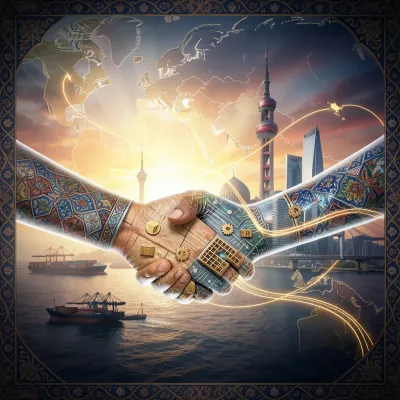
The 21st-century relationship between Iran and China has evolved from a series of transactional energy deals into a multi-dimensional strategic partnership defined by shared pragmatism and a mutual desire for strategic autonomy. Centered on the "25-Year Cooperation Framework," the bilateral tie leverages Iran’s vast hydrocarbon reserves and geographic position as a Eurasian hinge against China’s drive for secure energy, infrastructure connectivity, and the expansion of its "Digital Silk Road." This alignment is underscored by a shared necessity to build resilience against Western sanctions, leading to the development of sophisticated financial workarounds, local-currency settlements, and a parallel economic ecosystem that operates largely outside the dollar-dominated global order.
Energy remains the gravitational center of the partnership, but the book highlights a significant shift toward industrial upgrading, gas value chain monetization, and digital economy integration. Chinese State-Owned Enterprises (SOEs) and private firms are increasingly involved in Iranian infrastructure—ranging from port developments at Chabahar and Bandar Abbas to high-speed rail and smart-city technologies. These projects are not merely about exporting hardware; they export Chinese technical standards and management protocols, creating long-term path dependencies. However, these ambitions must navigate a volatile risk landscape characterized by Iran’s complex domestic factionalism, shifting regional rivalries with Gulf monarchies and Israel, and the constant threat of secondary sanctions from the United States.
Strategically, China utilizes its engagement with Iran as a laboratory for sanctions-resistant commerce and a vital node in the Belt and Road Initiative (BRI). For Iran, China represents a crucial economic lifeline and a means to reduce overreliance on European and American markets. The partnership is best understood as "layered hedging": while both sides seek deeper ties, they remain cautious of formal alliances that could provoke unnecessary global escalation. The relationship is managed through a "Policy Playbook" that prioritizes modular project design, incremental gains, and the cultivation of personal and professional networks to bypass bureaucratic and political friction.
Looking toward 2035, the book presents scenarios ranging from "Shock"—defined by regional conflict and economic rupture—to "Partnership-Plus," where partial geopolitical thaws allow for full-scale industrial and technological integration. Ultimately, the book concludes that the durability of the Iran-China tie rests on its unglamorous resilience. By mastering the granular details of legal contracting, environmental adaptation, and financial ingenuity, both nations have constructed a functional, adaptive partnership capable of withstanding external pressures while gradually reshaping the geoeconomic landscape of the Middle East and Central Asia.
What You'll Find Inside:
- Comprehensive analysis of Iran-China strategic partnership covering energy interdependence, infrastructure development, and technology transfer under sanctions pressure
- Detailed examination of the 25-Year Cooperation Framework, Belt and Road initiatives, and their implementation challenges in Iran
- Insights into financial mechanisms, payment workarounds, and risk management strategies for operating in sanctioned environments
- Sector-specific investment opportunities in energy efficiency, renewables, gas value chains, digital economy, and industrial upgrading
- Geopolitical analysis of great-power dynamics, regional balancing, and strategic autonomy considerations for both countries
Who's It For:
This book is essential for policymakers, investors, and business professionals engaged with or considering opportunities in Iran-China economic relations. It provides critical insights for those navigating sanctions-compliant trade mechanisms, infrastructure development, energy partnerships, and technology cooperation. Researchers and analysts focusing on Middle East geopolitics, China's Belt and Road Initiative, and emerging market investments will find particularly valuable the detailed case studies, risk assessments, and scenario planning through 2035.
Table of Contents:
- Introduction
- Chapter 1 Strategic Foundations: Why Iran and China Matter to Each Other
- Chapter 2 From Silk Road to Strategic Partnership: A Historical Arc
- Chapter 3 The 25-Year Cooperation Framework: Scope, Ambitions, and Realities
- Chapter 4 Energy Interdependence: Oil, Gas, and Petrochemicals
- Chapter 5 Infrastructure Corridors: Rail, Roads, Ports, and Power
- Chapter 6 The Belt and Road in Iran: Mapping Projects and Gaps
- Chapter 7 Finance Under Sanctions: Payments, Currencies, and Workarounds
- Chapter 8 Technology and the Digital Silk Road: 5G, Cloud, and Cybersecurity
- Chapter 9 Industrial Upgrading: Manufacturing, Mining, and Special Economic Zones
- Chapter 10 Logistics and Geopolitics: Hormuz, Gwadar, Chabahar, and the INSTC
- Chapter 11 Regional Balancing: Gulf Monarchies, Turkey, and Israel
- Chapter 12 Great-Power Triangles: The United States, Russia, Europe, and Strategic Autonomy
- Chapter 13 Defense and Security Engagement: Arms, Training, and Maritime Presence
- Chapter 14 Environmental and Social Impacts: Water, Emissions, and Labor
- Chapter 15 Legal Architecture: Contracts, Arbitration, and Compliance
- Chapter 16 Risk Landscape: Political, Regulatory, and Operational Exposures
- Chapter 17 Investment Opportunities: Energy Efficiency, Renewables, and Gas Value Chains
- Chapter 18 Digital Economy Opportunities: E‑commerce, Fintech, and Smart Cities
- Chapter 19 Health, Education, and People-to-People Links
- Chapter 20 Case Studies: Lessons from Ports, Rails, and Energy Projects
- Chapter 21 Supply Chains and Sanctions: Compliance Versus Evasion in Practice
- Chapter 22 Iran’s Domestic Political Economy: Stakeholders and Veto Players
- Chapter 23 Chinese Corporate Strategies: SOEs, POEs, and Provincial Actors
- Chapter 24 Scenarios to 2035: Shock, Baseline, and Partnership‑Plus
- Chapter 25 Policy Playbook: Recommendations for Policymakers and Investors
Author:
Published By:
Date Published:
April 30, 2026
Type:
Nonfiction
Language:
English
Word Count:
71,431 words
Reading Time:
5 hours
Sample:
MixCache.com Total Access
Get unlimited access to this book + all books published by MixCache.com for $11.99/month
Subscribe to MTAOr purchase this book individually below
Order:
Buy the Iran-China Relations: Strategic Partnership and Economic Opportunities ebook on MixCache.com:
Buy Now
Full ebook will be available immediately
- read online or download as a PDF file.
$5 account credit for all new MixCache.com accounts, usable toward any ebook purchase!*





Ratings & Reviews
Ask Questions About This Book
Have a question about the content? Ask our AI assistant!
Start by asking a question about "Iran-China Relations: Strategic Partnership and Economic Opportunities"
Example: "Does this book mention William Shakespeare?"
Thinking...