Browse by Category
Fiction
- Action & Adventure
- African American
- Anthologies
- Children's Fiction
- Classics
- Comics & Graphic Novels
- Coming of Age
- Contemporary
- Cultural & Regional
- Drama
- Erotica
- Fantasy
- General
- Historical Fiction
- Horror
- Humor & Satire
- Literary Fiction
- Mystery, Thriller & Suspense
- Poetry
- Religious & Inspirational
- Romance
- Science Fiction
- Short Stories
- War & Military
- Westerns
- Women's Fiction
- Young Adult
Non-Fiction
- Antiques & Collectibles
- Arts & Photography
- Biographies & Memoirs
- Business & Money
- Children's Non-Fiction
-
Computers & Technology
- Artificial Intelligence
- Computer Science
- Cybersecurity & Cryptography
- Data Science & Analytics
- Databases & Big Data
- Game Development & Design
- General
- Hardware & DIY
- Mobile App Development
- Networking & Cloud Computing
- Operating Systems
- Programming
- Robotics
- Software
- Software Engineering
- User Experience (UX) & Design
- Web Development & Design
- Cooking, Food & Wine
- Crafts, Hobbies & Home
- Education & Teaching
- Engineering
- General
- Health, Fitness & Dieting
-
History
- African History
- African History - North Africa
- African History - Sub-Saharan Africa
- American History
- American History - 20th Century
- American History - Civil War
- American History - Colonial Period
- Ancient History
- Asian History
- Asian History - China
- Asian History - India
- Asian History - Japan
- Asian History - Southeast Asia
- European History
- European History - Ancient Greece
- European History - Ancient Rome
- European History - Medieval
- European History - Modern
- European History - Renaissance
- General
- Middle Eastern History
- Military History
- Military History - Aviation
- Military History - Naval
- Social & Cultural History
- World History
- Humor & Entertainment
- Industrial Technology
- Language Learning
- Law
- LGBTQ+ Non-Fiction
- Literary Criticism
- Medical Books
- Parenting & Relationships
- Philosophy
- Politics & Social Sciences
- Reference
- Religion & Spirituality
-
Science & Math
- Agricultural Sciences
- Astronomy & Space Science
- Behavioral Sciences
- Biological Sciences
- Botany & Plant Science
- Chemistry
- Earth Sciences
- Engineering - Chemical
- Engineering - Civil
- Engineering - Electrical
- Engineering - Mechanical
- Environment
- General
- Geology
- Mathematics
- Nature & Ecology
- Oceanography
- Paleontology
- Physics
- Statistics
- Self-Help
- Sports & Outdoors
- Study Aids
- Sustainability & Green Living
- Textbooks
- Transportation
- Travel
- True Crime
- Urban Planning & Development
- Veterinary Medicine
- Writing & Publishing
Jump to Section

Want unlimited access to all books published by MixCache.com (plus their audiobooks)? Try MixCache.com Total Access. Look for the MTA badge on book covers to identify included titles.
Access to infinite ebooks: Don't see the book you want? Suggest it and we'll create it (free!) for you from scratch with our powerful AI book writer. Then read it with MTA - besides profiting from any sales it makes!
Margins and Heartlands
MTA
Comparative Regional Histories of the Deccan, South India, Bengal, and Punjab
About this book:

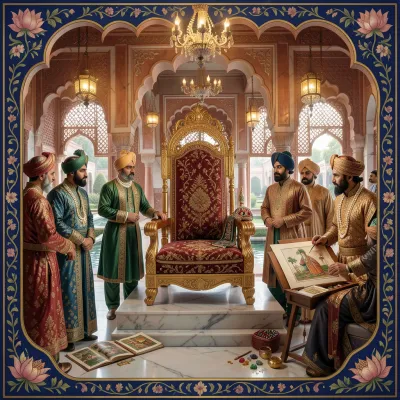
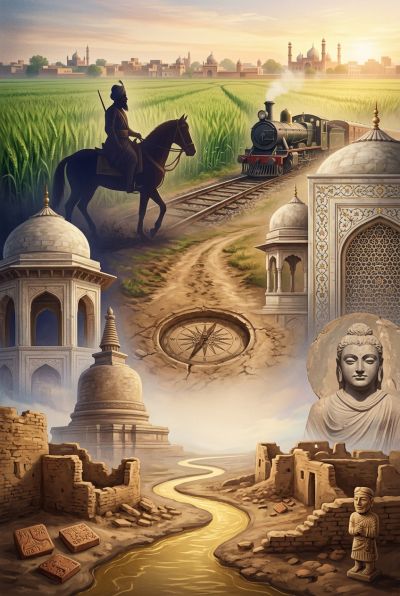
*Margins and Heartlands* offers a comparative historical analysis of four major South Asian regions—the Deccan, South India, Bengal, and Punjab—challenging the traditional "center-periphery" national narrative. By examining these areas from antiquity to the post-1947 era, the book demonstrates how distinct geographical foundations, such as the basaltic plateaus of the Deccan and the amphibious deltas of Bengal, dictated unique agrarian regimes and political ecologies. These regional specificities influenced the rise of diverse state forms, from the temple-centered sacred economies of the South to the martial agrarian heartland of Punjab, ensuring that each region developed a distinct historical trajectory that cannot be reduced to a single monolithic "Indian" story.
The book traces how these regional identities were further solidified through linguistic evolution and the role of local intermediaries like *zamindars* and *nayakas*, who negotiated power between the village and the empire. During the colonial era, British efforts to reorder the subcontinent through surveys, railways, and legal codifications often exacerbated regional differences rather than flattening them. This period saw the transformation of ports like Calcutta and Madras into global gateways and the emergence of intense peasant politics, such as the Tebhaga and Moplah movements, which were deeply rooted in specific regional socio-economic grievances.
A central focus is the divergence of these regions during the 20th century, particularly the traumatic partitions of Bengal and Punjab, which stood in contrast to the relative territorial continuity of South India and the Deccan. In the post-independence period, the book analyzes how developmentalist projects like the Green Revolution and the rise of industrial and IT corridors in South India further differentiated regional economies. The linguistic reorganization of states is presented as a pivotal moment in the success of Indian federalism, providing a political framework that accommodated regional aspirations while maintaining national unity.
Ultimately, the book concludes that South Asian national identity is an ongoing negotiation between its diverse constituent parts. By foregrounding the "granular" histories of specific landscapes, languages, and social formations, it argues that regionalism is not a threat to the nation but its foundational reality. The comparative study emphasizes that the future of the subcontinent depends on its ability to leverage these unique regional strengths and historical legacies, suggesting that the nation-state is best understood as a vibrant tapestry woven from its distinct and resilient heartlands.
What You'll Find Inside:
- The book demonstrates how geography actively shapes regional histories, with the Deccan's basaltic plateau fostering resilient millet agriculture, Bengal's delta enabling intensive rice cultivation, Punjab's riverine doabs supporting wheat-based martial agrarian societies, and South India's coasts facilitating Indian Ocean trade.
- It reveals distinct political formations across regions - from the tank-based sacred economies of South Indian temple towns to Bengal's wetland states managed through riverine trade, Punjab's martial agrarian heartland centered on forts and canal colonies, and the Deccan's trade-driven sultanates projecting power through coastal and inland networks.
- The comparative analysis shows how colonial policies like the Permanent Settlement in Bengal, Ryotwari in South India, and Mahalwari in Punjab interacted with pre-existing land tenure systems to produce divergent outcomes in revenue collection, peasant livelihoods, and rural power structures.
- It traces how post-independence developmental paths diverged: Punjab's Green Revolution transformed it into India's breadbasket, South India and parts of the Deccan emerged as IT and industrial corridors, while Bengal pursued land reform-oriented development after partition's economic dislocations.
- The book highlights how linguistic reorganization and federalism after 1947 empowered regional identities while maintaining national unity, creating states like Andhra Pradesh, Tamil Nadu, Karnataka, Kerala, Maharashtra, Gujarat, and Punjabi Suba Punjab that reflected linguistic and cultural aspirations.
Who's It For:
The book is aimed at students and scholars of South Asian history, particularly those interested in regional studies, comparative history, and the interplay of geography, economy, and polity. It would benefit researchers examining how local specificities shape national narratives, as well as policymakers and development professionals seeking to understand regional variations in agrarian systems, industrialization, and social movements. General readers with an interest in Indian history beyond national-level narratives would also find value in its detailed comparative approach.
Author:
Published By:
Date Published:
March 5, 2026
Type:
Nonfiction
Language:
English
Word Count:
50,954 words
Reading Time:
3 hours 34 minutes
Sample:
Order:
Order Margins and Heartlands (Hardcover) on MixCache.com:
Buy NowPrint copy is made to order and ships worldwide. Includes the ebook free, ready to read instantly.
$5 account credit for all new MixCache.com accounts, usable toward any ebook purchase!*