
Browse by Category
Fiction
- Action & Adventure
- African American
- Anthologies
- Children's Fiction
- Classics
- Comics & Graphic Novels
- Coming of Age
- Contemporary
- Cultural & Regional
- Drama
- Erotica
- Fantasy
- General
- Historical Fiction
- Horror
- Humor & Satire
- Literary Fiction
- Mystery, Thriller & Suspense
- Poetry
- Religious & Inspirational
- Romance
- Science Fiction
- Short Stories
- War & Military
- Westerns
- Women's Fiction
- Young Adult
Non-Fiction
- Antiques & Collectibles
- Arts & Photography
- Biographies & Memoirs
- Business & Money
- Children's Non-Fiction
-
Computers & Technology
- Artificial Intelligence
- Computer Science
- Cybersecurity & Cryptography
- Data Science & Analytics
- Databases & Big Data
- Game Development & Design
- General
- Hardware & DIY
- Mobile App Development
- Networking & Cloud Computing
- Operating Systems
- Programming
- Robotics
- Software
- Software Engineering
- User Experience (UX) & Design
- Web Development & Design
- Cooking, Food & Wine
- Crafts, Hobbies & Home
- Education & Teaching
- Engineering
- General
- Health, Fitness & Dieting
-
History
- African History
- African History - North Africa
- African History - Sub-Saharan Africa
- American History
- American History - 20th Century
- American History - Civil War
- American History - Colonial Period
- Ancient History
- Asian History
- Asian History - China
- Asian History - India
- Asian History - Japan
- Asian History - Southeast Asia
- European History
- European History - Ancient Greece
- European History - Ancient Rome
- European History - Medieval
- European History - Modern
- European History - Renaissance
- General
- Middle Eastern History
- Military History
- Military History - Aviation
- Military History - Naval
- Social & Cultural History
- World History
- Humor & Entertainment
- Industrial Technology
- Language Learning
- Law
- LGBTQ+ Non-Fiction
- Literary Criticism
- Medical Books
- Parenting & Relationships
- Philosophy
- Politics & Social Sciences
- Reference
- Religion & Spirituality
-
Science & Math
- Agricultural Sciences
- Astronomy & Space Science
- Behavioral Sciences
- Biological Sciences
- Botany & Plant Science
- Chemistry
- Earth Sciences
- Engineering - Chemical
- Engineering - Civil
- Engineering - Electrical
- Engineering - Mechanical
- Environment
- General
- Geology
- Mathematics
- Nature & Ecology
- Oceanography
- Paleontology
- Physics
- Statistics
- Self-Help
- Sports & Outdoors
- Study Aids
- Sustainability & Green Living
- Textbooks
- Transportation
- Travel
- True Crime
- Urban Planning & Development
- Veterinary Medicine
- Writing & Publishing
Jump to Section
MixCache.com Total Access
Unlimited reading and audiobooks for every book published by MixCache.com.
Included titles carry the MTA badge.
Learn more →
Court, Clergy, and Canon: Religion, Ritual, and the State in Chinese History
MTA
A study of Buddhism, Daoism, Confucianism, and popular religion in state formation and social life
About this book:
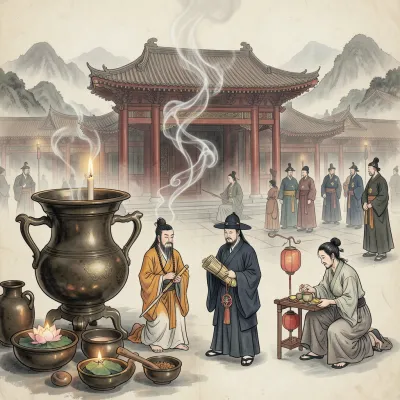
*Court, Clergy, and Canon: Religion, Ritual, and the State in Chinese History* provides a comprehensive analysis of the symbiotic and often contentious relationship between religious institutions and state power from the Shang dynasty to the post-Mao era. The book argues that Chinese state formation was inherently a sacral project, where the "Mandate of Heaven" and Confucian bureaucracy functioned alongside Buddhist monastic estates and Daoist celestial hierarchies. By examining Buddhism, Daoism, Confucianism, and popular religion as an entangled "Three Teachings" framework, the text demonstrates how ritual acted as a primary technology of governance, social welfare, and moral education.
The middle chapters detail the institutionalization of the sacred through statecraft. The authors explore the development of official cults, the rigorous registration of clergy to manage tax immunities, and the role of monasteries as economic engines and providers of social relief during crises like drought and plague. Significant attention is paid to the "Song Synthesis," where the scholar-official class reworked religious aesthetics and ethics into a Neo-Confucian social order, and the subsequent Ming and Qing efforts to codify orthodoxy through massive scriptural printing projects and legal suppression of "heretical" sects.
The final section addresses the radical transformations of the twentieth century, tracing the shift from imperial patronage to revolutionary secularization. From the Republican era’s "temples-into-schools" campaigns to the systematic destruction of the Cultural Revolution, the state sought to modernize by marginalizing "superstition." However, the book concludes with the post-Mao religious revival, illustrating how traditional practices have reemerged through the lenses of heritage, tourism, and digital innovation. Ultimately, the work suggests that despite radical political shifts, the fundamental grammar of Chinese life remains a negotiation between state authority and the irrepressible human impulse toward the sacred.
What You'll Find Inside:
- The book examines how Buddhism, Daoism, Confucianism, and popular religion were continually entangled in Chinese state formation over two millennia, rather than treating them as isolated traditions.
- It reveals how religious institutions functioned as engines of education, welfare, law, and culture—serving as granaries, schools, dispute resolution centers, and merit-making infrastructures beyond mere sites of devotion.
- The work traces the dynamic negotiation between state power and religious practice, showing how courts cultivated sacral authority through rituals while regulating clerical wealth, ordination, and popular cults through systems like temple registration and examination platforms.
- It explores specific mechanisms of religious-state interaction including the printing of canons as tools of orthodoxy, local god title-granting as spatial imperial control, and crisis rituals like rain prayers as technologies of cosmic governance.
- The book demonstrates how popular religion adapted elite forms while maintaining its own vitality, emphasizing religion as lived practice through ancestor veneration, pilgrimage networks, spirit-mediumship, and gendered household rituals rather than solely doctrinal belief.
Who's It For:
This book is intended for scholars and advanced students of Chinese history, religious studies, and Asian studies who seek a comprehensive understanding of how religion intersected with state formation, social governance, and cultural life across two millennia. It will particularly benefit researchers interested in comparative religion-state dynamics, the historical sociology of religious institutions, and the entanglement of Buddhist, Daoist, Confucian, and popular traditions in shaping Chinese civilization. Graduate students writing dissertations on premodern Chinese religion, statecraft, or cultural history will find its methodological approach of combining textual analysis with localized case studies especially valuable for their own work.
Table of Contents:
- Introduction
- Chapter 1 Mandate and Monastery: Religion and the Making of Imperial Authority
- Chapter 2 The Three Teachings in Tandem: Doctrinal Interactions and Boundaries
- Chapter 3 Court Rituals and Sacral Kingship from Han to Tang
- Chapter 4 Temples as Statecraft: Official Cults, Registrations, and Patronage
- Chapter 5 Monasteries as Estates: Economy, Land, and Immunities
- Chapter 6 Educating the Realm: Confucian Curricula, Examinations, and Ritual Learning
- Chapter 7 Printing, Scripture, and the State: Canons, Edicts, and the Circulation of Texts
- Chapter 8 Daoist Bureaucracy and Heavenly Administration: Mirrors of the Empire
- Chapter 9 Buddhist Networks: Vinaya, Ordination Platforms, and Infrastructures of Merit
- Chapter 10 Local Gods and Popular Religion: City Gods, Earth Gods, and Community Temples
- Chapter 11 Ancestors and Lineages: Household Rites and the Governance of Kin
- Chapter 12 Women, Family, and the Gendered Spaces of Piety
- Chapter 13 Pilgrimage, Festivals, and the Lunar Calendar of Power
- Chapter 14 Law, Heresy, and Suppression: Policing the Sacred
- Chapter 15 Charity, Relief, and Moral Exemplarity: Religion in Social Welfare
- Chapter 16 Rituals of Crisis: Drought, Plague, and State Liturgy
- Chapter 17 Mediums, Masters, and Magic: Spirit-Writing and Ritual Specialists
- Chapter 18 Borderlands and Empire: Tibet, Inner Asia, and the Peripheries of Rule
- Chapter 19 The Song Synthesis: Literati, Reform, and Temple Societies
- Chapter 20 Ming Regulation and Monastic Reform: From Hongwu to Wanli
- Chapter 21 Qing Codifications: Sacrifice, Orthodoxy, and Local Society
- Chapter 22 Encounters with the Modern: Missionaries, Reformers, and New Religions
- Chapter 23 Revolution and Reconfiguration: Religion and the Twentieth-Century State
- Chapter 24 Heritage, Tourism, and the Post-Mao Religious Landscape
- Chapter 25 Continuity and Change: The Public and Private Lives of Religion in China
Author:
Published By:
Date Published:
May 15, 2026
Type:
Nonfiction
Language:
English
Word Count:
76,870 words
Reading Time:
5 hours 23 minutes
Sample:
Order:
Order Court, Clergy, and Canon: Religion, Ritual, and the State in Chinese History (Paperback) on MixCache.com:
Buy NowPrint copy is made to order and ships worldwide. Includes the ebook free, ready to read instantly.
$5 account credit for all new MixCache.com accounts, usable toward any ebook purchase!*


