Browse by Category
Fiction
- Action & Adventure
- African American
- Anthologies
- Children's Fiction
- Classics
- Comics & Graphic Novels
- Coming of Age
- Contemporary
- Cultural & Regional
- Drama
- Erotica
- Fantasy
- General
- Historical Fiction
- Horror
- Humor & Satire
- Literary Fiction
- Mystery, Thriller & Suspense
- Poetry
- Religious & Inspirational
- Romance
- Science Fiction
- Short Stories
- War & Military
- Westerns
- Women's Fiction
- Young Adult
Non-Fiction
- Antiques & Collectibles
- Arts & Photography
- Biographies & Memoirs
- Business & Money
- Children's Non-Fiction
-
Computers & Technology
- Artificial Intelligence
- Computer Science
- Cybersecurity & Cryptography
- Data Science & Analytics
- Databases & Big Data
- Game Development & Design
- General
- Hardware & DIY
- Mobile App Development
- Networking & Cloud Computing
- Operating Systems
- Programming
- Robotics
- Software
- Software Engineering
- User Experience (UX) & Design
- Web Development & Design
- Cooking, Food & Wine
- Crafts, Hobbies & Home
- Education & Teaching
- Engineering
- General
- Health, Fitness & Dieting
-
History
- African History
- African History - North Africa
- African History - Sub-Saharan Africa
- American History
- American History - 20th Century
- American History - Civil War
- American History - Colonial Period
- Ancient History
- Asian History
- Asian History - China
- Asian History - India
- Asian History - Japan
- Asian History - Southeast Asia
- European History
- European History - Ancient Greece
- European History - Ancient Rome
- European History - Medieval
- European History - Modern
- European History - Renaissance
- General
- Middle Eastern History
- Military History
- Military History - Aviation
- Military History - Naval
- Social & Cultural History
- World History
- Humor & Entertainment
- Industrial Technology
- Language Learning
- Law
- LGBTQ+ Non-Fiction
- Literary Criticism
- Medical Books
- Parenting & Relationships
- Philosophy
- Politics & Social Sciences
- Reference
- Religion & Spirituality
-
Science & Math
- Agricultural Sciences
- Astronomy & Space Science
- Behavioral Sciences
- Biological Sciences
- Botany & Plant Science
- Chemistry
- Earth Sciences
- Engineering - Chemical
- Engineering - Civil
- Engineering - Electrical
- Engineering - Mechanical
- Environment
- General
- Geology
- Mathematics
- Nature & Ecology
- Oceanography
- Paleontology
- Physics
- Statistics
- Self-Help
- Sports & Outdoors
- Study Aids
- Sustainability & Green Living
- Textbooks
- Transportation
- Travel
- True Crime
- Urban Planning & Development
- Veterinary Medicine
- Writing & Publishing
Jump to Section
MixCache.com Total Access
Unlimited reading and audiobooks for every book published by MixCache.com.
Included titles carry the MTA badge.
Learn more →
Silk Roads and Sea Routes: Trade, Culture, and Power in China's World
MTA
The economic, cultural, and diplomatic impact of overland and maritime networks on China
About this book:
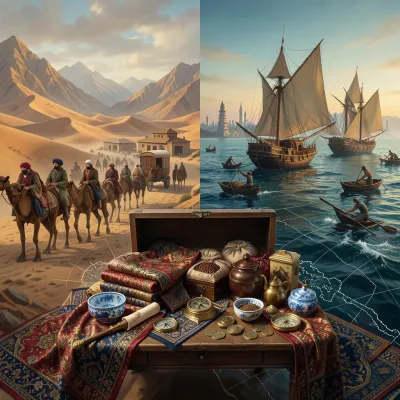
*Silk Roads and Sea Routes* provides a comprehensive historical analysis of how overland and maritime networks integrated China into the global economy while simultaneously transforming its internal social, cultural, and political structures. The book moves from the foundational influence of geography and monsoon cycles to the sophisticated development of credit, guilds, and diplomatic rituals like the tribute system. By examining commodities such as silk, porcelain, tea, silver, and opium, the text illustrates how material exchange dictated imperial policy and fostered technological innovation in shipbuilding, cartography, and the sciences.
The narrative highlights the "human infrastructure" of trade, focusing on the social worlds of merchants, middlemen, and the often-invisible labor of women and households. Through case studies in frontier regions like Xinjiang and Yunnan, and maritime hubs like Quanzhou and Guangzhou, the author demonstrates how local lives were refracted through global currents. These sites functioned not merely as transit points but as cosmopolitan centers where Buddhism, Islam, and Christianity took root, adapting to Chinese contexts while providing the trust and legal frameworks necessary for long-distance commerce.
A significant portion of the book tracks the macro-historical shifts that redefined China’s reach, from the high integration of the Mongol Era and the spectacular maritime expeditions of Zheng He to the "silver circuits" of the Manila galleons. These periods of expansion were eventually met by the upheavals of the nineteenth century, where the tea and opium trades led to the Treaty Port system and a fundamental recalibration of Chinese sovereignty. The text explores how these interactions with foreign powers—including the intellectual contributions of Jesuit missionaries—forced a selective appropriation of New World sciences and global financial models.
The final chapters address the environmental and biological legacies of connectivity, noting how the movement of goods inevitably facilitated the spread of plagues and the introduction of transformative New World crops. The book concludes by connecting these deep historical patterns to the modern era, suggesting that the contemporary "Belt and Road Initiative" is a deliberate revival of these ancient legacies. Ultimately, the work argues that China’s world was never a static entity but was perpetually made in motion, defined by the persistent human drive to overcome distance and forge connections across the steppe and the sea.
What You'll Find Inside:
- How geography - mountain passes, desert oases, monsoon winds, and river systems - actively shaped the feasibility, timing, and routes of China's overland and maritime trade networks across millennia.
- The movement of key commodities like silk, tea, porcelain, silver, and spices transferred not just goods but knowledge, religions, technologies, and cultural practices that transformed Chinese society.
- Trade infrastructure from caravanserais and harbor guilds to bills of exchange and credit networks created resilient systems that allowed commerce to persist despite political fragmentation and environmental challenges.
- The book reveals how women's often-invisible labor - managing households, extending credit, processing goods, and maintaining kinship networks - was fundamental to sustaining long-distance trade across generations.
- From the Mongol Pax Mongolica to Zheng He's voyages and the Manila Galleon silver trade to today's Belt and Road Initiative, China's world has been continuously remade by its engagement with overland and maritime exchange networks.
Who's It For:
This book will be valuable for students and scholars of Chinese history, world history, and economic history who seek to understand how overland and maritime trade networks shaped China's development. It will particularly interest researchers studying the Silk Road, maritime trade routes, cultural exchange, and the historical precedents for modern initiatives like the Belt and Road. The multidisciplinary approach covering geography, commerce, religion, and politics makes it relevant for anyone examining how connectivity influences societal transformation across time.
Table of Contents:
- Introduction
- Chapter 1 Maps, Monsoons, and Mountain Passes: The Geography of Connection
- Chapter 2 Silk, Spice, and Silver: Commodities that Moved Empires
- Chapter 3 Caravans and Caravanserais: Infrastructures of the Steppe and Desert
- Chapter 4 Ports, Harbors, and Monsoon Seamanship: Maritime Technologies and Routes
- Chapter 5 Merchants and Middlemen: The Social Worlds of Trade
- Chapter 6 Credit, Coins, and Paper: Finance and Risk in Long-Distance Exchange
- Chapter 7 Governing the Gateways: Empires, States, and the Politics of Passage
- Chapter 8 The Tribute System and Beyond: Diplomacy across Land and Sea
- Chapter 9 Religions on the Move: Buddhism, Islam, and Christianity in Transit
- Chapter 10 Ideas, Scripts, and Sciences: Knowledge on the Wing
- Chapter 11 Women, Households, and the Invisible Labors of Commerce
- Chapter 12 Frontier Markets: Borderland Towns from Dunhuang to Kashgar
- Chapter 13 Maritime Cities in Motion: Guangzhou, Quanzhou, and Ningbo
- Chapter 14 The Mongol Moment: Integrating Eurasian Overland and Sea Networks
- Chapter 15 Song-Era Innovations and the Rise of a Maritime Economy
- Chapter 16 Zheng He’s Voyages: Diplomacy, Display, and Exchange
- Chapter 17 Pirates, Privateers, and Smugglers: The Illicit Edge of Trade
- Chapter 18 Jesuits, Maps, and New Sciences: Early Modern Encounters
- Chapter 19 Silver Circuits: The Manila Galleons and China’s Markets
- Chapter 20 Tea, Opium, and Empire: Nineteenth-Century Upheavals
- Chapter 21 Local Lives, Global Currents: Case Studies from Yunnan, Fujian, and Xinjiang
- Chapter 22 Faith at the Crossroads: Mosques, Monasteries, and Temples as Hubs
- Chapter 23 Material Worlds: Porcelain, Textiles, and the Aesthetics of Exchange
- Chapter 24 Ecologies of Connection: Plagues, Climate, and Environmental Change
- Chapter 25 Legacies and Revivals: From Treaty Ports to the Belt and Road
Author:
Published By:
Date Published:
May 4, 2026
Type:
Nonfiction
Language:
English
Word Count:
72,607 words
Reading Time:
5 hours 5 minutes
Sample:
Order:
Order Silk Roads and Sea Routes: Trade, Culture, and Power in China's World (Paperback) on MixCache.com:
Buy NowPrint copy is made to order and ships worldwide. Includes the ebook free, ready to read instantly.
$5 account credit for all new MixCache.com accounts, usable toward any ebook purchase!*