Browse by Category
Fiction
- Action & Adventure
- African American
- Anthologies
- Children's Fiction
- Classics
- Comics & Graphic Novels
- Coming of Age
- Contemporary
- Cultural & Regional
- Drama
- Erotica
- Fantasy
- General
- Historical Fiction
- Horror
- Humor & Satire
- Literary Fiction
- Mystery, Thriller & Suspense
- Poetry
- Religious & Inspirational
- Romance
- Science Fiction
- Short Stories
- War & Military
- Westerns
- Women's Fiction
- Young Adult
Non-Fiction
- Antiques & Collectibles
- Arts & Photography
- Biographies & Memoirs
- Business & Money
- Children's Non-Fiction
-
Computers & Technology
- Artificial Intelligence
- Computer Science
- Cybersecurity & Cryptography
- Data Science & Analytics
- Databases & Big Data
- Game Development & Design
- General
- Hardware & DIY
- Mobile App Development
- Networking & Cloud Computing
- Operating Systems
- Programming
- Robotics
- Software
- Software Engineering
- User Experience (UX) & Design
- Web Development & Design
- Cooking, Food & Wine
- Crafts, Hobbies & Home
- Education & Teaching
- Engineering
- General
- Health, Fitness & Dieting
-
History
- African History
- African History - North Africa
- African History - Sub-Saharan Africa
- American History
- American History - 20th Century
- American History - Civil War
- American History - Colonial Period
- Ancient History
- Asian History
- Asian History - China
- Asian History - India
- Asian History - Japan
- Asian History - Southeast Asia
- European History
- European History - Ancient Greece
- European History - Ancient Rome
- European History - Medieval
- European History - Modern
- European History - Renaissance
- General
- Middle Eastern History
- Military History
- Military History - Aviation
- Military History - Naval
- Social & Cultural History
- World History
- Humor & Entertainment
- Industrial Technology
- Language Learning
- Law
- LGBTQ+ Non-Fiction
- Literary Criticism
- Medical Books
- Parenting & Relationships
- Philosophy
- Politics & Social Sciences
- Reference
- Religion & Spirituality
-
Science & Math
- Agricultural Sciences
- Astronomy & Space Science
- Behavioral Sciences
- Biological Sciences
- Botany & Plant Science
- Chemistry
- Earth Sciences
- Engineering - Chemical
- Engineering - Civil
- Engineering - Electrical
- Engineering - Mechanical
- Environment
- General
- Geology
- Mathematics
- Nature & Ecology
- Oceanography
- Paleontology
- Physics
- Statistics
- Self-Help
- Sports & Outdoors
- Study Aids
- Sustainability & Green Living
- Textbooks
- Transportation
- Travel
- True Crime
- Urban Planning & Development
- Veterinary Medicine
- Writing & Publishing
Jump to Section
MixCache.com Total Access
Unlimited reading and audiobooks for every book published by MixCache.com.
Included titles carry the MTA badge.
Learn more →A History of Prisons and Imprisonment
About this book:



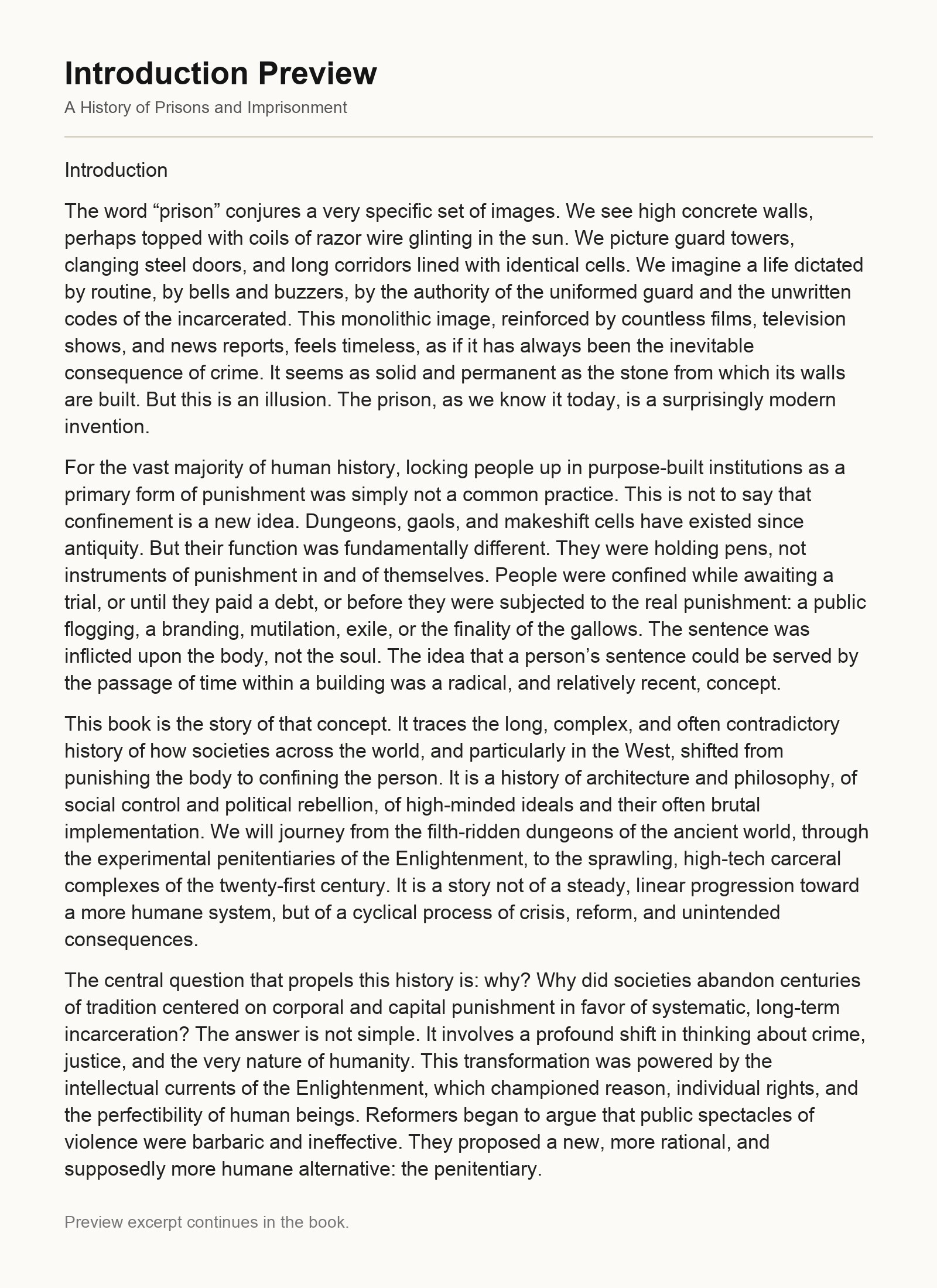
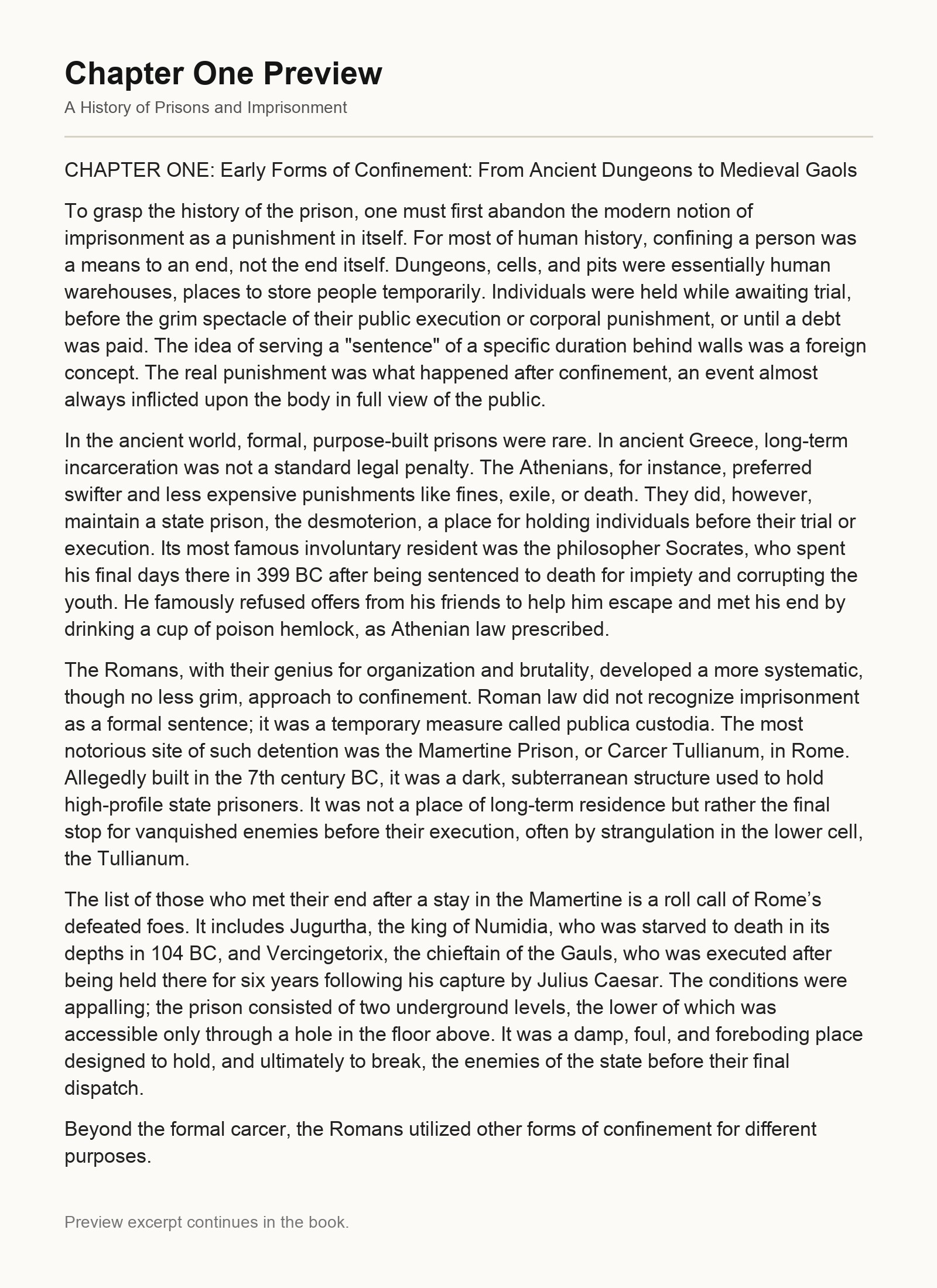
This book offers a sweeping journey through the history of imprisonment, tracing how societies have moved from temporary holding dungeons to the massive prison complexes of today. Readers will explore the origins of confinement in ancient Greece and Rome, the medieval gaols run for profit, and the shift toward seeing incarceration itself as punishment that began with Enlightenment thinkers like Beccaria and Howard. The narrative follows the birth of the penitentiary in America, contrasting the Pennsylvania System’s solitary reflection with the Auburn System’s silent labor, and examines how Jeremy Bentham’s Panopticon shaped modern surveillance ideals.
The work delves into the global spread of the prison model, showing how European nations adapted American designs, how penal colonies in Australia and Devil’s Island served as dumping grounds for unwanted populations, and how debtors’ prisons reflected class‑based coercion. It also confronts the brutal realities of wartime prison camps like Andersonville and Elmira, the post‑Civil War convict lease system that re‑enslaved African Americans, and the totalitarian extremes of the Soviet Gulag and Nazi concentration camps, revealing how the prison can be twisted into an instrument of terror and exploitation.
Moving into the modern era, the book analyzes the rise of the medical model of rehabilitation, the Attica uprising that ignited prisoners’ rights activism, and the War on Drugs that fueled mass incarceration and stark racial disparities. It examines the hidden experiences of women behind bars, the expansion of private, for‑profit prisons, and the ethical and psychological debates surrounding long‑term solitary confinement and supermax facilities. Readers will also encounter alternative approaches, notably the Scandinavian emphasis on normality and dynamic security, which challenge prevailing assumptions about punishment.
Finally, the volume looks toward the future, discussing decarceration efforts, problem‑solving courts, electronic monitoring, restorative justice, and the ongoing debate over whether the prison itself can be reformed or must be abolished. By the end, readers will have a deep, nuanced understanding of how prisons reflect broader social, economic, and political forces, and they will be equipped to think critically about justice, reform, and the possibilities for a more humane response to crime.
What You'll Find Inside:
- The book traces how imprisonment evolved from temporary holding pens to a primary form of punishment, examining the philosophical shift from punishing the body to reforming the soul during the Enlightenment.
- It compares the competing Pennsylvania System (solitary confinement for repentance) and Auburn System (congregate labor and silence) that shaped early American penitentiaries.
- The text analyzes how totalitarian regimes like the Soviet Gulag and Nazi concentration camps perverted imprisonment into tools of terror, slave labor, and genocide.
- It examines how race, class, and gender have influenced imprisonment patterns, from debtors' prisons to the convict lease system and modern racial disparities in mass incarceration.
- The book concludes with contemporary debates on solitary confinement, private prisons, Scandinavian models, and growing movements toward decarceration and alternatives to incarceration.
Who's It For:
This comprehensive historical analysis will benefit students and scholars of criminology, history, sociology, and criminal justice seeking to understand the evolution of punishment systems. It also provides valuable insights for policymakers, criminal justice professionals, and activists working on prison reform, mass incarceration, and alternatives to detention. General readers interested in social justice, human rights, and the societal implications of incarceration will find the narrative both informative and thought-provoking.
Table of Contents:
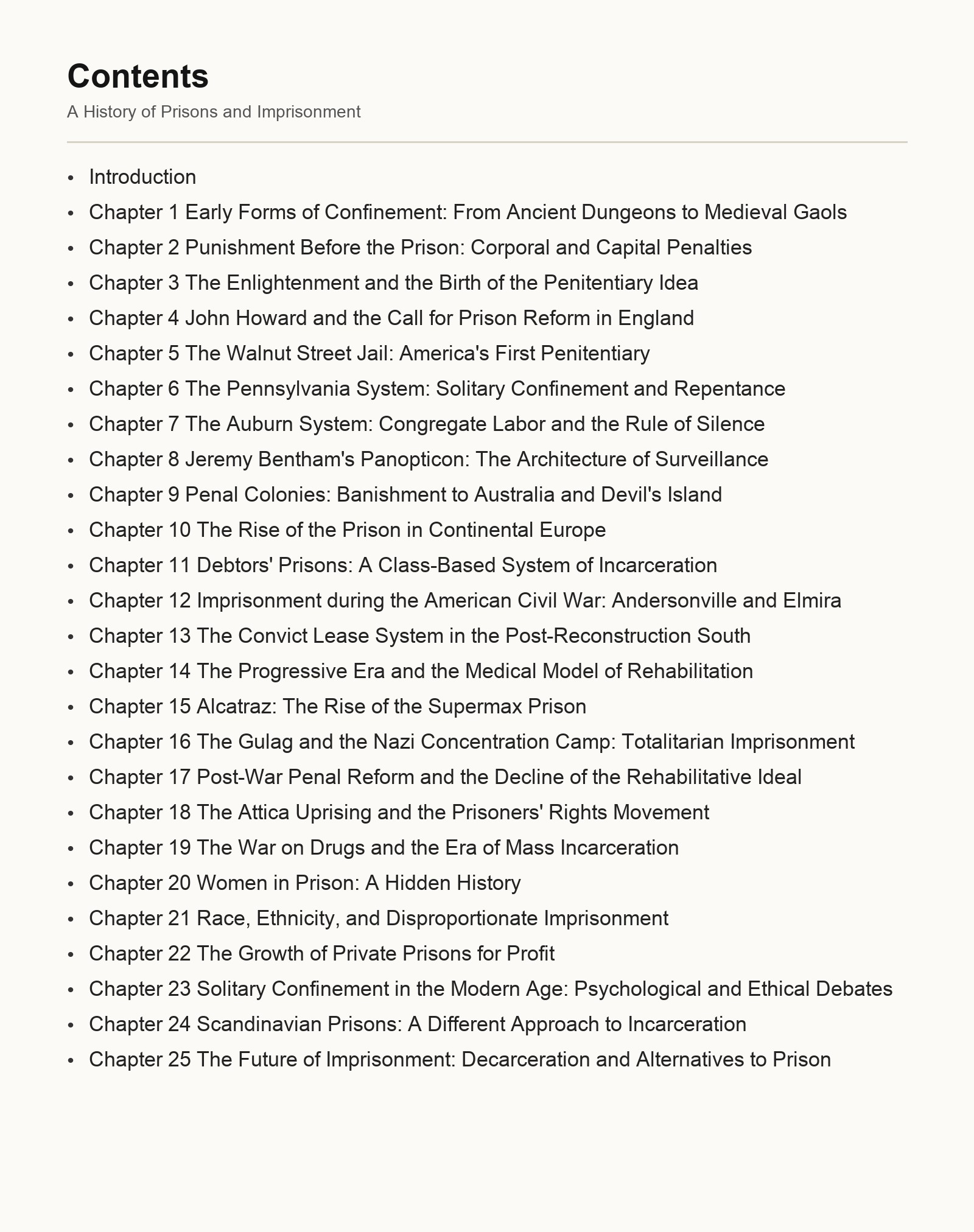
- Introduction
- Chapter 1 Early Forms of Confinement: From Ancient Dungeons to Medieval Gaols
- Chapter 2 Punishment Before the Prison: Corporal and Capital Penalties
- Chapter 3 The Enlightenment and the Birth of the Penitentiary Idea
- Chapter 4 John Howard and the Call for Prison Reform in England
- Chapter 5 The Walnut Street Jail: America's First Penitentiary
- Chapter 6 The Pennsylvania System: Solitary Confinement and Repentance
- Chapter 7 The Auburn System: Congregate Labor and the Rule of Silence
- Chapter 8 Jeremy Bentham's Panopticon: The Architecture of Surveillance
- Chapter 9 Penal Colonies: Banishment to Australia and Devil's Island
- Chapter 10 The Rise of the Prison in Continental Europe
- Chapter 11 Debtors' Prisons: A Class-Based System of Incarceration
- Chapter 12 Imprisonment during the American Civil War: Andersonville and Elmira
- Chapter 13 The Convict Lease System in the Post-Reconstruction South
- Chapter 14 The Progressive Era and the Medical Model of Rehabilitation
- Chapter 15 Alcatraz: The Rise of the Supermax Prison
- Chapter 16 The Gulag and the Nazi Concentration Camp: Totalitarian Imprisonment
- Chapter 17 Post-War Penal Reform and the Decline of the Rehabilitative Ideal
- Chapter 18 The Attica Uprising and the Prisoners' Rights Movement
- Chapter 19 The War on Drugs and the Era of Mass Incarceration
- Chapter 20 Women in Prison: A Hidden History
- Chapter 21 Race, Ethnicity, and Disproportionate Imprisonment
- Chapter 22 The Growth of Private Prisons for Profit
- Chapter 23 Solitary Confinement in the Modern Age: Psychological and Ethical Debates
- Chapter 24 Scandinavian Prisons: A Different Approach to Incarceration
- Chapter 25 The Future of Imprisonment: Decarceration and Alternatives to Prison
Author:
Published By:
Date Published:
May 17, 2026
Type:
Nonfiction
Language:
English
Also Available In:
German, Spanish, French, Italian, Dutch, Portuguese
Word Count:
48,279 words
Reading Time:
3 hours 23 minutes
Sample:
Order:
Order A History of Prisons and Imprisonment (Hardcover) on MixCache.com:
Buy NowPrint copy is made to order and ships worldwide. Includes the ebook free, ready to read instantly.
$5 account credit for all new MixCache.com accounts, usable toward any ebook purchase!*