
Browse by Category
Fiction
- Action & Adventure
- African American
- Anthologies
- Children's Fiction
- Classics
- Comics & Graphic Novels
- Coming of Age
- Contemporary
- Cultural & Regional
- Drama
- Erotica
- Fantasy
- General
- Historical Fiction
- Horror
- Humor & Satire
- Literary Fiction
- Mystery, Thriller & Suspense
- Poetry
- Religious & Inspirational
- Romance
- Science Fiction
- Short Stories
- War & Military
- Westerns
- Women's Fiction
- Young Adult
Non-Fiction
- Antiques & Collectibles
- Arts & Photography
- Biographies & Memoirs
- Business & Money
- Children's Non-Fiction
-
Computers & Technology
- Artificial Intelligence
- Computer Science
- Cybersecurity & Cryptography
- Data Science & Analytics
- Databases & Big Data
- Game Development & Design
- General
- Hardware & DIY
- Mobile App Development
- Networking & Cloud Computing
- Operating Systems
- Programming
- Robotics
- Software
- Software Engineering
- User Experience (UX) & Design
- Web Development & Design
- Cooking, Food & Wine
- Crafts, Hobbies & Home
- Education & Teaching
- Engineering
- General
- Health, Fitness & Dieting
-
History
- African History
- African History - North Africa
- African History - Sub-Saharan Africa
- American History
- American History - 20th Century
- American History - Civil War
- American History - Colonial Period
- Ancient History
- Asian History
- Asian History - China
- Asian History - India
- Asian History - Japan
- Asian History - Southeast Asia
- European History
- European History - Ancient Greece
- European History - Ancient Rome
- European History - Medieval
- European History - Modern
- European History - Renaissance
- General
- Middle Eastern History
- Military History
- Military History - Aviation
- Military History - Naval
- Social & Cultural History
- World History
- Humor & Entertainment
- Industrial Technology
- Language Learning
- Law
- LGBTQ+ Non-Fiction
- Literary Criticism
- Medical Books
- Parenting & Relationships
- Philosophy
- Politics & Social Sciences
- Reference
- Religion & Spirituality
-
Science & Math
- Agricultural Sciences
- Astronomy & Space Science
- Behavioral Sciences
- Biological Sciences
- Botany & Plant Science
- Chemistry
- Earth Sciences
- Engineering - Chemical
- Engineering - Civil
- Engineering - Electrical
- Engineering - Mechanical
- Environment
- General
- Geology
- Mathematics
- Nature & Ecology
- Oceanography
- Paleontology
- Physics
- Statistics
- Self-Help
- Sports & Outdoors
- Study Aids
- Sustainability & Green Living
- Textbooks
- Transportation
- Travel
- True Crime
- Urban Planning & Development
- Veterinary Medicine
- Writing & Publishing
Jump to Section
MixCache.com Total Access
Unlimited reading and audiobooks for every book published by MixCache.com.
Included titles carry the MTA badge.
Learn more →
Malta's Crossroads: A Mediterranean Island's Imperial Legacy
MTA
From Phoenician Traders to British Naval Base
About this book:
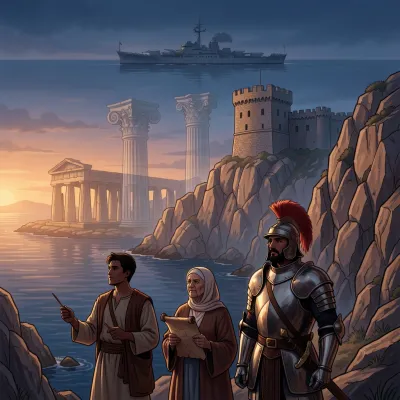
Malta’s strategic position at the heart of the Mediterranean made it a prized waypoint from prehistoric times, first settled by Neolithic temple builders and later colonized by Phoenician traders around 700 BC, who introduced writing and established Melite (Mdina). The island fell under Carthaginian influence, was seized by Rome in 218 BC, and remained a Romanized province until the Byzantine era, after which Arab conquest in 870 AD left a lasting linguistic and cultural imprint. Norman and Aragonese rulers integrated Malta into European feudalism, while the Knights of St. John, granted the islands by Charles V in 1530, transformed Malta into a formidable fortress, withstanding the Ottoman Great Siege of 1565 and ushering in a Baroque golden age of art, architecture, and maritime power that lasted until the Order’s decline in the late 18th century.
The French occupation under Napoleon in 1798 was brief but brutal, sparking a Maltese rebellion that led to British protection in 1800 and formal crown colony status by 1813. During the Victorian era Malta became a vital British naval base and coaling station, its importance magnified by the opening of the Suez Canal in 1869, which turned the island into a “Mediterranean Gibraltar” of extensive fortifications and imperial infrastructure. In World War I Malta served as the “Nurse of the Mediterranean,” caring for thousands of wounded Allied soldiers, while the interwar years saw rising Maltese nationalism, language struggles, and limited self‑governance that was suspended in 1933. World War II brought a devastating siege; Malta’s endurance earned the George Cross in 1942 and cemented its reputation for heroic resistance against Axis powers.
After the war, Malta embarked on reconstruction, gained responsible government in 1947, achieved full independence in 1964, and became a republic in 1974. The British military withdrawal in 1979 prompted a policy of neutrality and non‑aligned diplomacy during the Cold War, alongside economic diversification into tourism, finance, and manufacturing. Malta joined the European Union in 2004 and adopted the euro in 2007, confronting 21st‑century challenges such as irregular migration, environmental sustainability, and the need for balanced development while retaining its distinct Maltese identity rooted in a layered heritage of Semitic, Romance, and British influences. Throughout millennia, the island’s outsized impact has stemmed from its geographic crossroads, resilient populace, and ability to adapt successive imperial legacies into a unique, enduring national story.
What You'll Find Inside:
- Malta's central Mediterranean location made it a strategic prize for empires from Phoenician traders to the British Crown.
- The Knights of St. John turned Malta into a formidable fortress, epitomized by the heroic Great Siege of 1565 against Ottoman forces.
- British rule transformed Malta into a vital naval base and coaling station, crucial for imperial communications and both World Wars.
- WWII earned Malta the George Cross for civilian resilience, cementing its legacy as the 'Nurse of the Mediterranean'.
- After independence, Malta diversified its economy, joined the EU, and now confronts modern challenges like migration and sustainable development.
Who's It For:
This book is ideal for history enthusiasts, university students of Mediterranean or imperial studies, travelers seeking a deeper understanding of Malta’s past, and professionals interested in how a small island’s geopolitical location shaped global events across millennia.
Table of Contents:
- Introduction
- Chapter 1 Ancient Mariners and Island Origins: Malta's First Inhabitants and Phoenician Arrival
- Chapter 2 Carthage and Rome: Malta's Punic Wars and Integration into the Roman Empire
- Chapter 3 Byzantine Stronghold and Arab Conquest: Malta's Transition and Cultural Infusion
- Chapter 4 Norman Knights and Swabian Rule: Malta in the Medieval European Tapestry
- Chapter 5 The Aragonese Crown and Sicilian Ties: Malta's Feudal Era and Mediterranean Politics
- Chapter 6 The Knights of St. John: Arrival and the Building of a Fortress Island
- Chapter 7 The Great Siege of 1565: Malta's Defining Moment Against Ottoman Power
- Chapter 8 A Baroque Flourish: The Knights' Legacy in Art, Architecture, and Society
- Chapter 9 Naval Prowess and Mediterranean Dominance: The Knights as a Maritime Force
- Chapter 10 Decline and Discontent: The Later Years of the Order of St. John
- Chapter 11 Napoleon's Interlude: French Occupation and Maltese Resistance
- Chapter 12 British Protectorate to Crown Colony: Malta Enters a New Imperial Era
- Chapter 13 The Victorian Era: Malta as a Strategic Naval Base and Coaling Station
- Chapter 14 Imperial Infrastructure: Building the Suez Canal and Malta's Enhanced Role
- Chapter 15 A Mediterranean Gibraltar: Malta's Fortifications and Military Significance
- Chapter 16 World War I: Malta as the "Nurse of the Mediterranean"
- Chapter 17 Interwar Years: Political Awakening and the Quest for Self-Governance
- Chapter 18 World War II: The Siege of Malta and Its Enduring Heroism
- Chapter 19 Post-War Reconstruction and the Road to Independence
- Chapter 20 From Empire to Republic: Malta's New Identity on the Global Stage
- Chapter 21 Cold War Crossroads: Malta's Neutrality and Non-Aligned Diplomacy
- Chapter 22 Economic Diversification: Tourism, Finance, and Industry in Modern Malta
- Chapter 23 European Union Membership: Integrating into a New Geopolitical Bloc
- Chapter 24 Contemporary Challenges: Migration, Environment, and Sustainable Development
- Chapter 25 Malta's Enduring Legacy: A Small Island's Outsized Impact on History
Author:
Published By:
Date Published:
July 19, 2026
Type:
Nonfiction
Language:
English
Word Count:
38,298 words
Reading Time:
2 hours 41 minutes
Sample:
MixCache.com Total Access
Get unlimited access to this book + all books published by MixCache.com for $11.99/month
Subscribe to MTAOr purchase this book individually below
Order:
Buy the Malta's Crossroads: A Mediterranean Island's Imperial Legacy ebook on MixCache.com:
Buy Now
Full ebook will be available immediately
- read online or download as a PDF file.
$5 account credit for all new MixCache.com accounts, usable toward any ebook purchase!*



Ratings & Reviews
Ask Questions About This Book
Have a question about the content? Ask our AI assistant!
Start by asking a question about "Malta's Crossroads: A Mediterranean Island's Imperial Legacy"
Example: "Does this book mention William Shakespeare?"
Thinking...