Browse by Category
Fiction
- Action & Adventure
- African American
- Anthologies
- Children's Fiction
- Classics
- Comics & Graphic Novels
- Coming of Age
- Contemporary
- Cultural & Regional
- Drama
- Erotica
- Fantasy
- General
- Historical Fiction
- Horror
- Humor & Satire
- Literary Fiction
- Mystery, Thriller & Suspense
- Poetry
- Religious & Inspirational
- Romance
- Science Fiction
- Short Stories
- War & Military
- Westerns
- Women's Fiction
- Young Adult
Non-Fiction
- Antiques & Collectibles
- Arts & Photography
- Biographies & Memoirs
- Business & Money
- Children's Non-Fiction
-
Computers & Technology
- Artificial Intelligence
- Computer Science
- Cybersecurity & Cryptography
- Data Science & Analytics
- Databases & Big Data
- Game Development & Design
- General
- Hardware & DIY
- Mobile App Development
- Networking & Cloud Computing
- Operating Systems
- Programming
- Robotics
- Software
- Software Engineering
- User Experience (UX) & Design
- Web Development & Design
- Cooking, Food & Wine
- Crafts, Hobbies & Home
- Education & Teaching
- Engineering
- General
- Health, Fitness & Dieting
-
History
- African History
- African History - North Africa
- African History - Sub-Saharan Africa
- American History
- American History - 20th Century
- American History - Civil War
- American History - Colonial Period
- Ancient History
- Asian History
- Asian History - China
- Asian History - India
- Asian History - Japan
- Asian History - Southeast Asia
- European History
- European History - Ancient Greece
- European History - Ancient Rome
- European History - Medieval
- European History - Modern
- European History - Renaissance
- General
- Middle Eastern History
- Military History
- Military History - Aviation
- Military History - Naval
- Social & Cultural History
- World History
- Humor & Entertainment
- Industrial Technology
- Language Learning
- Law
- LGBTQ+ Non-Fiction
- Literary Criticism
- Medical Books
- Parenting & Relationships
- Philosophy
- Politics & Social Sciences
- Reference
- Religion & Spirituality
-
Science & Math
- Agricultural Sciences
- Astronomy & Space Science
- Behavioral Sciences
- Biological Sciences
- Botany & Plant Science
- Chemistry
- Earth Sciences
- Engineering - Chemical
- Engineering - Civil
- Engineering - Electrical
- Engineering - Mechanical
- Environment
- General
- Geology
- Mathematics
- Nature & Ecology
- Oceanography
- Paleontology
- Physics
- Statistics
- Self-Help
- Sports & Outdoors
- Study Aids
- Sustainability & Green Living
- Textbooks
- Transportation
- Travel
- True Crime
- Urban Planning & Development
- Veterinary Medicine
- Writing & Publishing
Jump to Section
MixCache.com Total Access
Unlimited reading and audiobooks for every book published by MixCache.com.
Included titles carry the MTA badge.
Learn more →
The Secret Life of Fungi
MTA
Unlocking Earth's Hidden Networks
About this book:
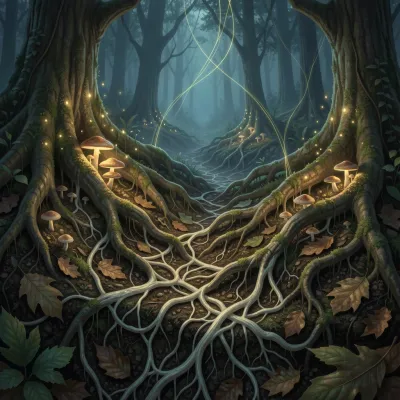
"The Secret Life of Fungi: Unlocking Earth's Hidden Networks" unveils the profound and multifaceted role of fungi in shaping ecosystems, human health, and technological innovation. The book begins by introducing fungi as neither plants nor animals but as a distinct kingdom of heterotrophic organisms with chitinous cell walls, highlighting their ancient evolutionary history dating back over 900 million years. Central to their ecological function is the mycelial network, the extensive underground web of hyphae that acts as Earth’s master recycler, breaking down organic matter and cycling essential nutrients like carbon and nitrogen. Mycorrhizal fungi further exemplify this interdependence, forming symbiotic relationships with plants to exchange nutrients and water, while also enabling the "Wood Wide Web," a subterranean communication system linking entire forests. The book underscores that fungi are indispensable architects of soil fertility, climate regulation, and biodiversity, yet remain understudied and underprotected.
Beyond ecology, fungi have revolutionized industries and medicine. Their metabolic versatility has yielded life-saving compounds like penicillin and statins, while the resurgence of research into psilocybin has illuminated their potential in treating mental health disorders. Chapters explore their roles in fermentation—producing bread, beer, and other foods—and their use as edible delicacies, from truffles to shiitake. Culturally, fungi have inspired artistic expressions and folklore, symbolizing transformation and mystery, and modern innovations like mycelium-based materials seek to replace plastics and synthetic packaging. However, pathogenic fungi such as those causing crop blights or human infections remind readers of their dual nature as both allies and adversaries in ecological and human systems.
The book also examines fungi’s adaptability in extreme environments, such as deserts, polar regions, and radioactive sites, showcasing their survival mechanisms and potential in bioremediation to detoxify pollutants and heavy metals. Their role in addressing climate change is discussed through carbon sequestration and their vulnerability to rising temperatures and habitat loss. Conservation efforts are critical, as fungi face threats from deforestation, pollution, and overharvesting, yet lack adequate legal protections compared to plants and animals. Citizen science plays an expanding role in documenting fungal diversity and conservation, as the book emphasizes the urgency of protecting these organisms to maintain ecosystem stability and unlock future discoveries.
In concluding, the author advocates for a "mycelial perspective" to reimagine humanity’s place within nature—not as separate dominators but as interconnected contributors to a web of life. This perspective, derived from studying fungi’s collaborative networks and cyclical processes, encourages sustainable practices and humility in addressing global challenges like climate change and biodiversity loss. By recognizing fungi’s hidden yet fundamental roles, the book argues, we can foster a more resilient, informed relationship with the planet, ensuring their preservation and leveraging their potential for societal and environmental wellness.
What You'll Find Inside:
- Discover how fungi diverged from animals nearly a billion years ago and played a crucial role in making Earth's continents habitable for plants by breaking down rock and forming the first soils.
- Explore the hidden 'Wood Wide Web' - vast fungal networks that connect trees underground, enabling them to share nutrients, water, and even warning signals through mycorrhizal associations.
- Learn how fungi serve as Earth's master recyclers, breaking down tough organic materials like lignin and cellulose to drive global nutrient cycles and prevent ecological collapse from dead matter accumulation.
- Uncover fungi's dual nature as both life-saving pharmaceutical producers (penicillin, statins) and emerging medical allies (psilocybin for depression) while also understanding their pathogenic threats.
- Investigate fungi's remarkable applications beyond ecology - from sustainable mycelium-based materials and bioremediation of pollutants to their profound influence on human culture, art, and consciousness throughout history.
Who's It For:
This book is ideal for curious general readers, nature enthusiasts, and amateur mycologists seeking to understand fungi's profound influence on Earth's ecosystems and human civilization. Students and professionals in biology, ecology, environmental science, or medicine will find valuable interdisciplinary connections, while anyone interested in sustainability, innovative solutions to environmental challenges, or the hidden interconnectedness of life will appreciate the book's comprehensive yet accessible exploration.
Table of Contents:
- Introduction: Unveiling the Mycelial Veil
- Chapter 1: The Ancient Kingdom: A Brief History of Fungi
- Chapter 2: What Even Are Fungi? Defining a Kingdom of Life
- Chapter 3: The Hidden World Beneath: Exploring Mycelial Networks
- Chapter 4: Spore Dispersal: The Invisible Journey
- Chapter 5: Fungi as Decomposers: Earth's Master Recyclers
- Chapter 6: Mycorrhizal Magic: The Symbiotic Dance with Plants
- Chapter 7: Lichens: Pioneers of the Planet
- Chapter 8: Endophytes: Fungi Living Within
- Chapter 9: Fungi in the Soil Food Web: Tiny Architects of Fertility
- Chapter 10: The Alchemists of the Forest: Fungi and Nutrient Cycling
- Chapter 11: Psilocybin and Beyond: Fungi in Medicine and Mind
- Chapter 12: From Penicillin to Statins: Fungi as Pharmaceutical Factories
- Chapter 13: Fungi in Fermentation: Bread, Beer, and Beyond
- Chapter 14: The Edible Delights: A Culinary Journey Through Fungi
- Chapter 15: The Dark Side: Pathogenic Fungi and Disease
- Chapter 16: Fungi as Biocontrol Agents: A Natural Defense
- Chapter 17: Bioremediation: Fungi Cleaning Up Our Mess
- Chapter 18: Fungi and Climate Change: Unexpected Allies and Threats
- Chapter 19: The Wood Wide Web: Fungal Communication Networks
- Chapter 20: Fungal Adaptations: Surviving Extremes
- Chapter 21: The Art and Culture of Fungi: Inspirations Throughout History
- Chapter 22: Citizen Science and Mycology: Exploring Fungi Together
- Chapter 23: The Future of Fungi: Innovation and Discovery
- Chapter 24: Protecting the Kingdom: Conservation of Fungal Biodiversity
- Chapter 25: A Mycelial Perspective: Rethinking Our Place on Earth
Author:
Published By:
Date Published:
July 12, 2026
Type:
Nonfiction
Language:
English
Word Count:
39,000 words
Reading Time:
2 hours 44 minutes
Sample:
Order:
Order The Secret Life of Fungi (Paperback) on MixCache.com:
Buy NowPrint copy is made to order and ships worldwide. Includes the ebook free, ready to read instantly.
$5 account credit for all new MixCache.com accounts, usable toward any ebook purchase!*