Browse by Category
Fiction
- Action & Adventure
- African American
- Anthologies
- Children's Fiction
- Classics
- Comics & Graphic Novels
- Coming of Age
- Contemporary
- Cultural & Regional
- Drama
- Erotica
- Fantasy
- General
- Historical Fiction
- Horror
- Humor & Satire
- Literary Fiction
- Mystery, Thriller & Suspense
- Poetry
- Religious & Inspirational
- Romance
- Science Fiction
- Short Stories
- War & Military
- Westerns
- Women's Fiction
- Young Adult
Non-Fiction
- Antiques & Collectibles
- Arts & Photography
- Biographies & Memoirs
- Business & Money
- Children's Non-Fiction
-
Computers & Technology
- Artificial Intelligence
- Computer Science
- Cybersecurity & Cryptography
- Data Science & Analytics
- Databases & Big Data
- Game Development & Design
- General
- Hardware & DIY
- Mobile App Development
- Networking & Cloud Computing
- Operating Systems
- Programming
- Robotics
- Software
- Software Engineering
- User Experience (UX) & Design
- Web Development & Design
- Cooking, Food & Wine
- Crafts, Hobbies & Home
- Education & Teaching
- Engineering
- General
- Health, Fitness & Dieting
-
History
- African History
- African History - North Africa
- African History - Sub-Saharan Africa
- American History
- American History - 20th Century
- American History - Civil War
- American History - Colonial Period
- Ancient History
- Asian History
- Asian History - China
- Asian History - India
- Asian History - Japan
- Asian History - Southeast Asia
- European History
- European History - Ancient Greece
- European History - Ancient Rome
- European History - Medieval
- European History - Modern
- European History - Renaissance
- General
- Middle Eastern History
- Military History
- Military History - Aviation
- Military History - Naval
- Social & Cultural History
- World History
- Humor & Entertainment
- Industrial Technology
- Language Learning
- Law
- LGBTQ+ Non-Fiction
- Literary Criticism
- Medical Books
- Parenting & Relationships
- Philosophy
- Politics & Social Sciences
- Reference
- Religion & Spirituality
-
Science & Math
- Agricultural Sciences
- Astronomy & Space Science
- Behavioral Sciences
- Biological Sciences
- Botany & Plant Science
- Chemistry
- Earth Sciences
- Engineering - Chemical
- Engineering - Civil
- Engineering - Electrical
- Engineering - Mechanical
- Environment
- General
- Geology
- Mathematics
- Nature & Ecology
- Oceanography
- Paleontology
- Physics
- Statistics
- Self-Help
- Sports & Outdoors
- Study Aids
- Sustainability & Green Living
- Textbooks
- Transportation
- Travel
- True Crime
- Urban Planning & Development
- Veterinary Medicine
- Writing & Publishing
Jump to Section
MixCache.com Total Access
Unlimited reading and audiobooks for every book published by MixCache.com.
Included titles carry the MTA badge.
Learn more →
Education In Bosnia and Herzegovina
MTA
A Comprehensive Overview from Early Childhood to Higher Education
About this book:
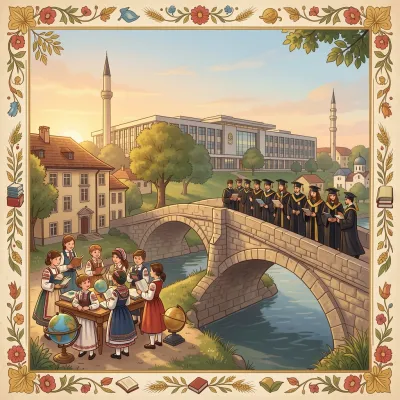
The education system in Bosnia and Herzegovina is shaped by its complex post-war political structure, established by the Dayton Peace Agreement. This decentralized framework, dividing the country into two entities (the Federation of Bosnia and Herzegovina and the Republika Srpska), the Brčko District, and ten cantons within the Federation, results in significant variations in governance, curriculum, and funding across regions. The system spans early childhood through higher education, with each level influenced by ethnic identities and resource disparities. Historical influences, including Ottoman and Austro-Hungarian periods, as well as the post-1990s war reconstruction, have left lasting impacts, such as the "two schools under one roof" phenomenon, where children from different ethnic backgrounds attend separate classes in the same institutions. International cooperation and donor aid have been pivotal in rebuilding infrastructure and harmonizing educational standards, particularly aligning with the Bologna Process in higher education.
Key challenges include the fragmentation of curricula and administrative practices, leading to inconsistencies in educational quality and equity. The lack of a unified national strategy impedes the development of common standards, complicating student mobility and fair resource distribution. Brain drain in higher education and the emigration of skilled professionals further weaken the system, while underfunding limits access to modern facilities and teacher training. Inclusive education for students with disabilities and marginalized groups, such as the Roma community, remains a work in progress, requiring specialized support and resources. Curriculum reform efforts aim to balance cultural identity with European standards, but debates over historical narratives and language instruction continue to create tensions. Vocational education faces hurdles in aligning with labor market demands, and the digital divide between urban and rural areas hinders equitable access to technology-enhanced learning.
Despite these obstacles, there are prospects for reform. Strengthening inter-entity and inter-cantonal cooperation could lead to harmonized curricula and quality assurance mechanisms, while sustained investment in teacher professionalization, infrastructure, and digital integration can enhance learning outcomes. The Brčko District serves as a model for integrated, multi-ethnic education. Efforts to combat brain drain focus on improving academic salaries, research opportunities, and industry partnerships. Vocational training is expanding to meet labor market needs, and lifelong learning initiatives aim to equip adults with digital and entrepreneurial skills. Future directions emphasize fostering inclusivity, leveraging technology, and aligning with European educational frameworks to prepare students for global competitiveness and social cohesion.
The system’s evolution reflects a tension between preserving cultural identity and pursuing national unity and European integration. Ongoing reforms seek to address systemic inequities, promote collaborative governance, and ensure that education serves as a catalyst for development and reconciliation. By prioritizing equity, quality, and adaptability, Bosnia and Herzegovina aims to build a resilient educational framework that transcends division and empowers all citizens for the future.
What You'll Find Inside:
- Explore the historical evolution of education in Bosnia and Herzegovina, from Ottoman and Austro-Hungarian influences to the impact of 1990s conflict on the current system.
- Understand the complex, multi-layered governance structure affecting all educational levels, including the roles of state, entity, cantonal, and district authorities.
- Examine challenges and ongoing reforms in inclusive education, minority rights, and efforts to overcome post-war ethnic segregation in schools.
- Investigate the role of international cooperation and technology in shaping modern educational practices and addressing systemic issues like brain drain and quality assurance.
- Discover future directions for educational reform, focusing on harmonization, vocational training, and strategies to enhance equity, quality, and European integration.
Who's It For:
This book is essential for policymakers, educators, researchers, and international development professionals interested in the unique socio-political and educational dynamics of Bosnia and Herzegovina. It offers valuable insights for those working on post-conflict education reconstruction, inclusive schooling models, and European integration strategies. Students and academics studying Southeastern European education systems or comparative education will also find it highly informative.
Table of Contents:
- Introduction
- Chapter 1: Historical Context of Education in Bosnia and Herzegovina
- Chapter 2: The Educational System Framework
- Chapter 3: Early Childhood Education: Nurseries and Kindergartens
- Chapter 4: Primary Education: Structure and Curriculum
- Chapter 5: Secondary Education: General and Vocational Schools
- Chapter 6: Higher Education Landscape: Universities and Colleges
- Chapter 7: Educational Governance and Administration
- Chapter 8: Funding and Financing of Education
- Chapter 9: Curriculum Development and Reform
- Chapter 10: Teacher Training and Professional Development
- Chapter 11: Inclusive Education for Students with Special Needs
- Chapter 12: Minority Rights and Education
- Chapter 13: Language of Instruction and Multilingualism
- Chapter 14: Impact of Conflict on the Education System
- Chapter 15: Post-War Reconstruction and Educational Challenges
- Chapter 16: International Cooperation and Educational Aid
- Chapter 17: Quality Assurance in Education
- Chapter 18: Student Assessment and Evaluation
- Chapter 19: Educational Access and Equity
- Chapter 20: Brain Drain and its Impact on Higher Education
- Chapter 21: The Role of Technology in Education
- Chapter 22: Adult Education and Lifelong Learning
- Chapter 23: Challenges and Prospects for Educational Reform
- Chapter 24: Vocational Education and Training for Employment
- Chapter 25: Future Directions for Education in Bosnia and Herzegovina
Author:
Published By:
Date Published:
June 19, 2026
Type:
Nonfiction
Language:
English
Word Count:
41,938 words
Reading Time:
2 hours 56 minutes
Sample:
Order:
Order Education In Bosnia and Herzegovina (Paperback) on MixCache.com:
Buy NowPrint copy is made to order and ships worldwide. Includes the ebook free, ready to read instantly.
$5 account credit for all new MixCache.com accounts, usable toward any ebook purchase!*