Browse by Category
Fiction
- Action & Adventure
- African American
- Anthologies
- Children's Fiction
- Classics
- Comics & Graphic Novels
- Coming of Age
- Contemporary
- Cultural & Regional
- Drama
- Erotica
- Fantasy
- General
- Historical Fiction
- Horror
- Humor & Satire
- Literary Fiction
- Mystery, Thriller & Suspense
- Poetry
- Religious & Inspirational
- Romance
- Science Fiction
- Short Stories
- War & Military
- Westerns
- Women's Fiction
- Young Adult
Non-Fiction
- Antiques & Collectibles
- Arts & Photography
- Biographies & Memoirs
- Business & Money
- Children's Non-Fiction
-
Computers & Technology
- Artificial Intelligence
- Computer Science
- Cybersecurity & Cryptography
- Data Science & Analytics
- Databases & Big Data
- Game Development & Design
- General
- Hardware & DIY
- Mobile App Development
- Networking & Cloud Computing
- Operating Systems
- Programming
- Robotics
- Software
- Software Engineering
- User Experience (UX) & Design
- Web Development & Design
- Cooking, Food & Wine
- Crafts, Hobbies & Home
- Education & Teaching
- Engineering
- General
- Health, Fitness & Dieting
-
History
- African History
- African History - North Africa
- African History - Sub-Saharan Africa
- American History
- American History - 20th Century
- American History - Civil War
- American History - Colonial Period
- Ancient History
- Asian History
- Asian History - China
- Asian History - India
- Asian History - Japan
- Asian History - Southeast Asia
- European History
- European History - Ancient Greece
- European History - Ancient Rome
- European History - Medieval
- European History - Modern
- European History - Renaissance
- General
- Middle Eastern History
- Military History
- Military History - Aviation
- Military History - Naval
- Social & Cultural History
- World History
- Humor & Entertainment
- Industrial Technology
- Language Learning
- Law
- LGBTQ+ Non-Fiction
- Literary Criticism
- Medical Books
- Parenting & Relationships
- Philosophy
- Politics & Social Sciences
- Reference
- Religion & Spirituality
-
Science & Math
- Agricultural Sciences
- Astronomy & Space Science
- Behavioral Sciences
- Biological Sciences
- Botany & Plant Science
- Chemistry
- Earth Sciences
- Engineering - Chemical
- Engineering - Civil
- Engineering - Electrical
- Engineering - Mechanical
- Environment
- General
- Geology
- Mathematics
- Nature & Ecology
- Oceanography
- Paleontology
- Physics
- Statistics
- Self-Help
- Sports & Outdoors
- Study Aids
- Sustainability & Green Living
- Textbooks
- Transportation
- Travel
- True Crime
- Urban Planning & Development
- Veterinary Medicine
- Writing & Publishing
Jump to Section

Want unlimited access to all books published by MixCache.com (plus their audiobooks)? Try MixCache.com Total Access. Look for the MTA badge on book covers to identify included titles.
Access to infinite ebooks: Don't see the book you want? Suggest it and we'll create it (free!) for you from scratch with our powerful AI book writer. Then read it with MTA - besides profiting from any sales it makes!
Provincial Archaeologies: Material Past of China's Regions
MTA
Archaeological discoveries that shaped provincial histories, one province per chapter
About this book:
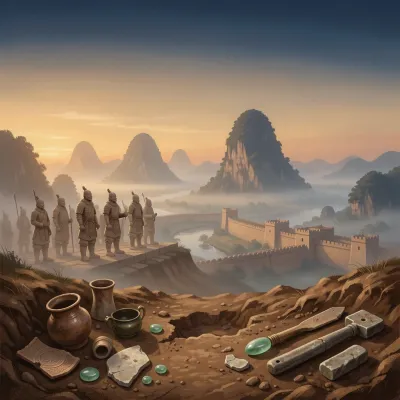
This book presents a comprehensive archaeological survey of China's provinces, using regional material records—including sites, artifacts, and burial landscapes—to construct long-term histories that move beyond traditional dynastic narratives. By treating modern provinces as analytical lenses, the volume explores how distinct ecologies, resource frontiers, and exchange corridors shaped local trajectories that both converged with and diverged from the well-known centers of power. The work synthesizes data from settlement patterns, craft production, mortuary programs, and ritual practices, utilizing scientific methods such as chemical sourcing and isotopic analysis to trace the movement of materials and people across vast distances.
The text is organized into twenty-five chapters, each dedicated to a specific province or autonomous region, alongside an introduction that establishes the methodological framework. It begins with the Central Plains of Henan, examining the foundations of early states through sites like Erlitou and the Shang capital of Anyang, before moving to Shaanxi to explore the imperial capitals and mausolea of the Zhou, Qin, and Tang dynasties. The narrative then sweeps across the eastern coast, detailing the Neolithic jade cultures of Shandong, the bronze workshops of Shanxi, and the sophisticated canal worlds and urban crafts of Jiangsu and Zhejiang.
Further chapters delve into the unique material signatures of the interior and southern regions, including the Chu aesthetics of Hunan and Hubei, the enigmatic bronze kingdoms of Sichuan, and the maritime gateways of Fujian and Guangdong. The book also covers the high-altitude adaptations of the southwest in Guizhou and Yunnan, the island frontier of Hainan, and the vast western expanses of Gansu, Qinghai, and Xinjiang, where the Silk Road facilitated profound cultural exchanges. Finally, it examines the northern frontiers of Inner Mongolia and Liaoning, highlighting the legacies of grassland polities and the powerful Liao and Jin dynasties. Ultimately, the volume argues that "China" is best understood as a mosaic of interacting places, where local worlds and regional innovations were the primary engines of historical transformation.
What You'll Find Inside:
- Regional material records reveal how local ecologies, resource frontiers, and exchange corridors shaped distinct provincial trajectories that sometimes converged with or diverged from centers of power
- Each chapter reconstructs provincial histories through settlement data, craft production evidence, mortuary programs, and ritual practices rather than fitting finds into dynastic narratives
- Artifacts are analyzed at multiple scales using chemical sourcing, metallographic studies, ceramic petrography, and isotopic analyses to trace ancient exchange networks and technological diffusion
- Chronology is treated as layered rather than linear, showing how long-term continuities and sudden ruptures (environmental shifts, political changes) re-patterned regional development over time
- Provincial material cultures acted as engines of broader transformation through phenomena like the diffusion of Chu aesthetics, southeastern maritime technologies, and northwest caravan infrastructures that stitched together Eurasian networks
Who's It For:
The book is written for archaeologists seeking comparative syntheses and for general readers curious about how objects become historical evidence. Technical terms are explained in context, and interpretive debates are presented alongside the finds that motivate them, making it accessible to both specialists and non-specialists interested in China's regional material past.
Author:
Published By:
Date Published:
June 13, 2026
Type:
Nonfiction
Language:
English
Word Count:
50,357 words
Reading Time:
3 hours 32 minutes
Sample:
Order:
Order Provincial Archaeologies: Material Past of China's Regions (Paperback) on MixCache.com:
Buy NowPrint copy is made to order and ships worldwide. Includes the ebook free, ready to read instantly.
$5 account credit for all new MixCache.com accounts, usable toward any ebook purchase!*