
Browse by Category
Fiction
- Action & Adventure
- African American
- Anthologies
- Children's Fiction
- Classics
- Comics & Graphic Novels
- Coming of Age
- Contemporary
- Cultural & Regional
- Drama
- Erotica
- Fantasy
- General
- Historical Fiction
- Horror
- Humor & Satire
- Literary Fiction
- Mystery, Thriller & Suspense
- Poetry
- Religious & Inspirational
- Romance
- Science Fiction
- Short Stories
- War & Military
- Westerns
- Women's Fiction
- Young Adult
Non-Fiction
- Antiques & Collectibles
- Arts & Photography
- Biographies & Memoirs
- Business & Money
- Children's Non-Fiction
-
Computers & Technology
- Artificial Intelligence
- Computer Science
- Cybersecurity & Cryptography
- Data Science & Analytics
- Databases & Big Data
- Game Development & Design
- General
- Hardware & DIY
- Mobile App Development
- Networking & Cloud Computing
- Operating Systems
- Programming
- Robotics
- Software
- Software Engineering
- User Experience (UX) & Design
- Web Development & Design
- Cooking, Food & Wine
- Crafts, Hobbies & Home
- Education & Teaching
- Engineering
- General
- Health, Fitness & Dieting
-
History
- African History
- African History - North Africa
- African History - Sub-Saharan Africa
- American History
- American History - 20th Century
- American History - Civil War
- American History - Colonial Period
- Ancient History
- Asian History
- Asian History - China
- Asian History - India
- Asian History - Japan
- Asian History - Southeast Asia
- European History
- European History - Ancient Greece
- European History - Ancient Rome
- European History - Medieval
- European History - Modern
- European History - Renaissance
- General
- Middle Eastern History
- Military History
- Military History - Aviation
- Military History - Naval
- Social & Cultural History
- World History
- Humor & Entertainment
- Industrial Technology
- Language Learning
- Law
- LGBTQ+ Non-Fiction
- Literary Criticism
- Medical Books
- Parenting & Relationships
- Philosophy
- Politics & Social Sciences
- Reference
- Religion & Spirituality
-
Science & Math
- Agricultural Sciences
- Astronomy & Space Science
- Behavioral Sciences
- Biological Sciences
- Botany & Plant Science
- Chemistry
- Earth Sciences
- Engineering - Chemical
- Engineering - Civil
- Engineering - Electrical
- Engineering - Mechanical
- Environment
- General
- Geology
- Mathematics
- Nature & Ecology
- Oceanography
- Paleontology
- Physics
- Statistics
- Self-Help
- Sports & Outdoors
- Study Aids
- Sustainability & Green Living
- Textbooks
- Transportation
- Travel
- True Crime
- Urban Planning & Development
- Veterinary Medicine
- Writing & Publishing
Jump to Section

Want unlimited access to all books published by MixCache.com (plus their audiobooks)? Try MixCache.com Total Access. Look for the MTA badge on book covers to identify included titles.
Access to infinite ebooks: Don't see the book you want? Suggest it and we'll create it (free!) for you from scratch with our powerful AI book writer. Then read it with MTA - besides profiting from any sales it makes!
Delhi's Political Theatre
MTA
Elections, protest culture, and the city's role in national politics
About this book:
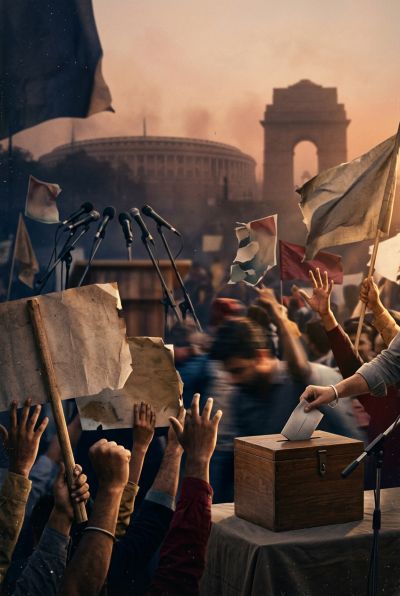
Delhi functions as a political theatre where constitutional institutions and informal street politics constantly negotiate visibility and power. The city’s geography—from the imperial grandeur of Raisina Hill to the protest sites of Jantar Mantar, Ramlila Maidan, Shaheen Bagh, and the highway borders—acts as a stage that determines who can speak, how messages are framed, and what gains national traction. Elections are meticulously engineered spectacles driven by war rooms, data analytics, microtargeting, and booth‑level mobilization, while protests serve as rehearsals of citizenship that test the limits of state response through policing, courts, and media amplification.
Major upheavals such as the 2011 Anna Hazare anti‑corruption movement, the 2012 Nirbhaya protests, the Shaheen Bagh sit‑ins against the CAA/NRC, and the year‑long farmers’ blockade of Delhi’s borders have reshaped Delhi’s political repertoire, spawning new parties like the AAP, prompting legislative reforms, and demonstrating how sustained, spatially strategic dissent can compel governmental retreat. These movements intertwine with electoral contests, where Congress, BJP, and AAP vie for dominance by blending national narratives with hyper‑local service delivery, often exploiting fault lines of religion, caste, migrant identity, and economic insecurity to mobilize vote banks.
The media, bureaucracy, and judiciary act as both amplifiers and arbiters in this theatre: television and social media turn local actions into national spectacles, the IAS, police, and municipal corporations implement (or obstruct) policy amid Centre‑state tugs‑over land, police, and public order, and the courts continually delineate the constitutional boundaries of protest, speech, and electoral fairness. Environmental crises, symbol politics, and the rise of digital publics further complicate the landscape, pointing to a future where online mobilization, AI‑driven campaigning, and evolving surveillance will continue to redefine how power is performed and challenged in India’s capital.
What You'll Find Inside:
- Delhi's political landscape as a theater where space, spectacle, and power intersect to shape national discourse
- The mechanics of Delhi's elections from grassroots mobilization to data-driven microtargeting and EVM voting
- Analysis of major protest movements including Anna Hazare's anti-corruption uprising, Nirbhaya protests, Shaheen Bagh sit-ins, and farmers' border occupations
- Examination of Delhi's unique federal tension between elected government and Union control over police, land, and public order
- How Delhi serves as a national mirror where local politics reflect and shape India's broader democratic evolution
Who's It For:
This book is essential reading for political activists, urban scholars, journalism professionals, and engaged citizens seeking to understand how Delhi's distinctive political ecosystem functions as both a battleground for national narratives and a laboratory for democratic innovation. It will particularly benefit those researching Indian politics, social movements, or electoral strategy who need concrete case studies of protest culture, campaign mechanics, and institutional-street dynamics in a capital city context.
Author:
Published By:
Date Published:
June 5, 2026
Type:
Nonfiction
Language:
English
Word Count:
47,661 words
Reading Time:
3 hours 20 minutes
Sample:
MixCache.com Total Access
Get unlimited access to this book + all books published by MixCache.com for $11.99/month
Subscribe to MTAOr purchase this book individually below
Order:
Buy the Delhi's Political Theatre ebook on MixCache.com:
Buy Now
Full ebook will be available immediately
- read online or download as a PDF file.
$5 account credit for all new MixCache.com accounts, usable toward any ebook purchase!*






Ratings & Reviews
Ask Questions About This Book
Have a question about the content? Ask our AI assistant!
Start by asking a question about "Delhi's Political Theatre"
Example: "Does this book mention William Shakespeare?"
Thinking...