
Browse by Category
Fiction
- Action & Adventure
- African American
- Anthologies
- Children's Fiction
- Classics
- Comics & Graphic Novels
- Coming of Age
- Contemporary
- Cultural & Regional
- Drama
- Erotica
- Fantasy
- General
- Historical Fiction
- Horror
- Humor & Satire
- Literary Fiction
- Mystery, Thriller & Suspense
- Poetry
- Religious & Inspirational
- Romance
- Science Fiction
- Short Stories
- War & Military
- Westerns
- Women's Fiction
- Young Adult
Non-Fiction
- Antiques & Collectibles
- Arts & Photography
- Biographies & Memoirs
- Business & Money
- Children's Non-Fiction
-
Computers & Technology
- Artificial Intelligence
- Computer Science
- Cybersecurity & Cryptography
- Data Science & Analytics
- Databases & Big Data
- Game Development & Design
- General
- Hardware & DIY
- Mobile App Development
- Networking & Cloud Computing
- Operating Systems
- Programming
- Robotics
- Software
- Software Engineering
- User Experience (UX) & Design
- Web Development & Design
- Cooking, Food & Wine
- Crafts, Hobbies & Home
- Education & Teaching
- Engineering
- General
- Health, Fitness & Dieting
-
History
- African History
- African History - North Africa
- African History - Sub-Saharan Africa
- American History
- American History - 20th Century
- American History - Civil War
- American History - Colonial Period
- Ancient History
- Asian History
- Asian History - China
- Asian History - India
- Asian History - Japan
- Asian History - Southeast Asia
- European History
- European History - Ancient Greece
- European History - Ancient Rome
- European History - Medieval
- European History - Modern
- European History - Renaissance
- General
- Middle Eastern History
- Military History
- Military History - Aviation
- Military History - Naval
- Social & Cultural History
- World History
- Humor & Entertainment
- Industrial Technology
- Language Learning
- Law
- LGBTQ+ Non-Fiction
- Literary Criticism
- Medical Books
- Parenting & Relationships
- Philosophy
- Politics & Social Sciences
- Reference
- Religion & Spirituality
-
Science & Math
- Agricultural Sciences
- Astronomy & Space Science
- Behavioral Sciences
- Biological Sciences
- Botany & Plant Science
- Chemistry
- Earth Sciences
- Engineering - Chemical
- Engineering - Civil
- Engineering - Electrical
- Engineering - Mechanical
- Environment
- General
- Geology
- Mathematics
- Nature & Ecology
- Oceanography
- Paleontology
- Physics
- Statistics
- Self-Help
- Sports & Outdoors
- Study Aids
- Sustainability & Green Living
- Textbooks
- Transportation
- Travel
- True Crime
- Urban Planning & Development
- Veterinary Medicine
- Writing & Publishing
Jump to Section
MixCache.com Total Access
Unlimited reading and audiobooks for every book published by MixCache.com.
Included titles carry the MTA badge.
Learn more →
The Yamuna and the City
MTA
River restoration, pollution challenges, and policy case studies for urban ecologists
About this book:
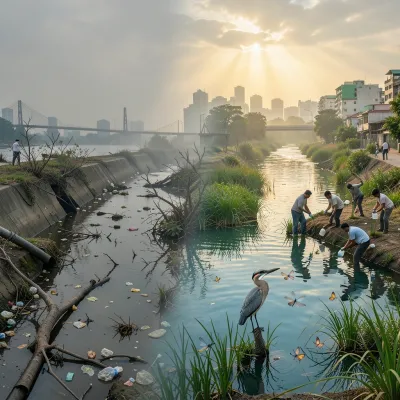
The Yamuna River, once a lifeline and cultural cornerstone of Delhi, has become a heavily polluted conduit for the city’s waste due to rapid urbanization, upstream diversions, and the construction of barrages that fragment its flow. The 22‑kilometre urban stretch receives the majority of Delhi’s untreated sewage through major drains like Najafgarh and Shahdara, compounded by industrial effluents, solid waste, and emerging pollutants. These inputs drive eutrophication, pathogen proliferation, dissolved‑oxygen crashes, and the loss of fish, bird, and wetland biodiversity, turning the river into a seasonal sewage‑bearing channel for much of the year.
Restoration attempts have centred on large‑scale engineering—interceptor sewers, sewage‑treatment‑plant upgrades, and barrage management—supported by successive Yamuna Action Plans and judicial mandates from the Supreme Court and the National Green Tribunal. Parallel efforts promote decentralized wastewater treatment, nature‑based solutions such as constructed wetlands and biodiversity parks, and floodplain rehabilitation to revive natural self‑purification and groundwater recharge. Yet progress is hindered by fragmented governance across agencies and states, inadequate sewer connectivity, power‑dependent plant operations, and continued encroachment on the floodplain for sand mining, real estate, and agriculture.
A viable recovery hinges on achieving 100 % sewer connectivity, ensuring tertiary‑level treatment at all STPs, enforcing industrial pre‑treatment, securing environmental flows, and eliminating new floodplain encroachments while restoring wetlands and biodiversity parks. Success must be measured by dissolved‑oxygen levels above 5 mg/L, BOD below 3 mg/L, fecal coliform counts under 2 500 MPN/100 ml, the return of sensitive species, and improved public health and equitable riverfront access. Ultimately, the Yamuna’s revival requires aligning infrastructure, policy, community stewardship, and climate‑resilient planning to transform the river from a polluted drain back into a living ecosystem that sustains Delhi’s ecology, culture, and well‑being.
What You'll Find Inside:
- The historical evolution of the Yamuna's relationship with Delhi from ancient settlements to modern urban challenges
- The multifaceted pollution crisis including sewage, industrial effluents, nutrients, pathogens, and emerging contaminants
- Engineering interventions like barrages, interceptor sewers, and sewage treatment plants and their limitations
- Ecological consequences and biodiversity loss affecting fish, birds, and wetland ecosystems
- Governance fragmentation, judicial interventions, and community-based restoration efforts
Who's It For:
This book is written for urban ecologists, planners, engineers, public officials, and activists who need a shared, evidence-based understanding of the Delhi Yamuna. It synthesizes monitoring data, policy reviews, engineering case studies, and community initiatives into a coherent narrative for those working to restore urban rivers.
Table of Contents:
- Introduction
- Chapter 1 The River and the Metropolis: A Historical Overview of the Yamuna in Delhi
- Chapter 2 Geomorphology and Hydrology of the Delhi Reach
- Chapter 3 Barrages and Broken Flows: Wazirabad, ITO, and Okhla
- Chapter 4 Monsoons, Droughts, and Environmental Flows
- Chapter 5 Mapping the Drains: Najafgarh, Shahdara, and Beyond
- Chapter 6 Sewage at Scale: Infrastructure, Deficits, and Leakage
- Chapter 7 Industrial Effluents and the Chemistry of Contamination
- Chapter 8 Nutrients, Algae, and the Science of Eutrophication
- Chapter 9 Pathogens, Public Health, and Riverine Risk
- Chapter 10 Trash, Foam, and Emerging Pollutants
- Chapter 11 Biodiversity in Decline: Fish, Birds, and Wetlands
- Chapter 12 Floodplains under Pressure: Sand, Real Estate, and Agriculture
- Chapter 13 Climate Change and the Future Hydro-ecology of Delhi’s Yamuna
- Chapter 14 Cultural Practices and River Rituals: Pollution and Possibility
- Chapter 15 Governance Labyrinth: Institutions, Mandates, and Fragmentation
- Chapter 16 The Yamuna Action Plans: Lessons from YAP I–III
- Chapter 17 Courts and Compliance: NGT and Supreme Court Interventions
- Chapter 18 Data for Decisions: Monitoring Networks and Citizen Science
- Chapter 19 Decentralized Wastewater Treatment and Nature-Based Solutions
- Chapter 20 Interceptor Sewers, STPs, and Upgrades: Engineering Case Studies
- Chapter 21 Restoring Wetlands: Najafgarh Jheel, Biodiversity Parks, and Beyond
- Chapter 22 Urban Design on the Riverfront: Access, Safety, and Equity
- Chapter 23 Economics of Restoration: Costs, Benefits, and Financing Models
- Chapter 24 Community Organizing and Behavior Change: Stories from the Floodplain
- Chapter 25 A Roadmap to Recovery: Scenarios, Milestones, and Metrics
Author:
Published By:
Date Published:
June 5, 2026
Type:
Nonfiction
Language:
English
Word Count:
42,813 words
Reading Time:
3 hours
Sample:
Order:
Order The Yamuna and the City (Hardcover) on MixCache.com:
Buy NowPrint copy is made to order and ships worldwide. Includes the ebook free, ready to read instantly.
$5 account credit for all new MixCache.com accounts, usable toward any ebook purchase!*


