Browse by Category
Fiction
- Action & Adventure
- African American
- Anthologies
- Children's Fiction
- Classics
- Comics & Graphic Novels
- Coming of Age
- Contemporary
- Cultural & Regional
- Drama
- Erotica
- Fantasy
- General
- Historical Fiction
- Horror
- Humor & Satire
- Literary Fiction
- Mystery, Thriller & Suspense
- Poetry
- Religious & Inspirational
- Romance
- Science Fiction
- Short Stories
- War & Military
- Westerns
- Women's Fiction
- Young Adult
Non-Fiction
- Antiques & Collectibles
- Arts & Photography
- Biographies & Memoirs
- Business & Money
- Children's Non-Fiction
-
Computers & Technology
- Artificial Intelligence
- Computer Science
- Cybersecurity & Cryptography
- Data Science & Analytics
- Databases & Big Data
- Game Development & Design
- General
- Hardware & DIY
- Mobile App Development
- Networking & Cloud Computing
- Operating Systems
- Programming
- Robotics
- Software
- Software Engineering
- User Experience (UX) & Design
- Web Development & Design
- Cooking, Food & Wine
- Crafts, Hobbies & Home
- Education & Teaching
- Engineering
- General
- Health, Fitness & Dieting
-
History
- African History
- African History - North Africa
- African History - Sub-Saharan Africa
- American History
- American History - 20th Century
- American History - Civil War
- American History - Colonial Period
- Ancient History
- Asian History
- Asian History - China
- Asian History - India
- Asian History - Japan
- Asian History - Southeast Asia
- European History
- European History - Ancient Greece
- European History - Ancient Rome
- European History - Medieval
- European History - Modern
- European History - Renaissance
- General
- Middle Eastern History
- Military History
- Military History - Aviation
- Military History - Naval
- Social & Cultural History
- World History
- Humor & Entertainment
- Industrial Technology
- Language Learning
- Law
- LGBTQ+ Non-Fiction
- Literary Criticism
- Medical Books
- Parenting & Relationships
- Philosophy
- Politics & Social Sciences
- Reference
- Religion & Spirituality
-
Science & Math
- Agricultural Sciences
- Astronomy & Space Science
- Behavioral Sciences
- Biological Sciences
- Botany & Plant Science
- Chemistry
- Earth Sciences
- Engineering - Chemical
- Engineering - Civil
- Engineering - Electrical
- Engineering - Mechanical
- Environment
- General
- Geology
- Mathematics
- Nature & Ecology
- Oceanography
- Paleontology
- Physics
- Statistics
- Self-Help
- Sports & Outdoors
- Study Aids
- Sustainability & Green Living
- Textbooks
- Transportation
- Travel
- True Crime
- Urban Planning & Development
- Veterinary Medicine
- Writing & Publishing
Jump to Section
MixCache.com Total Access
Unlimited reading and audiobooks for every book published by MixCache.com.
Included titles carry the MTA badge.
Learn more →
Air Quality and Public Health in New Delhi
MTA
Causes, health impacts, and mitigation strategies for residents and policymakers
About this book:
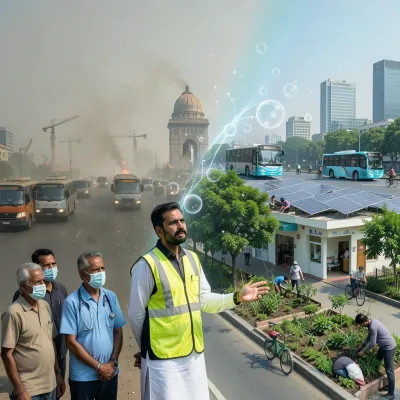
Air quality in New Delhi is shaped by a multitude of interacting sources—road transport, industry and power generation, construction and road dust, waste burning, household energy use, and seasonal agricultural residue burning—whose emissions are amplified by the city’s geography and meteorology within the Indo‑Gangetic Plain. Temperature inversions, stagnant winds, and regional transport of pollutants from neighboring states frequently trap fine particulate matter (PM2.5) and other contaminants, leading to severe pollution episodes, especially in winter and during pre‑monsoon dust storms. Effective characterization relies on a blend of regulatory monitoring networks, low‑cost sensors, satellite observations, emission inventories, and chemical transport models, which together feed the Air Quality Index and inform both public advisories and policy decisions.
Exposure to Delhi’s polluted air produces immediate health effects—respiratory irritation, asthma exacerbations, cardiovascular stress, and eye discomfort—that disproportionately affect children, older adults, pregnant people, outdoor workers, and low‑income communities. Long‑term exposure drives chronic diseases such as COPD, lung cancer, ischemic heart disease, stroke, and adverse birth outcomes, contributing to hundreds of thousands of premature deaths and millions of disability‑adjusted life years lost each year. The economic toll includes direct healthcare costs, lost productivity, reduced school attendance, and diminished tourism, while social costs manifest as eroded quality of life, heightened anxiety, and deepening inequities, as marginalized groups bear higher exposure yet have fewer resources to protect themselves.
Addressing the crisis demands a layered, multi‑sectoral strategy. Emergency frameworks like the Graded Response Action Plan provide rapid, tiered responses during severe episodes, but sustained improvement hinges on accelerating clean energy transitions (renewables, natural gas, electrification), tightening industrial and vehicular emission standards, expanding and electrifying public transport, promoting active mobility, adopting cleaner construction and waste‑management practices, and scaling up agricultural residue‑alternatives in Punjab and Haryana. Urban planning that expands green infrastructure, improves ventilation, and enforces low‑VOC building codes offers co‑benefits for heat reduction and air quality. Personal protection—well‑fitted masks, HEPA/activated carbon air purifiers, and informed behavioral choices—can reduce individual exposure, especially for vulnerable populations. Effective governance requires transparent data, strengthened inter‑state coordination via the Commission for Air Quality Management, and genuine public participation to ensure equitable, evidence‑based actions that steer Delhi toward breathable air by 2030 and beyond.
What You'll Find Inside:
- How Delhi's geography and weather patterns (Indo-Gangetic Plain topography, winter temperature inversions) trap pollutants and create severe seasonal air quality challenges.
- Detailed analysis of major pollution sources including road transport, industry/power generation, construction dust, waste burning, household energy, and cross-border agricultural residue burning.
- Comprehensive coverage of health impacts ranging from acute effects (asthma attacks, cardiovascular stress during pollution spikes) to chronic risks (heart disease, lung cancer, reduced life expectancy) across vulnerable populations.
- Evidence-based mitigation strategies at personal (masks, air purifiers), community, and policy levels including public transit expansion, cleaner fuels, industrial transitions, and urban planning with green infrastructure.
- Examination of environmental justice issues showing how pollution disproportionately affects marginalized communities, outdoor workers, and low-income residents despite their lower contribution to emissions.
Who's It For:
This book is essential for Delhi residents seeking to understand and protect themselves from air pollution, health professionals treating pollution-related illnesses, and policymakers designing effective interventions. It provides actionable insights for urban planners, environmental officers, and community organizers working toward cleaner air, while also serving as a valuable resource for researchers and students studying urban environmental health in rapidly developing cities.
Table of Contents:
- Introduction
- Chapter 1 The Air We Breathe: New Delhi in Context
- Chapter 2 Measuring Pollution: Metrics, Monitors, and Models
- Chapter 3 Weather, Geography, and Seasonality in the Indo‑Gangetic Plain
- Chapter 4 Road Transport: Congestion, Fuels, and Emissions
- Chapter 5 Industry and Power Generation
- Chapter 6 Construction, Demolition, and Road Dust
- Chapter 7 Waste Burning and the Open Fire Problem
- Chapter 8 Household Energy and Indoor–Outdoor Linkages
- Chapter 9 Agricultural Residue Burning and Regional Transport
- Chapter 10 Secondary Pollutants: Ozone and Aerosol Chemistry
- Chapter 11 Exposure Pathways: Homes, Schools, Commuting, and Work
- Chapter 12 Health Impacts I: Acute Effects and Vulnerable Groups
- Chapter 13 Health Impacts II: Chronic Disease and Life‑course Risks
- Chapter 14 Estimating the Burden: Epidemiology and Attribution Methods
- Chapter 15 Economic and Social Costs of Dirty Air
- Chapter 16 Inequities and Environmental Justice in Delhi
- Chapter 17 Communicating Risk: Forecasts, Media, and Behavior
- Chapter 18 Case Studies: Emergency Responses and Graded Action Plans
- Chapter 19 Personal Protection: Filtration, Masks, and Everyday Choices
- Chapter 20 Cleaner Indoors: Buildings, Ventilation, and IAQ Management
- Chapter 21 Mobility Transitions: Public Transit, Cycling, and Electrification
- Chapter 22 Energy and Industry Transitions: Cleaner Fuels and Technologies
- Chapter 23 Urban Planning, Green Infrastructure, and Heat–Air Quality Co‑benefits
- Chapter 24 Governance, Data Transparency, and Public Participation
- Chapter 25 Pathways to 2030 and Beyond: A Roadmap for Residents and Policymakers
Author:
Published By:
Date Published:
June 5, 2026
Type:
Nonfiction
Language:
English
Word Count:
43,661 words
Reading Time:
3 hours 3 minutes
Sample:
Order:
Order Air Quality and Public Health in New Delhi (Hardcover) on MixCache.com:
Buy NowPrint copy is made to order and ships worldwide. Includes the ebook free, ready to read instantly.
$5 account credit for all new MixCache.com accounts, usable toward any ebook purchase!*