
Browse by Category
Fiction
- Action & Adventure
- African American
- Anthologies
- Children's Fiction
- Classics
- Comics & Graphic Novels
- Coming of Age
- Contemporary
- Cultural & Regional
- Drama
- Erotica
- Fantasy
- General
- Historical Fiction
- Horror
- Humor & Satire
- Literary Fiction
- Mystery, Thriller & Suspense
- Poetry
- Religious & Inspirational
- Romance
- Science Fiction
- Short Stories
- War & Military
- Westerns
- Women's Fiction
- Young Adult
Non-Fiction
- Antiques & Collectibles
- Arts & Photography
- Biographies & Memoirs
- Business & Money
- Children's Non-Fiction
-
Computers & Technology
- Artificial Intelligence
- Computer Science
- Cybersecurity & Cryptography
- Data Science & Analytics
- Databases & Big Data
- Game Development & Design
- General
- Hardware & DIY
- Mobile App Development
- Networking & Cloud Computing
- Operating Systems
- Programming
- Robotics
- Software
- Software Engineering
- User Experience (UX) & Design
- Web Development & Design
- Cooking, Food & Wine
- Crafts, Hobbies & Home
- Education & Teaching
- Engineering
- General
- Health, Fitness & Dieting
-
History
- African History
- African History - North Africa
- African History - Sub-Saharan Africa
- American History
- American History - 20th Century
- American History - Civil War
- American History - Colonial Period
- Ancient History
- Asian History
- Asian History - China
- Asian History - India
- Asian History - Japan
- Asian History - Southeast Asia
- European History
- European History - Ancient Greece
- European History - Ancient Rome
- European History - Medieval
- European History - Modern
- European History - Renaissance
- General
- Middle Eastern History
- Military History
- Military History - Aviation
- Military History - Naval
- Social & Cultural History
- World History
- Humor & Entertainment
- Industrial Technology
- Language Learning
- Law
- LGBTQ+ Non-Fiction
- Literary Criticism
- Medical Books
- Parenting & Relationships
- Philosophy
- Politics & Social Sciences
- Reference
- Religion & Spirituality
-
Science & Math
- Agricultural Sciences
- Astronomy & Space Science
- Behavioral Sciences
- Biological Sciences
- Botany & Plant Science
- Chemistry
- Earth Sciences
- Engineering - Chemical
- Engineering - Civil
- Engineering - Electrical
- Engineering - Mechanical
- Environment
- General
- Geology
- Mathematics
- Nature & Ecology
- Oceanography
- Paleontology
- Physics
- Statistics
- Self-Help
- Sports & Outdoors
- Study Aids
- Sustainability & Green Living
- Textbooks
- Transportation
- Travel
- True Crime
- Urban Planning & Development
- Veterinary Medicine
- Writing & Publishing
Jump to Section
MixCache.com Total Access
Unlimited reading and audiobooks for every book published by MixCache.com.
Included titles carry the MTA badge.
Learn more →Stupid Little Man
About this book:


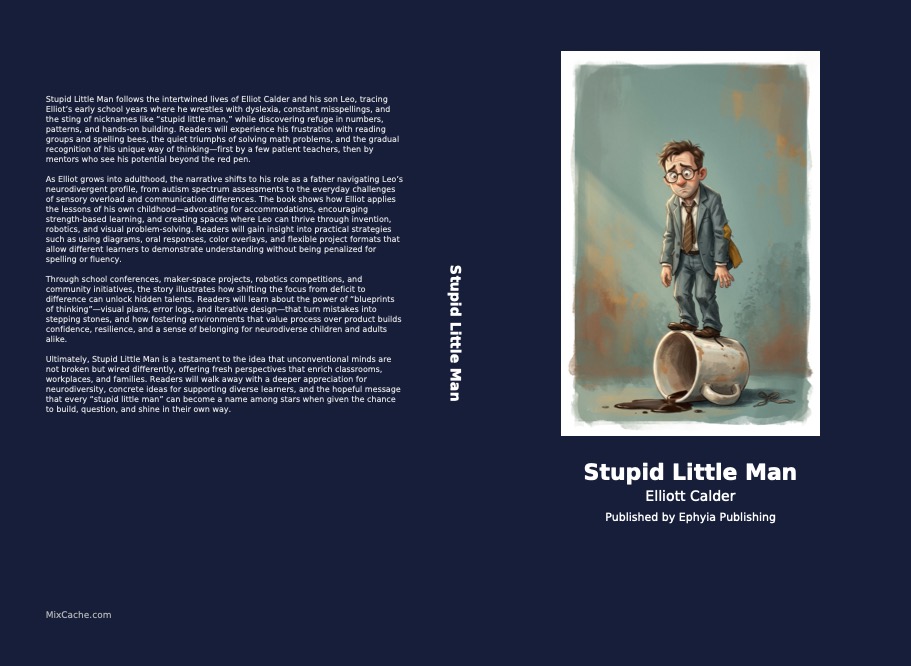
Stupid Little Man follows the intertwined lives of Elliot Calder and his son Leo, tracing Elliot’s early school years where he wrestles with dyslexia, constant misspellings, and the sting of nicknames like “stupid little man,” while discovering refuge in numbers, patterns, and hands‑on building. Readers will experience his frustration with reading groups and spelling bees, the quiet triumphs of solving math problems, and the gradual recognition of his unique way of thinking—first by a few patient teachers, then by mentors who see his potential beyond the red pen.
As Elliot grows into adulthood, the narrative shifts to his role as a father navigating Leo’s neurodivergent profile, from autism spectrum assessments to the everyday challenges of sensory overload and communication differences. The book shows how Elliot applies the lessons of his own childhood—advocating for accommodations, encouraging strength‑based learning, and creating spaces where Leo can thrive through invention, robotics, and visual problem‑solving. Readers will gain insight into practical strategies such as using diagrams, oral responses, color overlays, and flexible project formats that allow different learners to demonstrate understanding without being penalized for spelling or fluency.
Through school conferences, maker‑space projects, robotics competitions, and community initiatives, the story illustrates how shifting the focus from deficit to difference can unlock hidden talents. Readers will learn about the power of “blueprints of thinking”—visual plans, error logs, and iterative design—that turn mistakes into stepping stones, and how fostering environments that value process over product builds confidence, resilience, and a sense of belonging for neurodiverse children and adults alike.
Ultimately, Stupid Little Man is a testament to the idea that unconventional minds are not broken but wired differently, offering fresh perspectives that enrich classrooms, workplaces, and families. Readers will walk away with a deeper appreciation for neurodiversity, concrete ideas for supporting diverse learners, and the hopeful message that every “stupid little man” can become a name among stars when given the chance to build, question, and shine in their own way.
What You'll Find Inside:
- Follow Elliot's lifelong journey from childhood struggles with dyslexia to adulthood success as an inventor and advocate, highlighting how different brains learn and thrive
- Discover how focusing on strengths rather than just fixing weaknesses leads to fulfillment - Elliot excels through math, engineering, and systems thinking despite reading challenges
- Learn about the evolution of educational support and accommodations over generations, from Elliot's childhood to better resources for his neurodiverse son Leo
- Understand the importance of recognizing neurodiversity and alternative learning styles in both school and home environments
- See how persistence, creativity, and building on individual strengths can create success and belonging even when traditional academics are difficult
Who's It For:
This book is ideal for parents of neurodiverse children, educators working with students who learn differently, and neurodiverse individuals themselves. It offers practical hope and insights for families navigating school systems with children who have learning differences like dyslexia or autism, demonstrating how to recognize and nurture unique strengths while advocating for appropriate support. The memoir also serves as an inspiring read for anyone who has ever felt misunderstood in traditional educational settings, showing how different ways of thinking can lead to meaningful contributions and personal fulfillment.
Table of Contents:
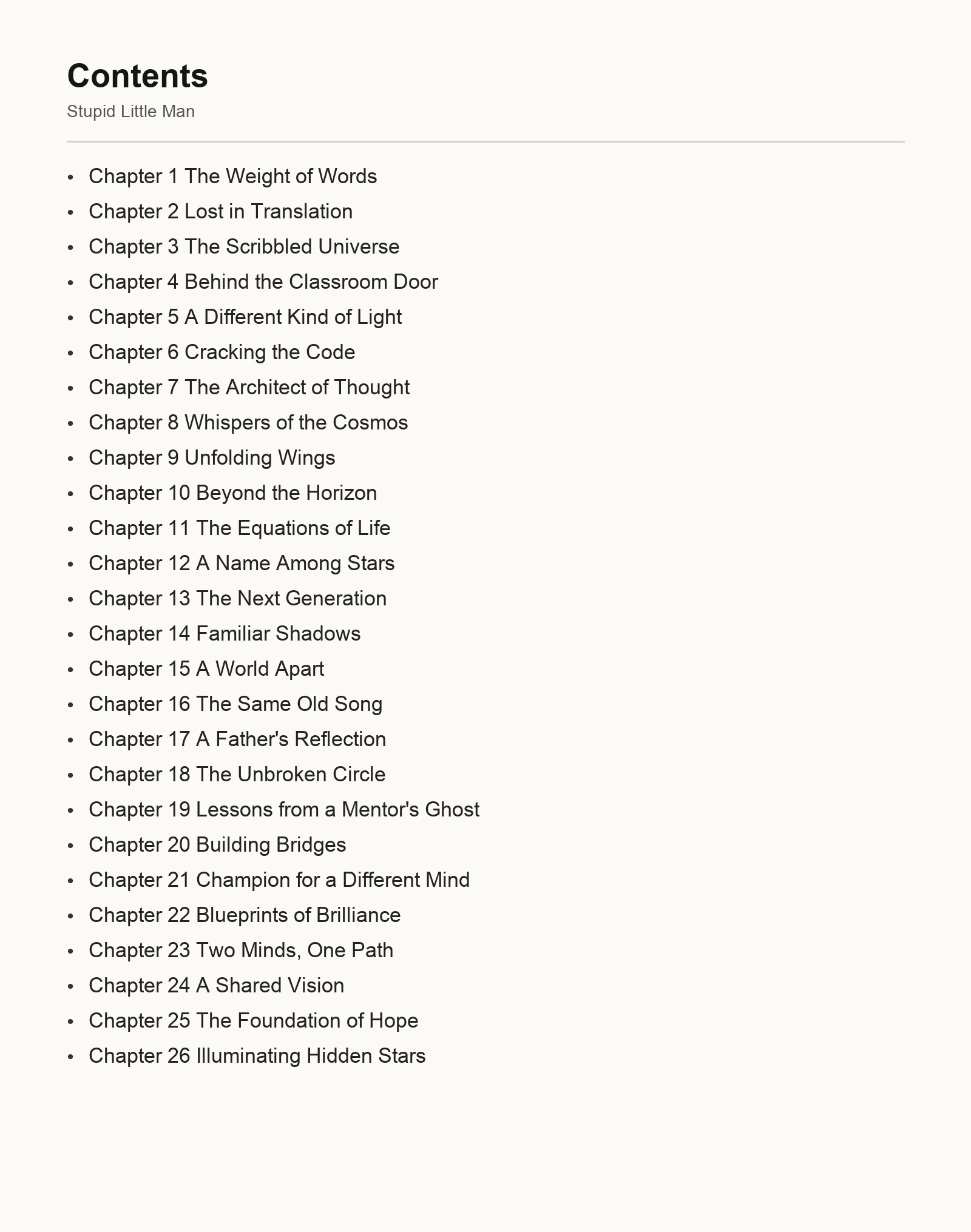
- Chapter 1 The Weight of Words
- Chapter 2 Lost in Translation
- Chapter 3 The Scribbled Universe
- Chapter 4 Behind the Classroom Door
- Chapter 5 A Different Kind of Light
- Chapter 6 Cracking the Code
- Chapter 7 The Architect of Thought
- Chapter 8 Whispers of the Cosmos
- Chapter 9 Unfolding Wings
- Chapter 10 Beyond the Horizon
- Chapter 11 The Equations of Life
- Chapter 12 A Name Among Stars
- Chapter 13 The Next Generation
- Chapter 14 Familiar Shadows
- Chapter 15 A World Apart
- Chapter 16 The Same Old Song
- Chapter 17 A Father's Reflection
- Chapter 18 The Unbroken Circle
- Chapter 19 Lessons from a Mentor's Ghost
- Chapter 20 Building Bridges
- Chapter 21 Champion for a Different Mind
- Chapter 22 Blueprints of Brilliance
- Chapter 23 Two Minds, One Path
- Chapter 24 A Shared Vision
- Chapter 25 The Foundation of Hope
- Chapter 26 Illuminating Hidden Stars
Author:
Published By:
Date Published:
May 29, 2026
Type:
Nonfiction
Language:
English
Also Available In:
Word Count:
67,626 words
Reading Time:
4 hours 44 minutes
Sample:
Order:
Order Stupid Little Man (Hardcover) on MixCache.com:
Buy NowPrint copy is made to order and ships worldwide. Includes the ebook free, ready to read instantly.
$5 account credit for all new MixCache.com accounts, usable toward any ebook purchase!*


