Browse by Category
Fiction
- Action & Adventure
- African American
- Anthologies
- Children's Fiction
- Classics
- Comics & Graphic Novels
- Coming of Age
- Contemporary
- Cultural & Regional
- Drama
- Erotica
- Fantasy
- General
- Historical Fiction
- Horror
- Humor & Satire
- Literary Fiction
- Mystery, Thriller & Suspense
- Poetry
- Religious & Inspirational
- Romance
- Science Fiction
- Short Stories
- War & Military
- Westerns
- Women's Fiction
- Young Adult
Non-Fiction
- Antiques & Collectibles
- Arts & Photography
- Biographies & Memoirs
- Business & Money
- Children's Non-Fiction
-
Computers & Technology
- Artificial Intelligence
- Computer Science
- Cybersecurity & Cryptography
- Data Science & Analytics
- Databases & Big Data
- Game Development & Design
- General
- Hardware & DIY
- Mobile App Development
- Networking & Cloud Computing
- Operating Systems
- Programming
- Robotics
- Software
- Software Engineering
- User Experience (UX) & Design
- Web Development & Design
- Cooking, Food & Wine
- Crafts, Hobbies & Home
- Education & Teaching
- Engineering
- General
- Health, Fitness & Dieting
-
History
- African History
- African History - North Africa
- African History - Sub-Saharan Africa
- American History
- American History - 20th Century
- American History - Civil War
- American History - Colonial Period
- Ancient History
- Asian History
- Asian History - China
- Asian History - India
- Asian History - Japan
- Asian History - Southeast Asia
- European History
- European History - Ancient Greece
- European History - Ancient Rome
- European History - Medieval
- European History - Modern
- European History - Renaissance
- General
- Middle Eastern History
- Military History
- Military History - Aviation
- Military History - Naval
- Social & Cultural History
- World History
- Humor & Entertainment
- Industrial Technology
- Language Learning
- Law
- LGBTQ+ Non-Fiction
- Literary Criticism
- Medical Books
- Parenting & Relationships
- Philosophy
- Politics & Social Sciences
- Reference
- Religion & Spirituality
-
Science & Math
- Agricultural Sciences
- Astronomy & Space Science
- Behavioral Sciences
- Biological Sciences
- Botany & Plant Science
- Chemistry
- Earth Sciences
- Engineering - Chemical
- Engineering - Civil
- Engineering - Electrical
- Engineering - Mechanical
- Environment
- General
- Geology
- Mathematics
- Nature & Ecology
- Oceanography
- Paleontology
- Physics
- Statistics
- Self-Help
- Sports & Outdoors
- Study Aids
- Sustainability & Green Living
- Textbooks
- Transportation
- Travel
- True Crime
- Urban Planning & Development
- Veterinary Medicine
- Writing & Publishing
Jump to Section
MixCache.com Total Access
Unlimited reading and audiobooks for every book published by MixCache.com.
Included titles carry the MTA badge.
Learn more →A History of Antarctica
About this book:
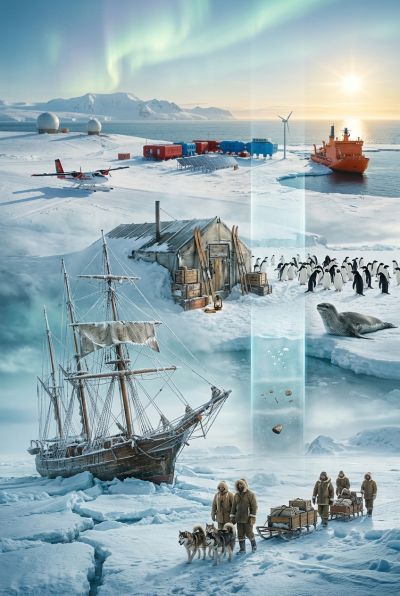
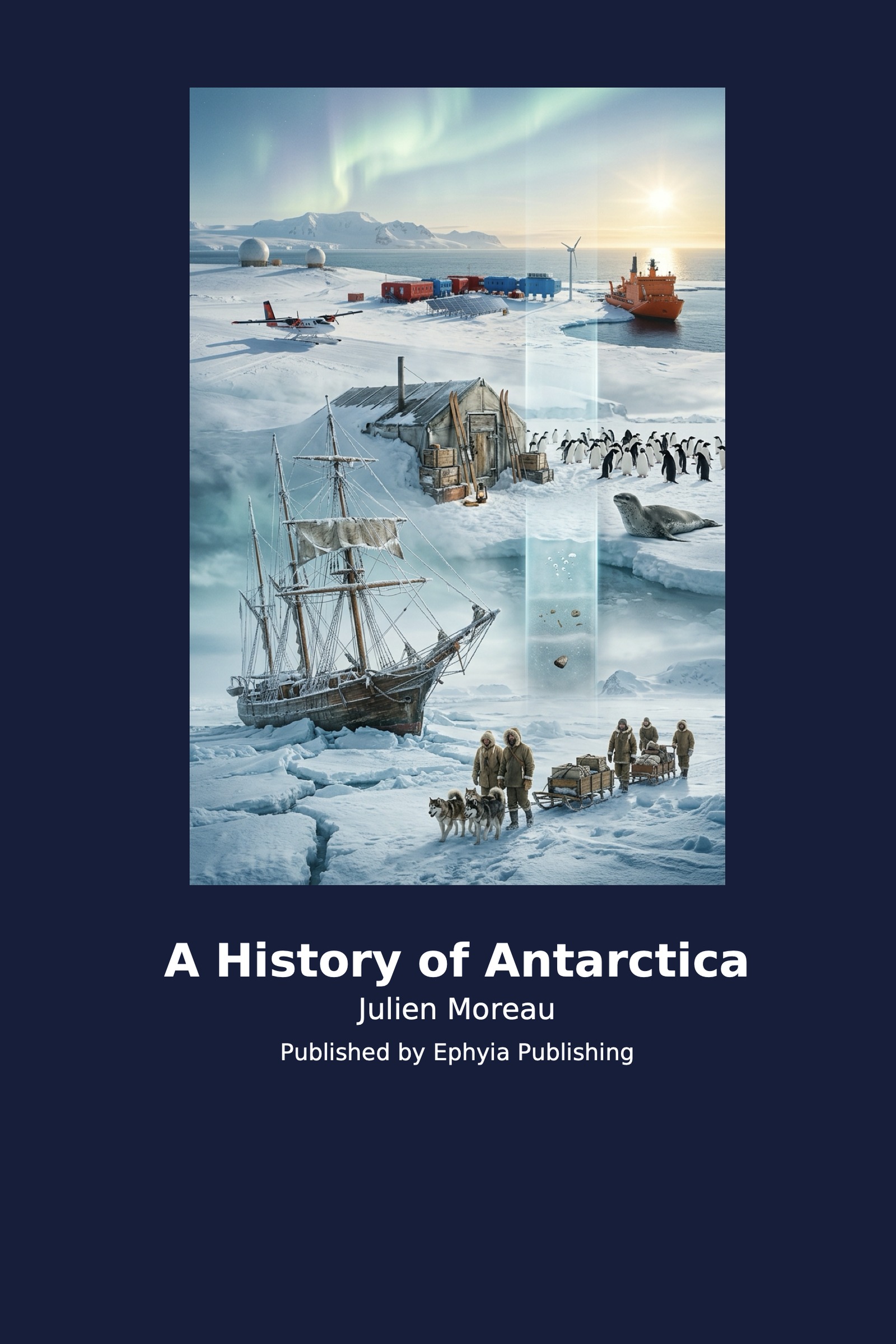
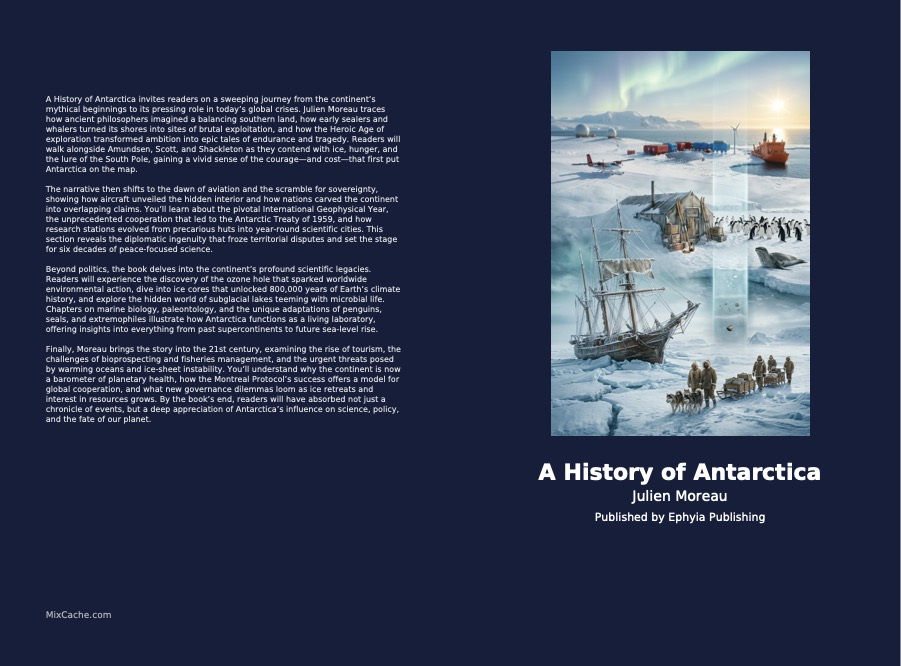
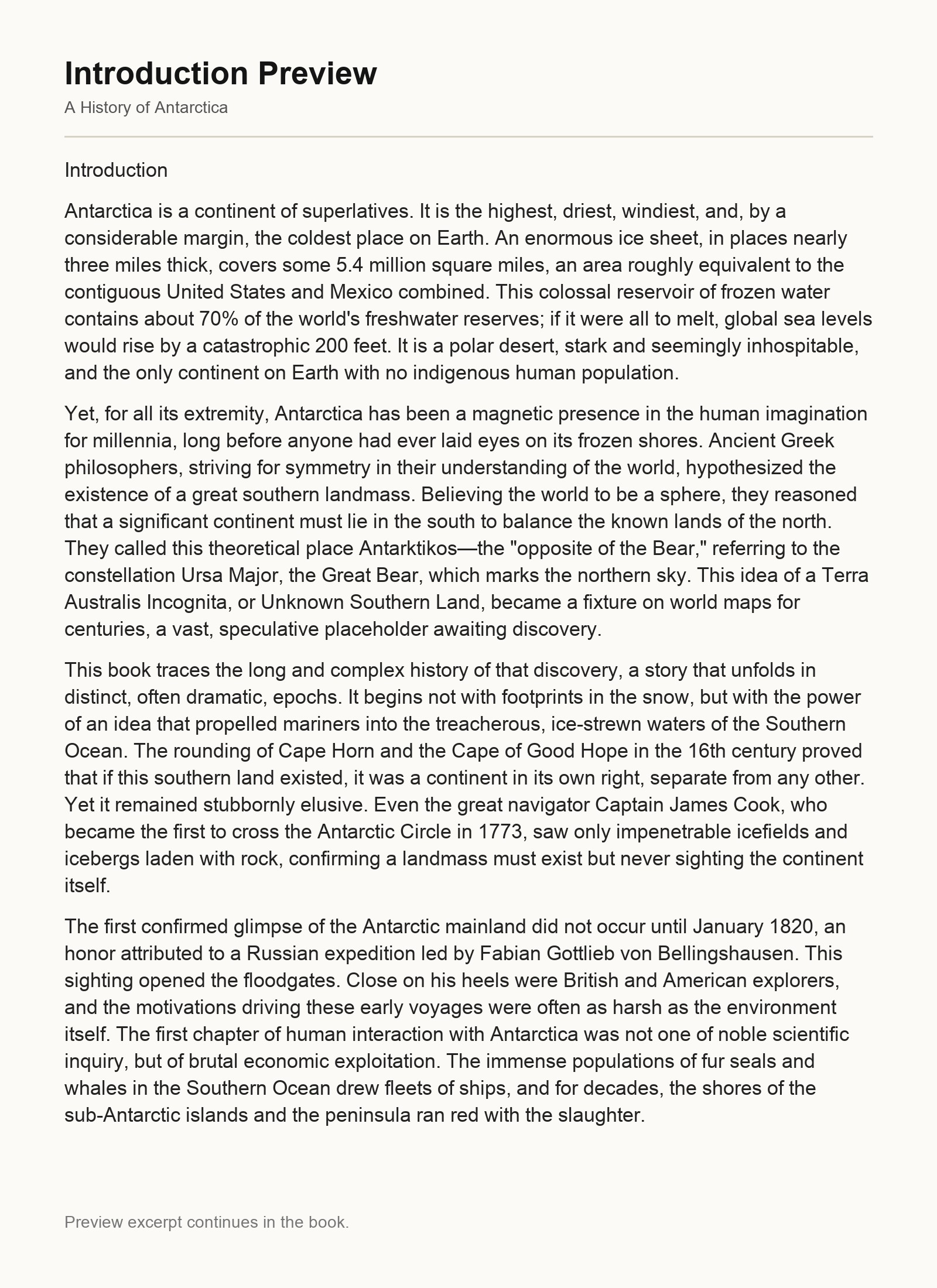
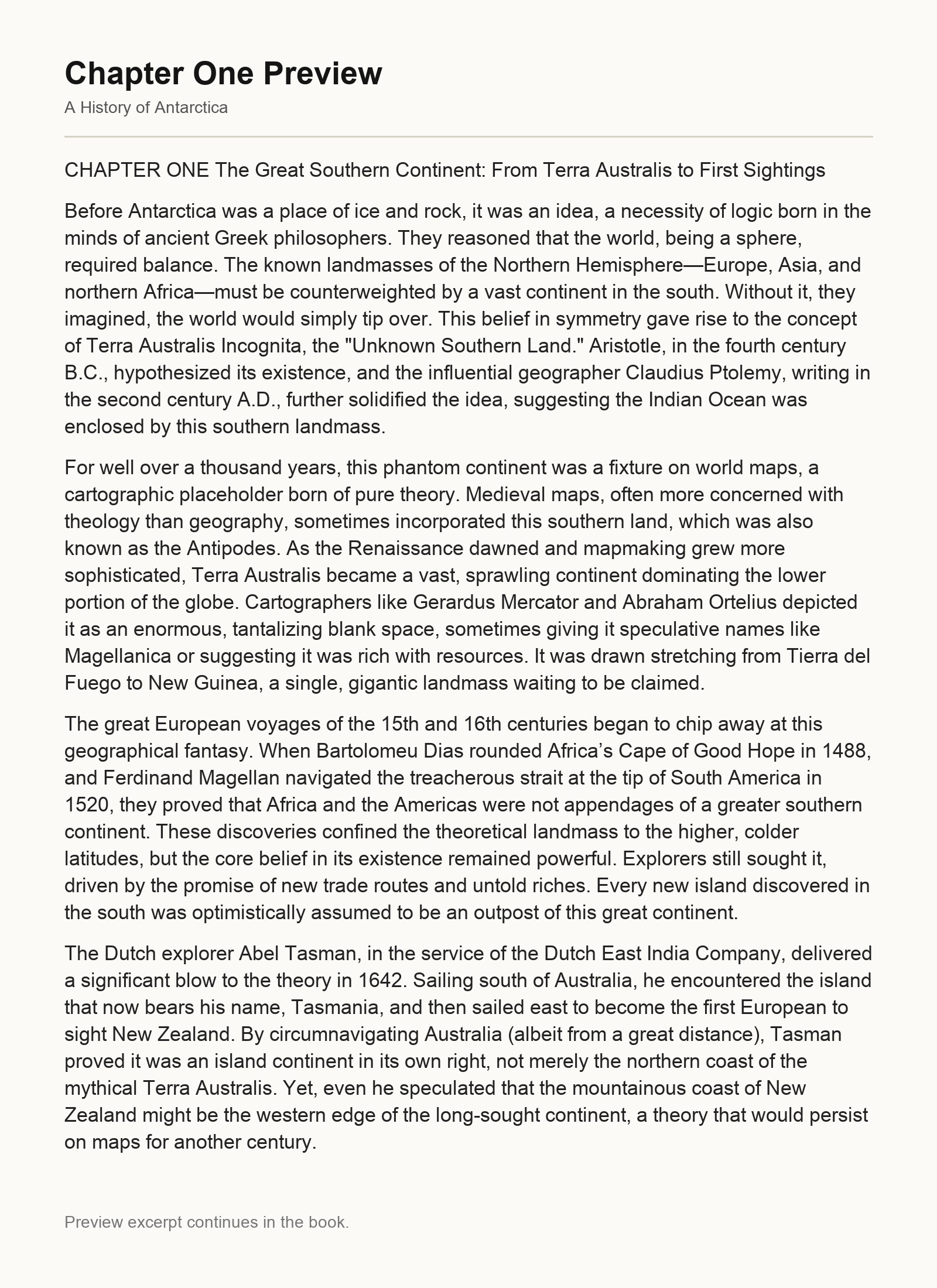
A History of Antarctica invites readers on a sweeping journey from the continent’s mythical beginnings to its pressing role in today’s global crises. Julien Moreau traces how ancient philosophers imagined a balancing southern land, how early sealers and whalers turned its shores into sites of brutal exploitation, and how the Heroic Age of exploration transformed ambition into epic tales of endurance and tragedy. Readers will walk alongside Amundsen, Scott, and Shackleton as they contend with ice, hunger, and the lure of the South Pole, gaining a vivid sense of the courage—and cost—that first put Antarctica on the map.
The narrative then shifts to the dawn of aviation and the scramble for sovereignty, showing how aircraft unveiled the hidden interior and how nations carved the continent into overlapping claims. You’ll learn about the pivotal International Geophysical Year, the unprecedented cooperation that led to the Antarctic Treaty of 1959, and how research stations evolved from precarious huts into year‑round scientific cities. This section reveals the diplomatic ingenuity that froze territorial disputes and set the stage for six decades of peace‑focused science.
Beyond politics, the book delves into the continent’s profound scientific legacies. Readers will experience the discovery of the ozone hole that sparked worldwide environmental action, dive into ice cores that unlocked 800,000 years of Earth’s climate history, and explore the hidden world of subglacial lakes teeming with microbial life. Chapters on marine biology, paleontology, and the unique adaptations of penguins, seals, and extremophiles illustrate how Antarctica functions as a living laboratory, offering insights into everything from past supercontinents to future sea‑level rise.
Finally, Moreau brings the story into the 21st century, examining the rise of tourism, the challenges of bioprospecting and fisheries management, and the urgent threats posed by warming oceans and ice‑sheet instability. You’ll understand why the continent is now a barometer of planetary health, how the Montreal Protocol’s success offers a model for global cooperation, and what new governance dilemmas loom as ice retreats and interest in resources grows. By the book’s end, readers will have absorbed not just a chronicle of events, but a deep appreciation of Antarctica’s influence on science, policy, and the fate of our planet.
What You'll Find Inside:
- Traces Antarctica's transformation from a philosophical concept (Terra Australis) to a confirmed continent through early sightings and subsequent economic exploitation of seals and whales.
- Details the Heroic Age of Exploration, highlighting the epic races to the South Pole by Amundsen and Scott and the legendary survival saga of Shackleton's Endurance expedition.
- Explains how the International Geophysical Year and the Antarctic Treaty of 1959 shifted the continent from geopolitical rivalry to a cooperative scientific preserve dedicated to peace and science.
- Highlights landmark scientific discoveries made in Antarctica, including the ozone hole, deep ice core climate records, and the hidden world of subglacial lakes and ecosystems.
- Examines modern challenges such as rising tourism, climate change impacts on ice shelves and ecosystems, and evolving governance debates over resources and environmental protection.
Who's It For:
This book is ideal for undergraduate and graduate students in history, environmental science, or international relations, as well as general readers with a keen interest in polar exploration, climate science, and global governance. It also serves policymakers, researchers, and educators seeking a comprehensive, accessible overview of Antarctica's past, scientific significance, and future challenges.
Table of Contents:
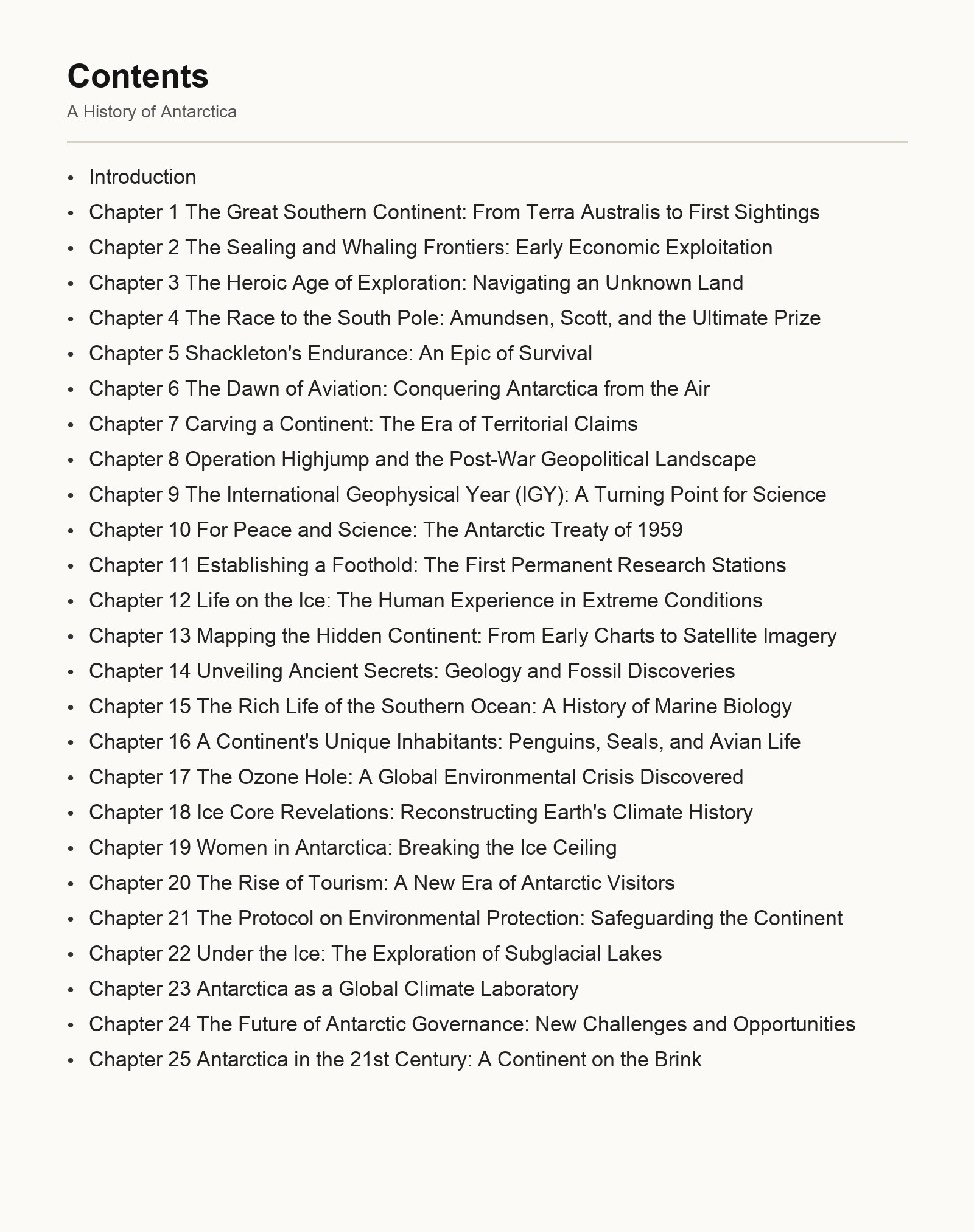
- Introduction
- Chapter 1 The Great Southern Continent: From Terra Australis to First Sightings
- Chapter 2 The Sealing and Whaling Frontiers: Early Economic Exploitation
- Chapter 3 The Heroic Age of Exploration: Navigating an Unknown Land
- Chapter 4 The Race to the South Pole: Amundsen, Scott, and the Ultimate Prize
- Chapter 5 Shackleton's Endurance: An Epic of Survival
- Chapter 6 The Dawn of Aviation: Conquering Antarctica from the Air
- Chapter 7 Carving a Continent: The Era of Territorial Claims
- Chapter 8 Operation Highjump and the Post-War Geopolitical Landscape
- Chapter 9 The International Geophysical Year (IGY): A Turning Point for Science
- Chapter 10 For Peace and Science: The Antarctic Treaty of 1959
- Chapter 11 Establishing a Foothold: The First Permanent Research Stations
- Chapter 12 Life on the Ice: The Human Experience in Extreme Conditions
- Chapter 13 Mapping the Hidden Continent: From Early Charts to Satellite Imagery
- Chapter 14 Unveiling Ancient Secrets: Geology and Fossil Discoveries
- Chapter 15 The Rich Life of the Southern Ocean: A History of Marine Biology
- Chapter 16 A Continent's Unique Inhabitants: Penguins, Seals, and Avian Life
- Chapter 17 The Ozone Hole: A Global Environmental Crisis Discovered
- Chapter 18 Ice Core Revelations: Reconstructing Earth's Climate History
- Chapter 19 Women in Antarctica: Breaking the Ice Ceiling
- Chapter 20 The Rise of Tourism: A New Era of Antarctic Visitors
- Chapter 21 The Protocol on Environmental Protection: Safeguarding the Continent
- Chapter 22 Under the Ice: The Exploration of Subglacial Lakes
- Chapter 23 Antarctica as a Global Climate Laboratory
- Chapter 24 The Future of Antarctic Governance: New Challenges and Opportunities
- Chapter 25 Antarctica in the 21st Century: A Continent on the Brink
Author:
Published By:
Date Published:
May 28, 2026
Type:
Nonfiction
Language:
English
Word Count:
41,227 words
Reading Time:
2 hours 53 minutes
Sample:
Order:
Order A History of Antarctica (Hardcover) on MixCache.com:
Buy NowPrint copy is made to order and ships worldwide. Includes the ebook free, ready to read instantly.
$5 account credit for all new MixCache.com accounts, usable toward any ebook purchase!*