
Browse by Category
Fiction
- Action & Adventure
- African American
- Anthologies
- Children's Fiction
- Classics
- Comics & Graphic Novels
- Coming of Age
- Contemporary
- Cultural & Regional
- Drama
- Erotica
- Fantasy
- General
- Historical Fiction
- Horror
- Humor & Satire
- Literary Fiction
- Mystery, Thriller & Suspense
- Poetry
- Religious & Inspirational
- Romance
- Science Fiction
- Short Stories
- War & Military
- Westerns
- Women's Fiction
- Young Adult
Non-Fiction
- Antiques & Collectibles
- Arts & Photography
- Biographies & Memoirs
- Business & Money
- Children's Non-Fiction
-
Computers & Technology
- Artificial Intelligence
- Computer Science
- Cybersecurity & Cryptography
- Data Science & Analytics
- Databases & Big Data
- Game Development & Design
- General
- Hardware & DIY
- Mobile App Development
- Networking & Cloud Computing
- Operating Systems
- Programming
- Robotics
- Software
- Software Engineering
- User Experience (UX) & Design
- Web Development & Design
- Cooking, Food & Wine
- Crafts, Hobbies & Home
- Education & Teaching
- Engineering
- General
- Health, Fitness & Dieting
-
History
- African History
- African History - North Africa
- African History - Sub-Saharan Africa
- American History
- American History - 20th Century
- American History - Civil War
- American History - Colonial Period
- Ancient History
- Asian History
- Asian History - China
- Asian History - India
- Asian History - Japan
- Asian History - Southeast Asia
- European History
- European History - Ancient Greece
- European History - Ancient Rome
- European History - Medieval
- European History - Modern
- European History - Renaissance
- General
- Middle Eastern History
- Military History
- Military History - Aviation
- Military History - Naval
- Social & Cultural History
- World History
- Humor & Entertainment
- Industrial Technology
- Language Learning
- Law
- LGBTQ+ Non-Fiction
- Literary Criticism
- Medical Books
- Parenting & Relationships
- Philosophy
- Politics & Social Sciences
- Reference
- Religion & Spirituality
-
Science & Math
- Agricultural Sciences
- Astronomy & Space Science
- Behavioral Sciences
- Biological Sciences
- Botany & Plant Science
- Chemistry
- Earth Sciences
- Engineering - Chemical
- Engineering - Civil
- Engineering - Electrical
- Engineering - Mechanical
- Environment
- General
- Geology
- Mathematics
- Nature & Ecology
- Oceanography
- Paleontology
- Physics
- Statistics
- Self-Help
- Sports & Outdoors
- Study Aids
- Sustainability & Green Living
- Textbooks
- Transportation
- Travel
- True Crime
- Urban Planning & Development
- Veterinary Medicine
- Writing & Publishing
Jump to Section
MixCache.com Total Access
Unlimited reading and audiobooks for every book published by MixCache.com.
Included titles carry the MTA badge.
Learn more →
A History of Malware
The story of computer viruses, worms, ransomware, spyware and other unwelcome digital visitors
About this book:

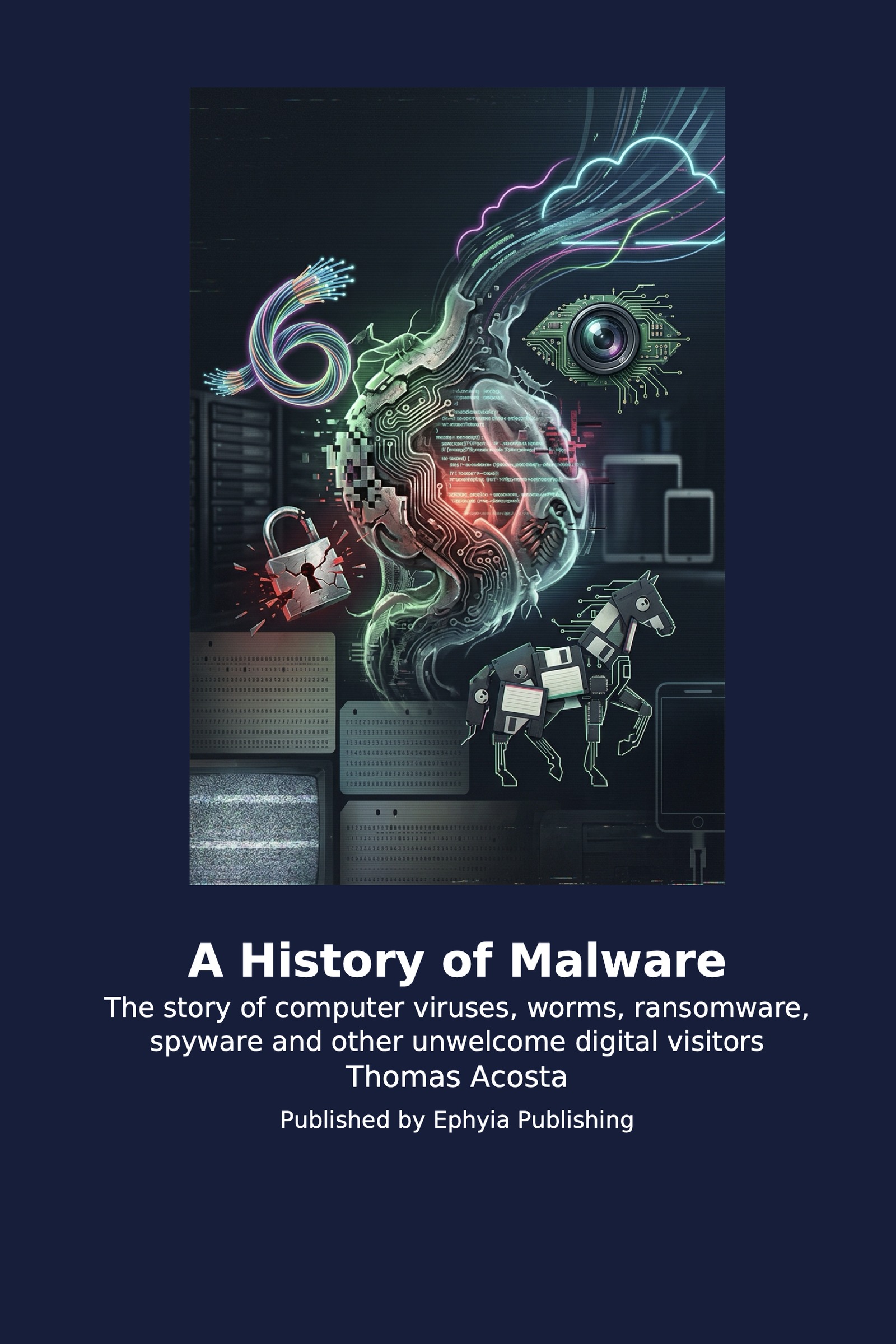
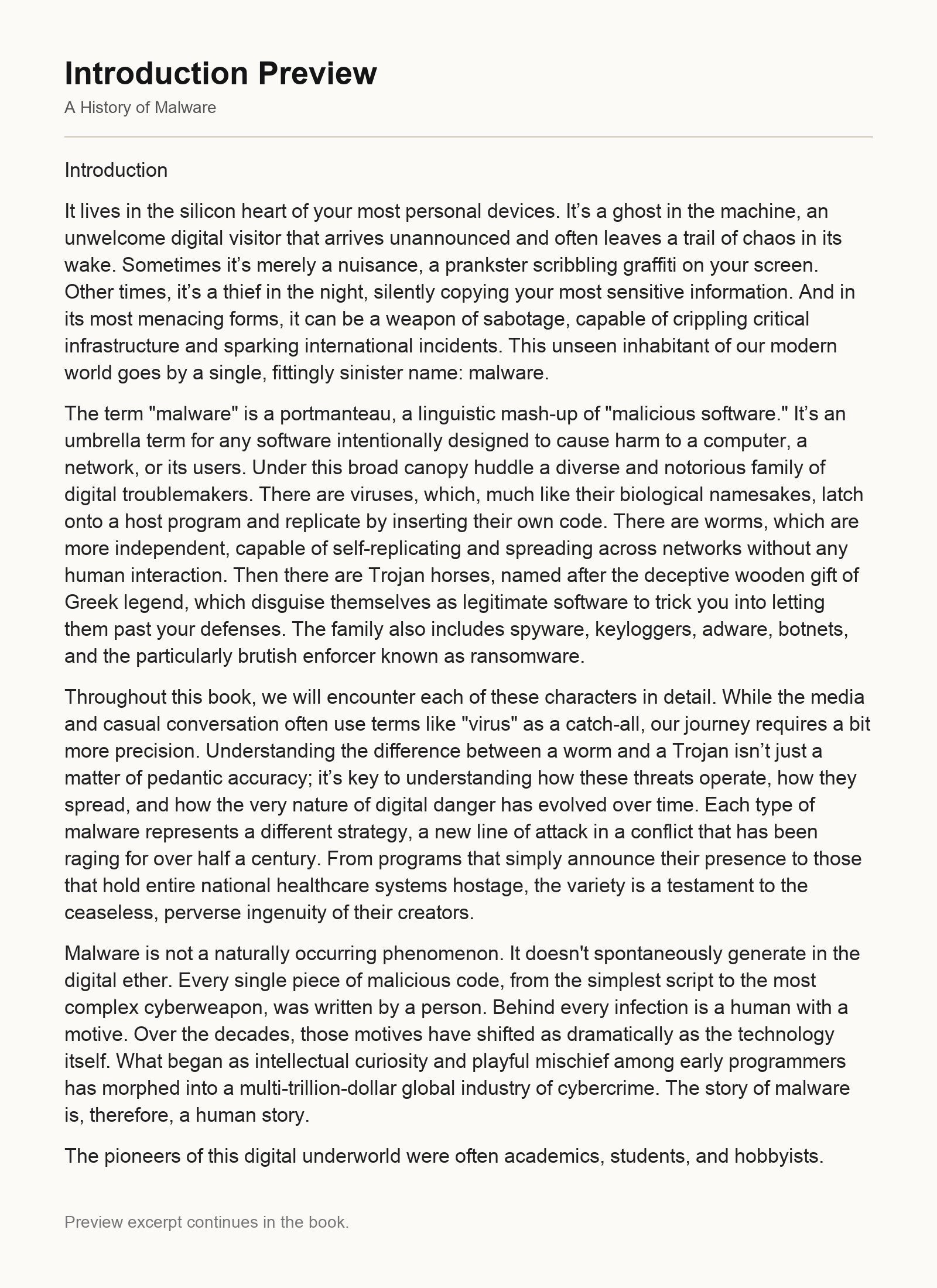
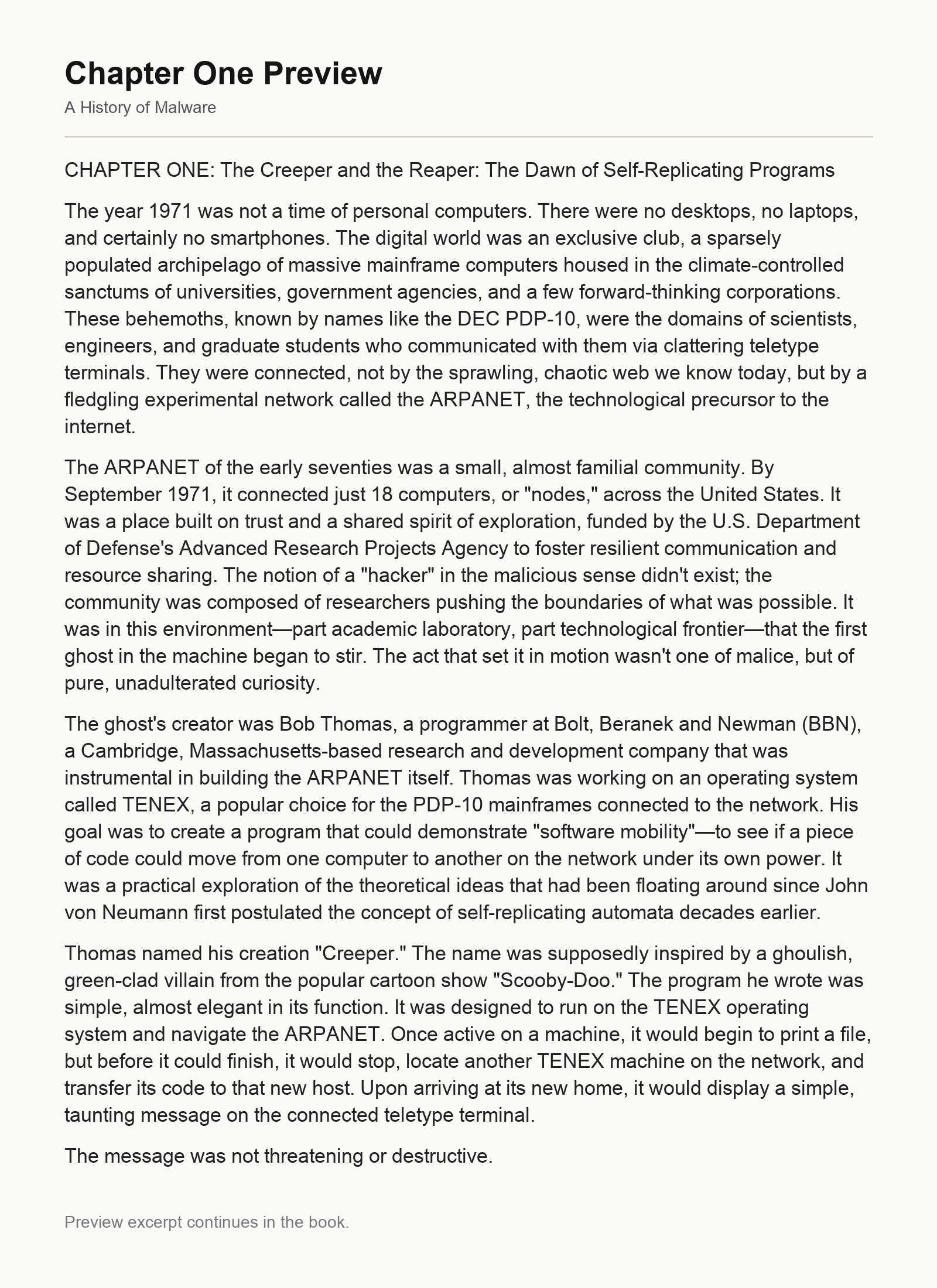
A History of Malware invites readers on a chronological journey through the shadowy evolution of digital threats, from the earliest experimental programs that hopped between mainframes to the sophisticated, nation‑state weapons that can cripple power grids and financial systems. Each chapter dissects a landmark outbreak—Creeper, Brain, Morris Worm, ILOVEYOU, Stuxnet, WannaCry, NotPetya, Mirai, and many others—revealing how the code worked, who created it, and why it mattered. By tracing the motivations that shifted from curious pranks to profit‑driven cybercrime and then to geopolitical sabotage, the book shows how malware mirrors the changing priorities of its makers and the growing dependence of society on interconnected technology.
Readers will gain a clear understanding of the different families of malicious software—viruses, worms, Trojans, ransomware, spyware, adware, fileless malware, botnets, and cryptojackers—and learn how each exploits specific weaknesses in hardware, software, or human behavior. The narrative explains core concepts such as polymorphism, stealth techniques, macro viruses, living‑off‑the‑land attacks, and domain generation algorithms, illustrating how attackers continually adapt to evade defenses while defenders respond with heuristics, sandboxing, behavior‑based detection, and AI‑driven threat hunting. Real‑world case studies highlight the economic, operational, and human costs of infections, from halted hospital services and shuttered factories to massive data theft and erosion of privacy.
Beyond the technical details, the book explores the broader social and legal ramifications of malware: the birth of antivirus companies and CERT, the rise of ransomware‑as‑a‑service, the challenges of attributing state‑sponsored attacks, and the ongoing struggle to balance security with user convenience. It shows how each major outbreak forced governments, corporations, and individuals to rethink security policies, patch management, and user education, turning fear into proactive defense strategies. By examining the human motives behind the code—curiosity, notoriety, profit, espionage, and warfare—the reader sees malware not just as a technical problem but as a reflection of our own ambitions and vulnerabilities.
Finally, A History of Malware looks ahead to the next generation of threats, discussing how artificial intelligence, machine learning, and quantum computing could reshape the attack surface. It considers emerging vectors such as automotive malware, medical‑device exploits, and smart‑city infrastructure attacks, and explains how defensive AI and behavior‑based monitoring are evolving to meet these challenges. Whether you are a cybersecurity professional, a student of technology, or simply a curious reader who wants to understand the invisible forces shaping our digital world, this book equips you with the knowledge to recognize past patterns, anticipate future dangers, and appreciate the relentless cat‑and‑mouse game that defines the modern age of malware.
What You'll Find Inside:
- Traces malware's evolution from early experiments like Creeper and Elk Cloner to sophisticated nation-state weapons such as Stuxnet and NotPetya.
- Highlights how attacker motives shifted from curiosity and pranks to profit-driven cybercrime, espionage, and sabotage.
- Explores key malware categories—worms, ransomware, botnets, spyware, fileless, and cryptojacking—and their infection vectors.
- Shows the arms race between malware and defenses, leading to innovations like heuristics, sandboxing, EDR, and AI-based detection.
- Examines emerging threats including AI-powered malware, IoT weaponization, and the potential impact of quantum computing on encryption.
Who's It For:
This book is ideal for cybersecurity professionals, IT administrators, and students seeking a deep historical understanding of malware trends and tactics. It also appeals to policymakers, business leaders, and technology enthusiasts who need to grasp how past threats shape today's defense strategies and future risk landscape.
Table of Contents:
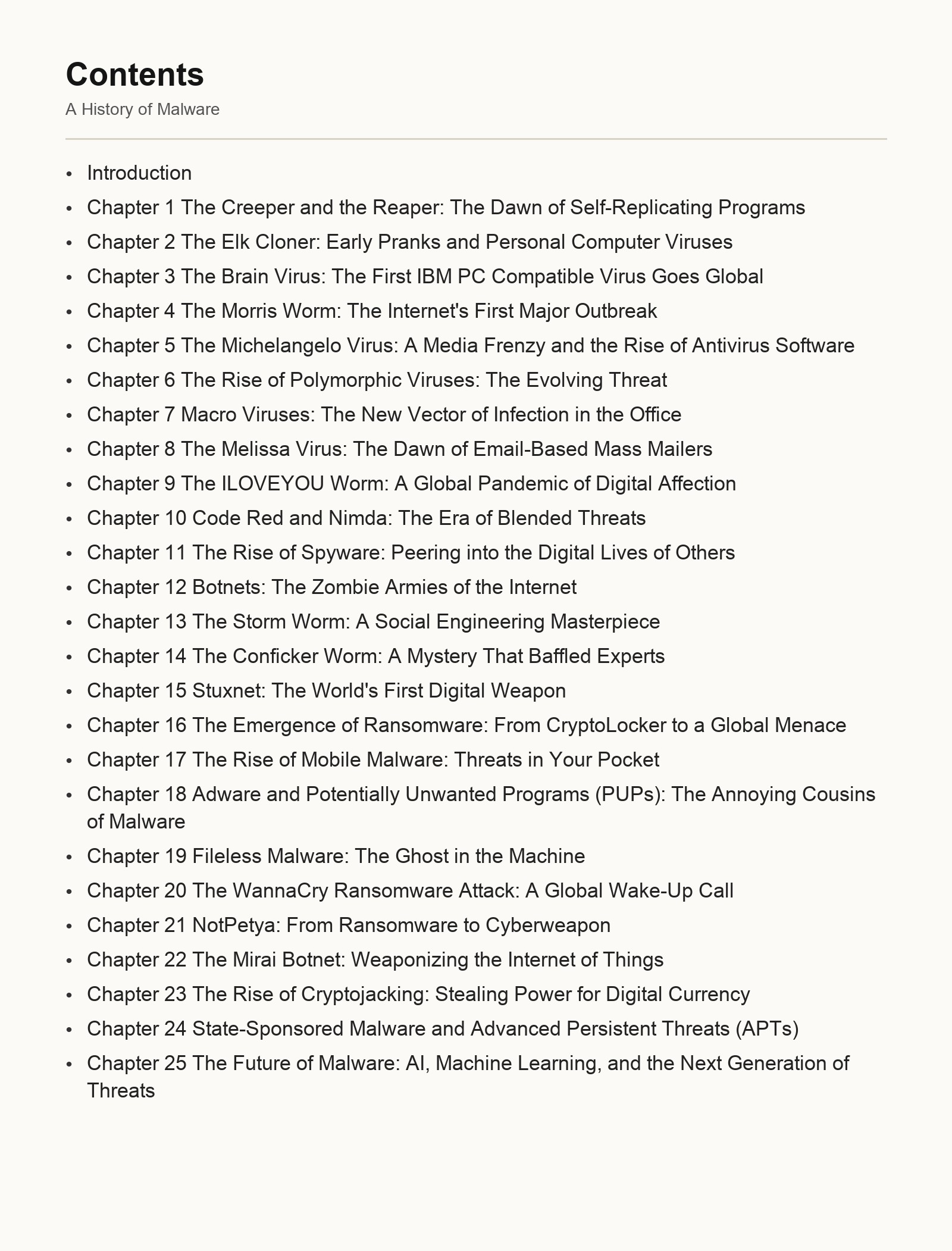
- Introduction
- Chapter 1 The Creeper and the Reaper: The Dawn of Self-Replicating Programs
- Chapter 2 The Elk Cloner: Early Pranks and Personal Computer Viruses
- Chapter 3 The Brain Virus: The First IBM PC Compatible Virus Goes Global
- Chapter 4 The Morris Worm: The Internet's First Major Outbreak
- Chapter 5 The Michelangelo Virus: A Media Frenzy and the Rise of Antivirus Software
- Chapter 6 The Rise of Polymorphic Viruses: The Evolving Threat
- Chapter 7 Macro Viruses: The New Vector of Infection in the Office
- Chapter 8 The Melissa Virus: The Dawn of Email-Based Mass Mailers
- Chapter 9 The ILOVEYOU Worm: A Global Pandemic of Digital Affection
- Chapter 10 Code Red and Nimda: The Era of Blended Threats
- Chapter 11 The Rise of Spyware: Peering into the Digital Lives of Others
- Chapter 12 Botnets: The Zombie Armies of the Internet
- Chapter 13 The Storm Worm: A Social Engineering Masterpiece
- Chapter 14 The Conficker Worm: A Mystery That Baffled Experts
- Chapter 15 Stuxnet: The World's First Digital Weapon
- Chapter 16 The Emergence of Ransomware: From CryptoLocker to a Global Menace
- Chapter 17 The Rise of Mobile Malware: Threats in Your Pocket
- Chapter 18 Adware and Potentially Unwanted Programs (PUPs): The Annoying Cousins of Malware
- Chapter 19 Fileless Malware: The Ghost in the Machine
- Chapter 20 The WannaCry Ransomware Attack: A Global Wake-Up Call
- Chapter 21 NotPetya: From Ransomware to Cyberweapon
- Chapter 22 The Mirai Botnet: Weaponizing the Internet of Things
- Chapter 23 The Rise of Cryptojacking: Stealing Power for Digital Currency
- Chapter 24 State-Sponsored Malware and Advanced Persistent Threats (APTs)
- Chapter 25 The Future of Malware: AI, Machine Learning, and the Next Generation of Threats
Author:
Published By:
Date Published:
May 25, 2026
Type:
Nonfiction
Language:
English
Also Available In:
Word Count:
42,180 words
Reading Time:
2 hours 57 minutes
Sample:
Order:
Buy the A History of Malware ebook on MixCache.com:
Buy NowThe full ebook will be available immediately to read instantly on any device.
$5 account credit for all new MixCache.com accounts, usable toward any ebook purchase!*




Ratings & Reviews
Ask Questions About This Book
Have a question about the content? Ask our AI assistant!
Start by asking a question about "A History of Malware"
Example: "Does this book mention William Shakespeare?"
Thinking...