
Browse by Category
Fiction
- Action & Adventure
- African American
- Anthologies
- Children's Fiction
- Classics
- Comics & Graphic Novels
- Coming of Age
- Contemporary
- Cultural & Regional
- Drama
- Erotica
- Fantasy
- General
- Historical Fiction
- Horror
- Humor & Satire
- Literary Fiction
- Mystery, Thriller & Suspense
- Poetry
- Religious & Inspirational
- Romance
- Science Fiction
- Short Stories
- War & Military
- Westerns
- Women's Fiction
- Young Adult
Non-Fiction
- Antiques & Collectibles
- Arts & Photography
- Biographies & Memoirs
- Business & Money
- Children's Non-Fiction
-
Computers & Technology
- Artificial Intelligence
- Computer Science
- Cybersecurity & Cryptography
- Data Science & Analytics
- Databases & Big Data
- Game Development & Design
- General
- Hardware & DIY
- Mobile App Development
- Networking & Cloud Computing
- Operating Systems
- Programming
- Robotics
- Software
- Software Engineering
- User Experience (UX) & Design
- Web Development & Design
- Cooking, Food & Wine
- Crafts, Hobbies & Home
- Education & Teaching
- Engineering
- General
- Health, Fitness & Dieting
-
History
- African History
- African History - North Africa
- African History - Sub-Saharan Africa
- American History
- American History - 20th Century
- American History - Civil War
- American History - Colonial Period
- Ancient History
- Asian History
- Asian History - China
- Asian History - India
- Asian History - Japan
- Asian History - Southeast Asia
- European History
- European History - Ancient Greece
- European History - Ancient Rome
- European History - Medieval
- European History - Modern
- European History - Renaissance
- General
- Middle Eastern History
- Military History
- Military History - Aviation
- Military History - Naval
- Social & Cultural History
- World History
- Humor & Entertainment
- Industrial Technology
- Language Learning
- Law
- LGBTQ+ Non-Fiction
- Literary Criticism
- Medical Books
- Parenting & Relationships
- Philosophy
- Politics & Social Sciences
- Reference
- Religion & Spirituality
-
Science & Math
- Agricultural Sciences
- Astronomy & Space Science
- Behavioral Sciences
- Biological Sciences
- Botany & Plant Science
- Chemistry
- Earth Sciences
- Engineering - Chemical
- Engineering - Civil
- Engineering - Electrical
- Engineering - Mechanical
- Environment
- General
- Geology
- Mathematics
- Nature & Ecology
- Oceanography
- Paleontology
- Physics
- Statistics
- Self-Help
- Sports & Outdoors
- Study Aids
- Sustainability & Green Living
- Textbooks
- Transportation
- Travel
- True Crime
- Urban Planning & Development
- Veterinary Medicine
- Writing & Publishing
Jump to Section
MixCache.com Total Access
Unlimited reading and audiobooks for every book published by MixCache.com.
Included titles carry the MTA badge.
Learn more →The History of Concrete
About this book:
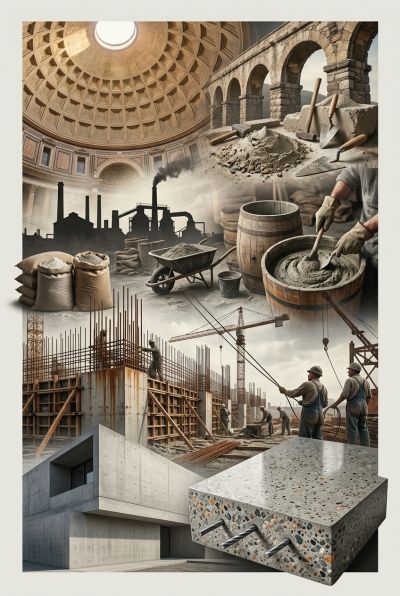
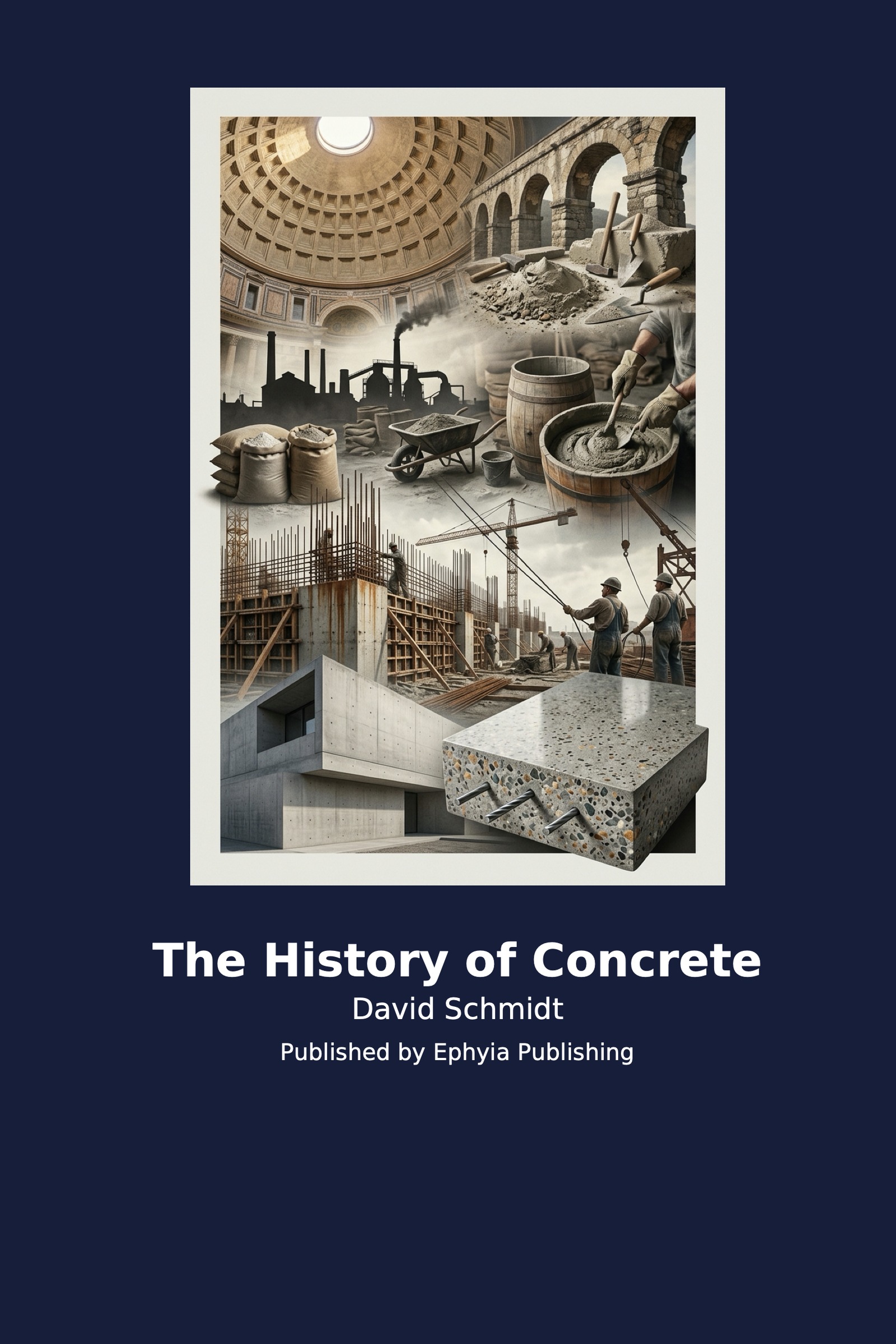
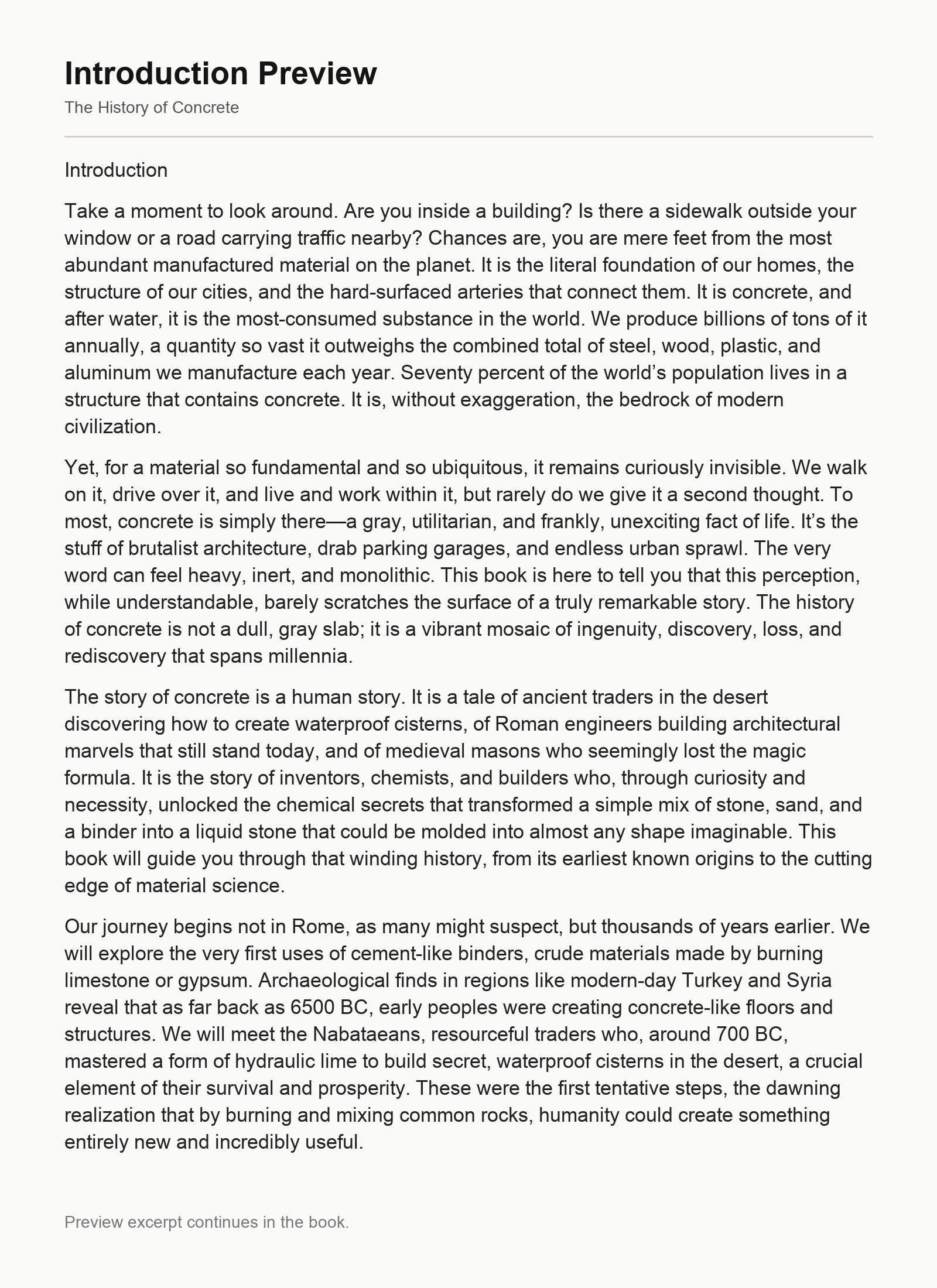
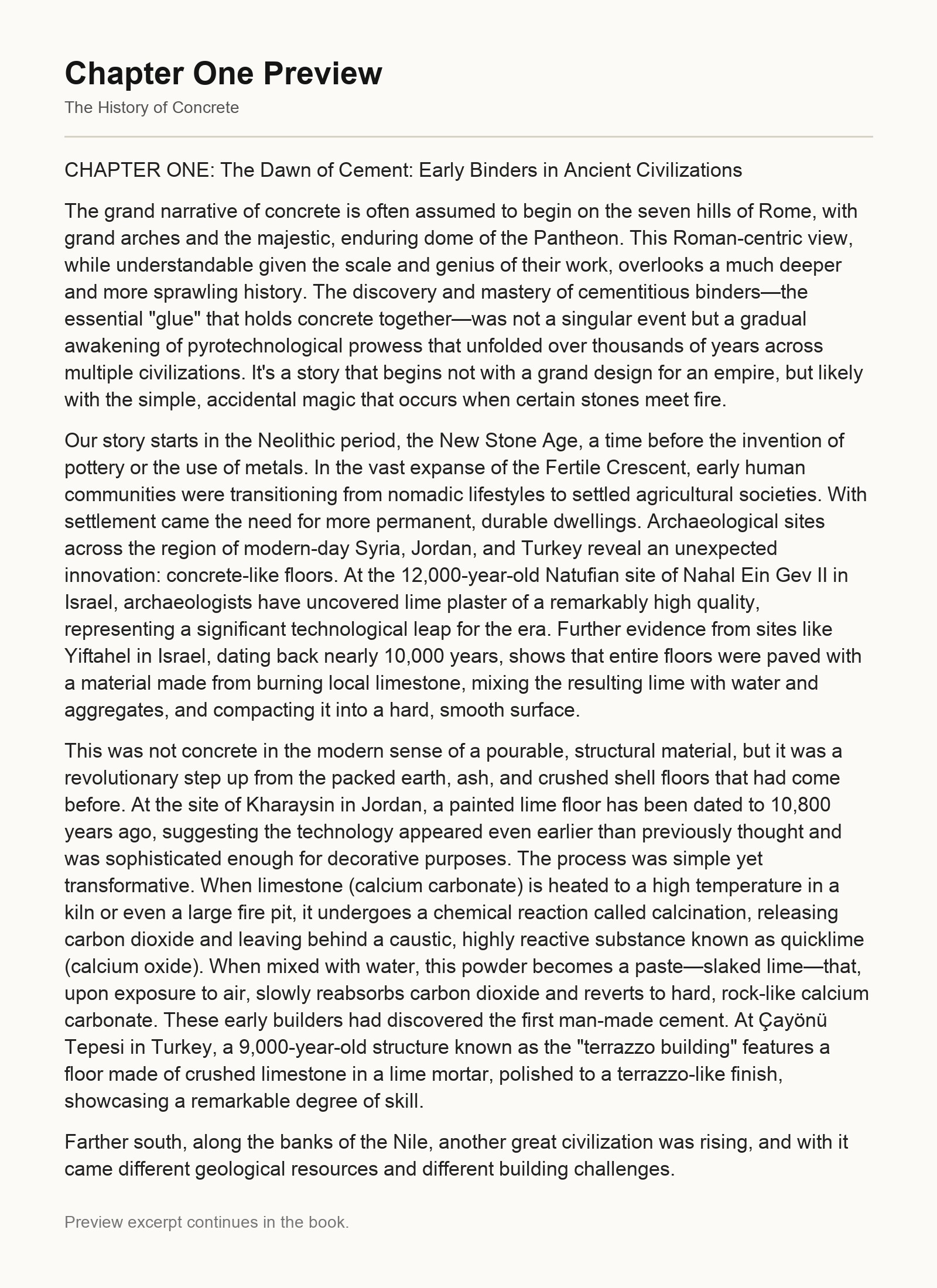
From the earliest lime‑plaster floors of Neolithic settlements to the self‑healing, carbon‑capturing mixes being tested in today’s labs, this book traces concrete’s extraordinary journey across millennia. Readers will discover how ancient traders in the desert created waterproof cisterns, how Roman engineers harnessed volcanic ash to build the Pantheon’s dome and seawalls that grow stronger with age, and why the knowledge of that “liquid stone” vanished during the Middle Ages only to be resurrected by Renaissance scholars and the meticulous experiments of John Smeaton. Each chapter reveals a pivotal moment—from Joseph Aspdin’s Portland cement patent to the daring reinforced‑concrete experiments of Lambot, Monier, and Coignet—showing how a simple mixture of stone, sand, and binder evolved into the backbone of modern civilization.
The narrative follows concrete’s rise as the industrial workhorse of the 19th century, detailing its role in London’s sewers, railways, bridges, and the monumental Hoover and Grand Coulee dams, where breakthroughs in low‑heat cement and massive refrigeration turned a thermal nightmare into a triumph of engineering. You’ll learn how the invention of reinforced concrete opened the door to skyscrapers, precast and prestressed components, and the sprawling infrastructure that powered two world wars, from the Maginot Line’s subterranean fortresses to the Mulberry harbors that made D‑Day possible. The book also explores concrete’s artistic awakening in the mid‑20th century, when Le Corbusier, Niemeyer, and Candela transformed the material into sculptural masterpieces, and how decorative techniques like stamped concrete, acid staining, and exposed aggregate turned gray slabs into imitations of brick, stone, and wood.
Beyond strength and form, the text delves into the science that keeps concrete standing: the chemistry of admixtures that accelerate set, entrain air, and reduce water; the durability battles against alkali‑silica reaction, sulfate attack, corrosion, and freeze‑thaw cycles; and the revolution of ready‑mix delivery that turned a chaotic site‑mixing craft into a precise industrial process. Readers will confront the environmental challenges cement production poses—its massive CO₂ footprint, sand and water consumption, and urban heat‑island effects—while also discovering the cutting‑edge responses driving the green concrete movement, from supplementary cementitious materials and geopolymers to carbon‑capture technologies, pervious pavements, and high‑performance mixes infused with silica fume and superplasticizers.
Finally, the book looks ahead to a digital and biological future where concrete is no longer a passive block but an active, sensing, and even self‑repairing system. You’ll encounter 3D‑printed homes that rise in under two days, smart concrete laced with fiber‑optic sensors that monitor strain in real time, self‑healing mixes that use bacteria to seal cracks, and experimental materials that store energy, clean the air, or sequester carbon. By the end, readers will not only understand how concrete built the world but also glimpse how it may help sustain it—offering a comprehensive, engaging, and inspiring portrait of humanity’s most ubiquitous man‑made material.
What You'll Find Inside:
- Ancient origins of cementitious binders from Neolithic lime plasters to Nabataean waterproof cisterns, showing early experimentation across civilizations.
- Roman engineering breakthrough with pozzolanic concrete enabling underwater curing and monumental structures like the Pantheon and harbor works.
- The loss of concrete knowledge in the medieval West and its partial preservation in Byzantium, followed by Renaissance rediscovery and empirical experimentation.
- Industrial-era innovations: Portland cement, reinforcement, precast/prestressed methods, and massive 20th‑century infrastructure such as the Hoover Dam.
- Contemporary advances toward sustainability and intelligence: green cements, self‑healing biology, 3D printing, smart sensors, and carbon‑negative technologies.
Who's It For:
This book is ideal for civil engineers, architects, and construction professionals seeking a deep technical and historical understanding of the material they work with. It also serves students and academics in materials science, engineering history, or urban studies who need a comprehensive reference on concrete’s evolution. Additionally, sustainability specialists, policymakers, and informed general readers interested in how concrete shapes—and can be made to lessen its impact on—the built environment will find valuable insights.
Table of Contents:
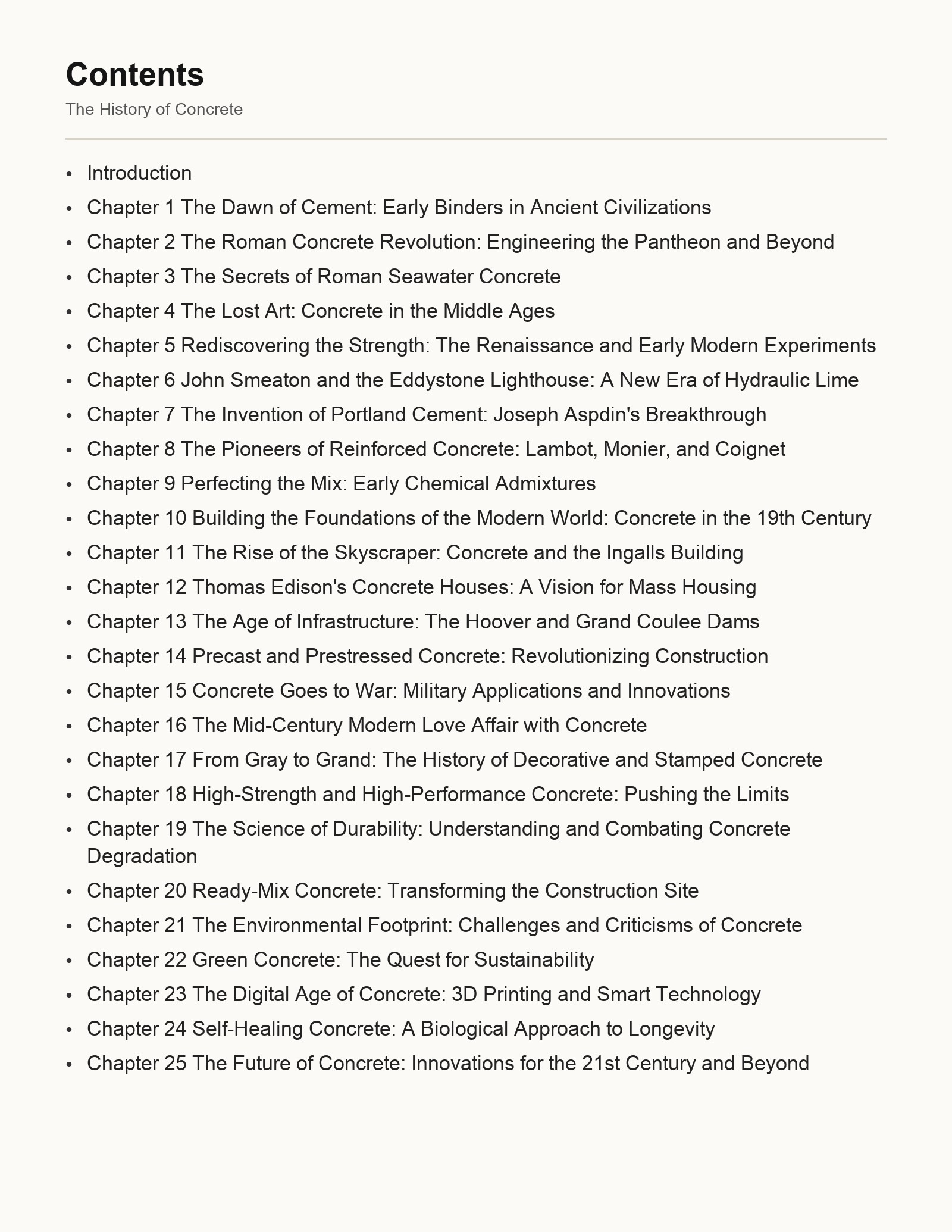
- Introduction
- Chapter 1 The Dawn of Cement: Early Binders in Ancient Civilizations.
- Chapter 2 The Roman Concrete Revolution: Engineering the Pantheon and Beyond.
- Chapter 3 The Secrets of Roman Seawater Concrete.
- Chapter 4 The Lost Art: Concrete in the Middle Ages.
- Chapter 5 Rediscovering the Strength: The Renaissance and Early Modern Experiments.
- Chapter 6 John Smeaton and the Eddystone Lighthouse: A New Era of Hydraulic Lime.
- Chapter 7 The Invention of Portland Cement: Joseph Aspdin's Breakthrough.
- Chapter 8 The Pioneers of Reinforced Concrete: Lambot, Monier, and Coignet.
- Chapter 9 Perfecting the Mix: Early Chemical Admixtures.
- Chapter 10 Building the Foundations of the Modern World: Concrete in the 19th Century.
- Chapter 11 The Rise of the Skyscraper: Concrete and the Ingalls Building.
- Chapter 12 Thomas Edison's Concrete Houses: A Vision for Mass Housing.
- Chapter 13 The Age of Infrastructure: The Hoover and Grand Coulee Dams.
- Chapter 14 Precast and Prestressed Concrete: Revolutionizing Construction.
- Chapter 15 Concrete Goes to War: Military Applications and Innovations.
- Chapter 16 The Mid-Century Modern Love Affair with Concrete.
- Chapter 17 From Gray to Grand: The History of Decorative and Stamped Concrete.
- Chapter 18 High-Strength and High-Performance Concrete: Pushing the Limits.
- Chapter 19 The Science of Durability: Understanding and Combating Concrete Degradation.
- Chapter 20 Ready-Mix Concrete: Transforming the Construction Site.
- Chapter 21 The Environmental Footprint: Challenges and Criticisms of Concrete.
- Chapter 22 Green Concrete: The Quest for Sustainability.
- Chapter 23 The Digital Age of Concrete: 3D Printing and Smart Technology.
- Chapter 24 Self-Healing Concrete: A Biological Approach to Longevity.
- Chapter 25 The Future of Concrete: Innovations for the 21st Century and Beyond.
Author:
Published By:
Date Published:
May 24, 2026
Type:
Nonfiction
Language:
English
Word Count:
41,740 words
Reading Time:
2 hours 55 minutes
Sample:
Order:
Buy the The History of Concrete ebook on MixCache.com:
Buy NowThe full ebook will be available immediately to read instantly on any device.
$5 account credit for all new MixCache.com accounts, usable toward any ebook purchase!*





Ratings & Reviews
Ask Questions About This Book
Have a question about the content? Ask our AI assistant!
Start by asking a question about "The History of Concrete"
Example: "Does this book mention William Shakespeare?"
Thinking...