
Browse by Category
Fiction
- Action & Adventure
- African American
- Anthologies
- Children's Fiction
- Classics
- Comics & Graphic Novels
- Coming of Age
- Contemporary
- Cultural & Regional
- Drama
- Erotica
- Fantasy
- General
- Historical Fiction
- Horror
- Humor & Satire
- Literary Fiction
- Mystery, Thriller & Suspense
- Poetry
- Religious & Inspirational
- Romance
- Science Fiction
- Short Stories
- War & Military
- Westerns
- Women's Fiction
- Young Adult
Non-Fiction
- Antiques & Collectibles
- Arts & Photography
- Biographies & Memoirs
- Business & Money
- Children's Non-Fiction
-
Computers & Technology
- Artificial Intelligence
- Computer Science
- Cybersecurity & Cryptography
- Data Science & Analytics
- Databases & Big Data
- Game Development & Design
- General
- Hardware & DIY
- Mobile App Development
- Networking & Cloud Computing
- Operating Systems
- Programming
- Robotics
- Software
- Software Engineering
- User Experience (UX) & Design
- Web Development & Design
- Cooking, Food & Wine
- Crafts, Hobbies & Home
- Education & Teaching
- Engineering
- General
- Health, Fitness & Dieting
-
History
- African History
- African History - North Africa
- African History - Sub-Saharan Africa
- American History
- American History - 20th Century
- American History - Civil War
- American History - Colonial Period
- Ancient History
- Asian History
- Asian History - China
- Asian History - India
- Asian History - Japan
- Asian History - Southeast Asia
- European History
- European History - Ancient Greece
- European History - Ancient Rome
- European History - Medieval
- European History - Modern
- European History - Renaissance
- General
- Middle Eastern History
- Military History
- Military History - Aviation
- Military History - Naval
- Social & Cultural History
- World History
- Humor & Entertainment
- Industrial Technology
- Language Learning
- Law
- LGBTQ+ Non-Fiction
- Literary Criticism
- Medical Books
- Parenting & Relationships
- Philosophy
- Politics & Social Sciences
- Reference
- Religion & Spirituality
-
Science & Math
- Agricultural Sciences
- Astronomy & Space Science
- Behavioral Sciences
- Biological Sciences
- Botany & Plant Science
- Chemistry
- Earth Sciences
- Engineering - Chemical
- Engineering - Civil
- Engineering - Electrical
- Engineering - Mechanical
- Environment
- General
- Geology
- Mathematics
- Nature & Ecology
- Oceanography
- Paleontology
- Physics
- Statistics
- Self-Help
- Sports & Outdoors
- Study Aids
- Sustainability & Green Living
- Textbooks
- Transportation
- Travel
- True Crime
- Urban Planning & Development
- Veterinary Medicine
- Writing & Publishing
Jump to Section
MixCache.com Total Access
Unlimited reading and audiobooks for every book published by MixCache.com.
Included titles carry the MTA badge.
Learn more →
Mosquitoes
Enemy No. 1 Of Humanity
About this book:
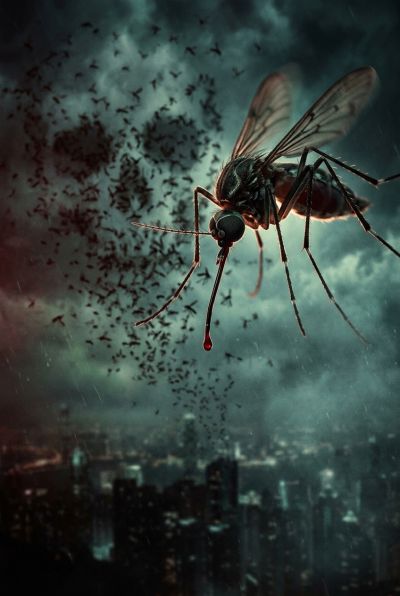
Mosquitoes: Enemy No. 1 Of Humanity takes readers on a sweeping journey through the biology, history, and global impact of the world’s deadliest insect. From the intricate anatomy of the mosquito’s proboscis and the sensory tricks it uses to locate a host, to the life‑cycle stages that turn stagnant water into a nursery, the book reveals how a creature no larger than a fingernail has shaped empires, altered genetic landscapes, and dictated the fates of nations. Readers will gain a deep understanding of why only a fraction of the 3,500+ species pose a threat, and how those few have become masterful vectors for malaria, dengue, yellow fever, Zika, chikungunya, West Nile virus, and a host of other debilitating diseases.
The narrative then turns to the human cost of this tiny predator, detailing the staggering economic burden that runs into billions of dollars each year in treatment, lost productivity, and strained healthcare systems. Chapters explore how mosquito‑borne illnesses have fueled poverty cycles, disrupted agriculture and tourism, and forced governments to divert precious resources from other critical needs. By examining real‑world case studies—from the construction of the Panama Canal to modern urban outbreaks—readers will see how the mosquito’s bite translates into lost wages, missed school days, and long‑term disabilities that echo across generations.
Equally important, the book chronicles humanity’s evolving arsenal against the mosquito, from ancient smoky fires and bed nets to the chemical age of DDT, the rise of insecticide resistance, and the dawn of biological control with bacteria, fish, and Wolbachia‑infected mosquitoes. Readers will learn about the science behind genetic modifications, sterile insect techniques, and controversial gene drives, as well as the surveillance tools—satellite imagery, PCR testing, and citizen‑science apps—that now allow public health officials to predict and intervene before epidemics take hold. Each chapter balances technical detail with accessible storytelling, making complex concepts clear for both specialists and curious laypeople.
Finally, Mosquitoes looks ahead to the innovations that could one day render the mosquito’s bite harmless: next‑generation vaccines, monoclonal antibodies, spatial repellents, attractive toxic sugar baits, and CRISPR‑based diagnostics. It confronts the ethical, ecological, and political questions surrounding eradication efforts, asking what a world without this ancient scourge might look like and what responsibilities humanity bears when wielding such power. By the end, readers will not only grasp the full scope of the mosquito’s threat but also appreciate the ingenuity, collaboration, and vigilance required to tip the scales in humanity’s favor.
What You'll Find Inside:
- The mosquito's specialized anatomy—especially the female's proboscis and host‑seeking senses—makes it a highly efficient vector for deadly pathogens.
- Mosquito‑borne diseases such as malaria, dengue, Zika, and yellow fever have profoundly influenced human history, causing massive mortality and ongoing economic strain.
- Control strategies have progressed from environmental management and chemical insecticides to biological agents, genetic modifications, and integrated surveillance‑based approaches.
- Climate change and urbanization expand mosquito habitats and accelerate pathogen transmission, increasing the risk of outbreaks in new regions.
- Emerging innovations like gene drives, Wolbachia‑infected mosquitoes, and next‑generation vaccines offer promise for disease suppression or eradication but raise significant ethical and ecological questions.
Who's It For:
This book is ideal for public health professionals, entomologists, infectious disease researchers, and policymakers who need a comprehensive understanding of mosquito biology, disease impact, and control strategies. It also serves students and educated readers interested in global health, environmental science, and the interplay between technology, ethics, and society in the fight against one of humanity's deadliest pests.
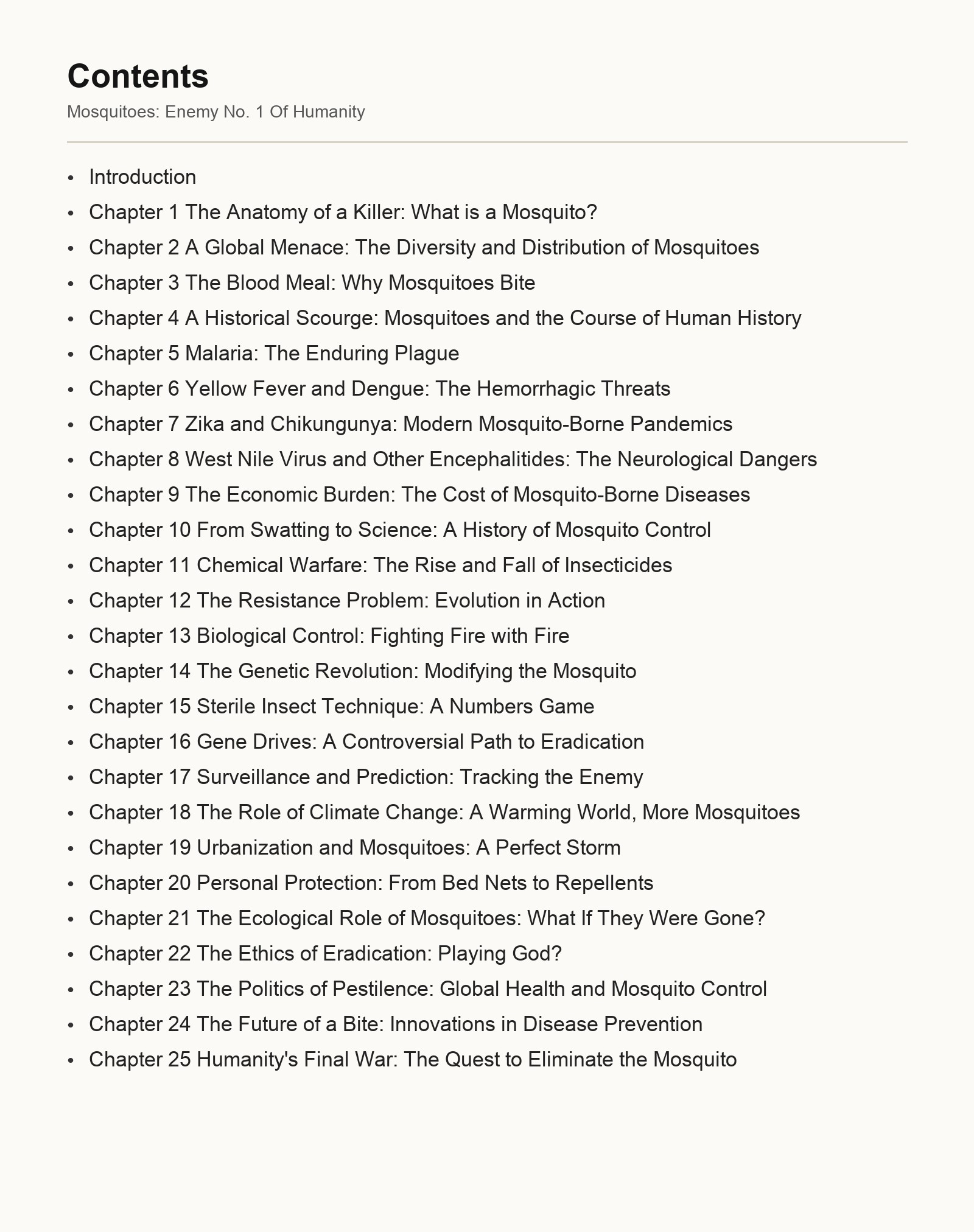
Table of Contents:
- Introduction
- Chapter 1 The Anatomy of a Killer: What is a Mosquito?
- Chapter 2 A Global Menace: The Diversity and Distribution of Mosquitoes
- Chapter 3 The Blood Meal: Why Mosquitoes Bite
- Chapter 4 A Historical Scourge: Mosquitoes and the Course of Human History
- Chapter 5 Malaria: The Enduring Plague
- Chapter 6 Yellow Fever and Dengue: The Hemorrhagic Threats
- Chapter 7 Zika and Chikungunya: Modern Mosquito-Borne Pandemics
- Chapter 8 West Nile Virus and Other Encephalitides: The Neurological Dangers
- Chapter 9 The Economic Burden: The Cost of Mosquito-Borne Diseases
- Chapter 10 From Swatting to Science: A History of Mosquito Control
- Chapter 11 Chemical Warfare: The Rise and Fall of Insecticides
- Chapter 12 The Resistance Problem: Evolution in Action
- Chapter 13 Biological Control: Fighting Fire with Fire
- Chapter 14 The Genetic Revolution: Modifying the Mosquito
- Chapter 15 Sterile Insect Technique: A Numbers Game
- Chapter 16 Gene Drives: A Controversial Path to Eradication
- Chapter 17 Surveillance and Prediction: Tracking the Enemy
- Chapter 18 The Role of Climate Change: A Warming World, More Mosquitoes
- Chapter 19 Urbanization and Mosquitoes: A Perfect Storm
- Chapter 20 Personal Protection: From Bed Nets to Repellents
- Chapter 21 The Ecological Role of Mosquitoes: What If They Were Gone?
- Chapter 22 The Ethics of Eradication: Playing God?
- Chapter 23 The Politics of Pestilence: Global Health and Mosquito Control
- Chapter 24 The Future of a Bite: Innovations in Disease Prevention
- Chapter 25 Humanity's Final War: The Quest to Eliminate the Mosquito
Author:
Published By:
Date Published:
May 22, 2026
Type:
Nonfiction
Language:
English
Also Available In:
Word Count:
49,220 words
Reading Time:
3 hours 27 minutes
Sample:
Order:
Order Mosquitoes (Hardcover) on MixCache.com:
Buy NowPrint copy is made to order and ships worldwide. Includes the ebook free, ready to read instantly.
$5 account credit for all new MixCache.com accounts, usable toward any ebook purchase!*


