
Browse by Category
Fiction
- Action & Adventure
- African American
- Anthologies
- Children's Fiction
- Classics
- Comics & Graphic Novels
- Coming of Age
- Contemporary
- Cultural & Regional
- Drama
- Erotica
- Fantasy
- General
- Historical Fiction
- Horror
- Humor & Satire
- Literary Fiction
- Mystery, Thriller & Suspense
- Poetry
- Religious & Inspirational
- Romance
- Science Fiction
- Short Stories
- War & Military
- Westerns
- Women's Fiction
- Young Adult
Non-Fiction
- Antiques & Collectibles
- Arts & Photography
- Biographies & Memoirs
- Business & Money
- Children's Non-Fiction
-
Computers & Technology
- Artificial Intelligence
- Computer Science
- Cybersecurity & Cryptography
- Data Science & Analytics
- Databases & Big Data
- Game Development & Design
- General
- Hardware & DIY
- Mobile App Development
- Networking & Cloud Computing
- Operating Systems
- Programming
- Robotics
- Software
- Software Engineering
- User Experience (UX) & Design
- Web Development & Design
- Cooking, Food & Wine
- Crafts, Hobbies & Home
- Education & Teaching
- Engineering
- General
- Health, Fitness & Dieting
-
History
- African History
- African History - North Africa
- African History - Sub-Saharan Africa
- American History
- American History - 20th Century
- American History - Civil War
- American History - Colonial Period
- Ancient History
- Asian History
- Asian History - China
- Asian History - India
- Asian History - Japan
- Asian History - Southeast Asia
- European History
- European History - Ancient Greece
- European History - Ancient Rome
- European History - Medieval
- European History - Modern
- European History - Renaissance
- General
- Middle Eastern History
- Military History
- Military History - Aviation
- Military History - Naval
- Social & Cultural History
- World History
- Humor & Entertainment
- Industrial Technology
- Language Learning
- Law
- LGBTQ+ Non-Fiction
- Literary Criticism
- Medical Books
- Parenting & Relationships
- Philosophy
- Politics & Social Sciences
- Reference
- Religion & Spirituality
-
Science & Math
- Agricultural Sciences
- Astronomy & Space Science
- Behavioral Sciences
- Biological Sciences
- Botany & Plant Science
- Chemistry
- Earth Sciences
- Engineering - Chemical
- Engineering - Civil
- Engineering - Electrical
- Engineering - Mechanical
- Environment
- General
- Geology
- Mathematics
- Nature & Ecology
- Oceanography
- Paleontology
- Physics
- Statistics
- Self-Help
- Sports & Outdoors
- Study Aids
- Sustainability & Green Living
- Textbooks
- Transportation
- Travel
- True Crime
- Urban Planning & Development
- Veterinary Medicine
- Writing & Publishing
Jump to Section
MixCache.com Total Access
Unlimited reading and audiobooks for every book published by MixCache.com.
Included titles carry the MTA badge.
Learn more →The History of Artillery
About this book:
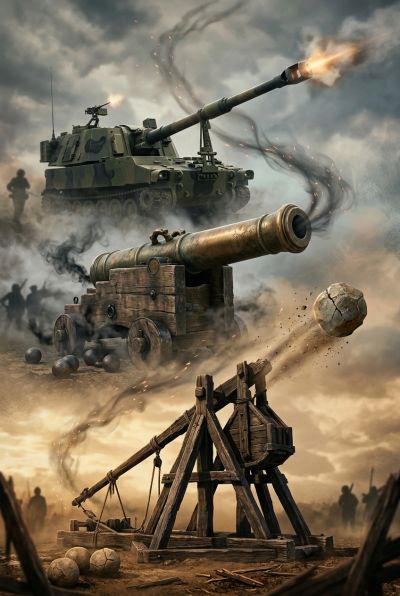
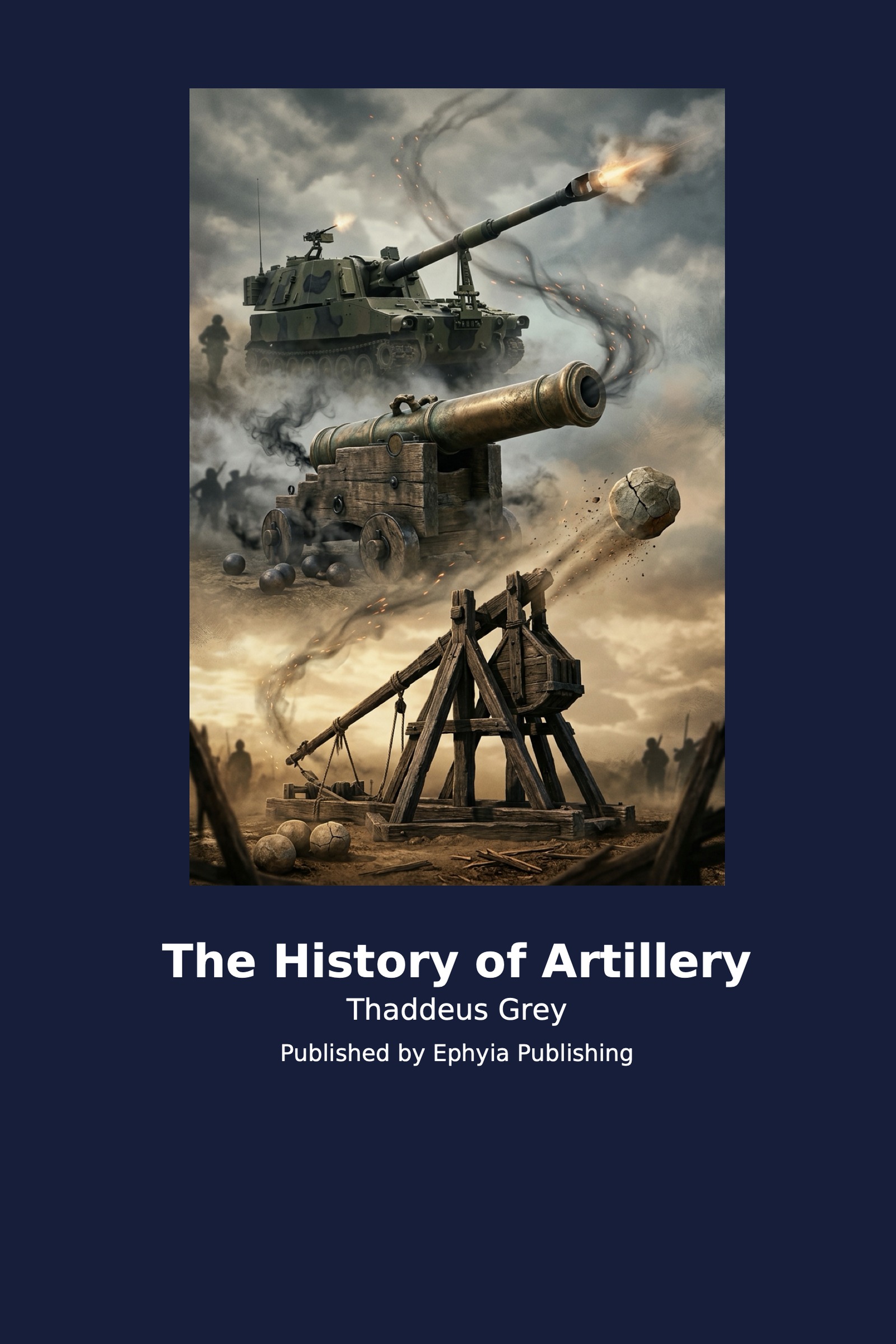

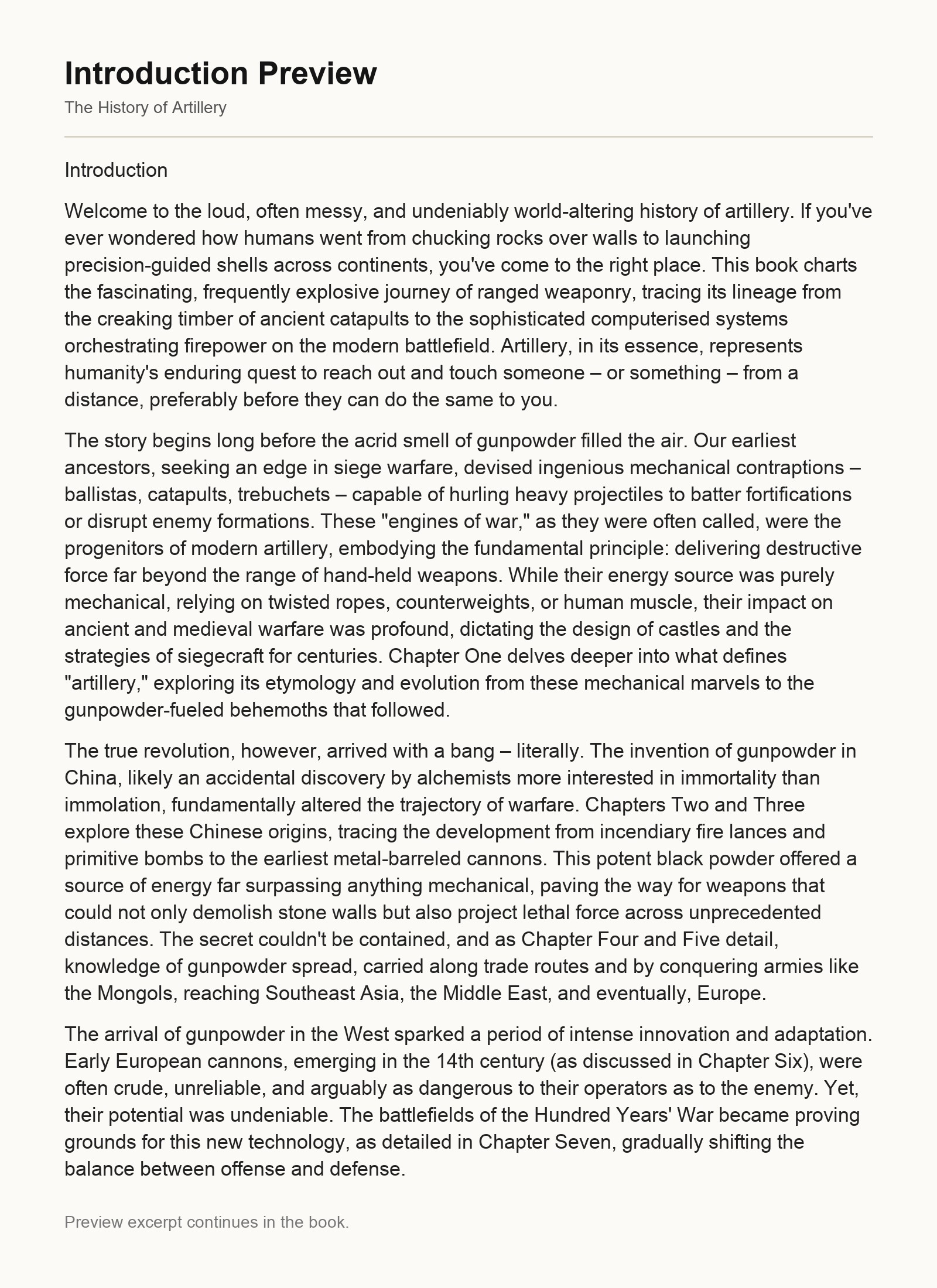
From the creaking timbers of ancient trebuchets to the whisper‑quiet guidance of GPS‑driven shells, this book charts the full sweep of artillery’s evolution. Readers will walk through every major era, seeing how humanity’s desire to strike from a distance drove relentless innovation in materials, chemistry, and engineering. The narrative makes clear that artillery is not just a collection of guns but a story of technological breakthroughs that reshaped the very nature of war.
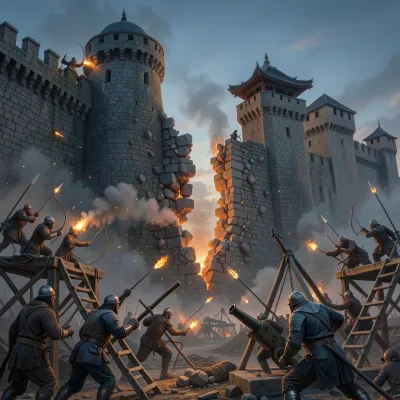
The journey begins in the alchemists’ workshops of Tang and Song China, where the accidental discovery of gunpowder lit the fuse for centuries of change. You will learn how early weapons like fire lances, thunderclap bombs, and primitive rockets emerged from those experiments, and how Chinese dynasties turned incendiary powder into the first true cannons. The text details the spread of this knowledge across Asia—Mongol conquests, Javanese foundries, Korean hwacha rockets—showing how diverse cultures adapted and improved the technology long before it reached Europe.
From there, the book follows gunpowder westward, tracing the slow diffusion through the Islamic world and into medieval Europe. You will witness the birth of hand cannons, the rise of monstrous bombards that shattered Constantinople’s walls, and the gradual refinement of cannon design that produced the “classic” bronze gun. Chapters on naval artillery reveal how gunpowder turned sea battles into long-range duels, while the section on bastion forts explains how engineers reinvented defense to counter the new threat, setting the stage for centuries of siegecraft innovation.
The industrial age brought a quantum leap: rifling, breech‑loading, and the Armstrong gun unlocked unprecedented range and accuracy. You will explore how these advances played out in the American Civil War, the birth of indirect fire in the late‑19th century, and the horrifying dominance of artillery in World War I’s trench warfare. The narrative continues into World War II, where mechanization, self‑propelled guns, proximity fuzes, and rocket systems transformed artillery into a mobile, lethal arm of combined‑arms warfare.
Finally, the book brings the story to the present and beyond. Readers will discover the precision revolution—guided munitions like Excalibur and GMLRS, networked fire control, and sensor‑fuzed submunitions—that turned artillery from an area weapon into a precise scalpel. The concluding chapters examine emerging technologies such as hypersonic projectiles, railguns, directed energy, and autonomous systems, revealing how the quest for ever‑greater reach, speed, and accuracy continues to shape the future of firepower. By the end, you will have a deep, global understanding of how artillery has evolved, why it matters on the battlefield, and what the next generation of long‑range weapons might look like.
What You'll Find Inside:
- Traces artillery's origins from ancient mechanical siege engines (trebuchets, ballistas) through Chinese gunpowder innovations like fire lances and iron-cased bombs to the first true cannons.
- Details pivotal technological leaps including rifling, breech-loading mechanisms, and the Armstrong gun that enabled modern artillery's range and accuracy.
- Explores tactical revolutions from direct fire to indirect fire systems, networked fire control, and precision-guided munitions transforming battlefield effectiveness.
- Examines artillery's decisive role in major conflicts from the Hundred Years' War and Napoleonic tactics to World War I's dominance and WWII mechanization.
- Covers global adaptations, specialized systems (naval, anti-aircraft, coastal), and emerging technologies like hypersonic projectiles and AI integration shaping future firepower.
Who's It For:
This comprehensive history is ideal for military history enthusiasts, defense professionals, and students of technological warfare seeking to understand artillery's evolution from ancient siege engines to modern precision systems. Readers interested in the interplay between technology, tactics, and conflict will find valuable insights into how artillery shaped major historical developments. The book particularly benefits those studying military innovation, fortification design, or the industrialization of war through detailed analysis of key advancements across centuries.
Table of Contents:
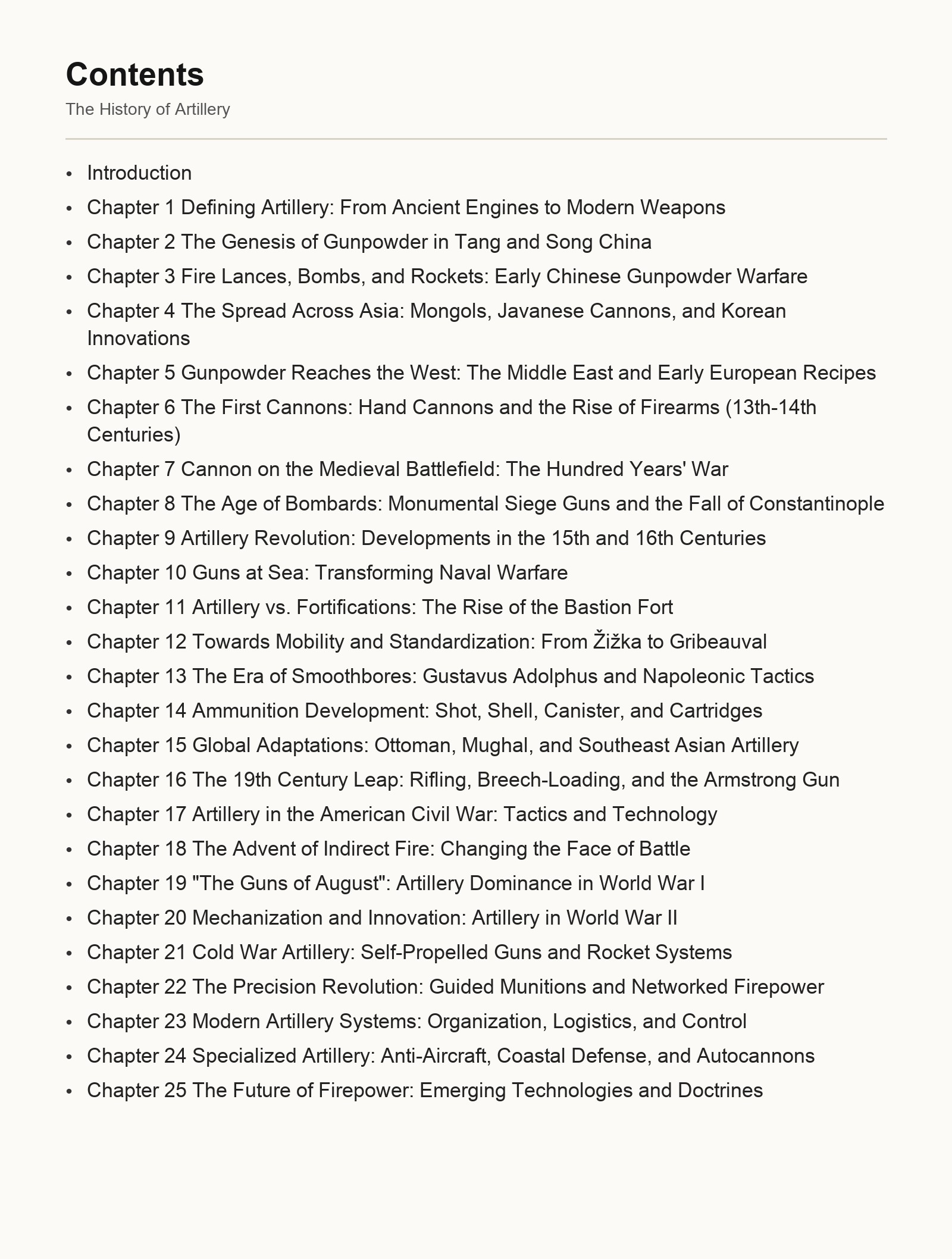
- Introduction
- Chapter 1 Defining Artillery: From Ancient Engines to Modern Weapons
- Chapter 2 The Genesis of Gunpowder in Tang and Song China
- Chapter 3 Fire Lances, Bombs, and Rockets: Early Chinese Gunpowder Warfare
- Chapter 4 The Spread Across Asia: Mongols, Javanese Cannons, and Korean Innovations
- Chapter 5 Gunpowder Reaches the West: The Middle East and Early European Recipes
- Chapter 6 The First Cannons: Hand Cannons and the Rise of Firearms (13th-14th Centuries)
- Chapter 7 Cannon on the Medieval Battlefield: The Hundred Years' War
- Chapter 8 The Age of Bombards: Monumental Siege Guns and the Fall of Constantinople
- Chapter 9 Artillery Revolution: Developments in the 15th and 16th Centuries
- Chapter 10 Guns at Sea: Transforming Naval Warfare
- Chapter 11 Artillery vs. Fortifications: The Rise of the Bastion Fort
- Chapter 12 Towards Mobility and Standardization: From Žižka to Gribeauval
- Chapter 13 The Era of Smoothbores: Gustavus Adolphus and Napoleonic Tactics
- Chapter 14 Ammunition Development: Shot, Shell, Canister, and Cartridges
- Chapter 15 Global Adaptations: Ottoman, Mughal, and Southeast Asian Artillery
- Chapter 16 The 19th Century Leap: Rifling, Breech-Loading, and the Armstrong Gun
- Chapter 17 Artillery in the American Civil War: Tactics and Technology
- Chapter 18 The Advent of Indirect Fire: Changing the Face of Battle
- Chapter 19 "The Guns of August": Artillery Dominance in World War I
- Chapter 20 Mechanization and Innovation: Artillery in World War II
- Chapter 21 Cold War Artillery: Self-Propelled Guns and Rocket Systems
- Chapter 22 The Precision Revolution: Guided Munitions and Networked Firepower
- Chapter 23 Modern Artillery Systems: Organization, Logistics, and Control
- Chapter 24 Specialized Artillery: Anti-Aircraft, Coastal Defense, and Autocannons
- Chapter 25 The Future of Firepower: Emerging Technologies and Doctrines
Author:
Published By:
Date Published:
May 21, 2026
Type:
Nonfiction
Language:
English
Also Available In:
Word Count:
55,593 words
Reading Time:
3 hours 54 minutes
Sample:
Order:
Buy the The History of Artillery ebook on MixCache.com:
Buy NowThe full ebook will be available immediately to read instantly on any device.
$5 account credit for all new MixCache.com accounts, usable toward any ebook purchase!*




Ratings & Reviews
Ask Questions About This Book
Have a question about the content? Ask our AI assistant!
Start by asking a question about "The History of Artillery"
Example: "Does this book mention William Shakespeare?"
Thinking...