Browse by Category
Fiction
- Action & Adventure
- African American
- Anthologies
- Children's Fiction
- Classics
- Comics & Graphic Novels
- Coming of Age
- Contemporary
- Cultural & Regional
- Drama
- Erotica
- Fantasy
- General
- Historical Fiction
- Horror
- Humor & Satire
- Literary Fiction
- Mystery, Thriller & Suspense
- Poetry
- Religious & Inspirational
- Romance
- Science Fiction
- Short Stories
- War & Military
- Westerns
- Women's Fiction
- Young Adult
Non-Fiction
- Antiques & Collectibles
- Arts & Photography
- Biographies & Memoirs
- Business & Money
- Children's Non-Fiction
-
Computers & Technology
- Artificial Intelligence
- Computer Science
- Cybersecurity & Cryptography
- Data Science & Analytics
- Databases & Big Data
- Game Development & Design
- General
- Hardware & DIY
- Mobile App Development
- Networking & Cloud Computing
- Operating Systems
- Programming
- Robotics
- Software
- Software Engineering
- User Experience (UX) & Design
- Web Development & Design
- Cooking, Food & Wine
- Crafts, Hobbies & Home
- Education & Teaching
- Engineering
- General
- Health, Fitness & Dieting
-
History
- African History
- African History - North Africa
- African History - Sub-Saharan Africa
- American History
- American History - 20th Century
- American History - Civil War
- American History - Colonial Period
- Ancient History
- Asian History
- Asian History - China
- Asian History - India
- Asian History - Japan
- Asian History - Southeast Asia
- European History
- European History - Ancient Greece
- European History - Ancient Rome
- European History - Medieval
- European History - Modern
- European History - Renaissance
- General
- Middle Eastern History
- Military History
- Military History - Aviation
- Military History - Naval
- Social & Cultural History
- World History
- Humor & Entertainment
- Industrial Technology
- Language Learning
- Law
- LGBTQ+ Non-Fiction
- Literary Criticism
- Medical Books
- Parenting & Relationships
- Philosophy
- Politics & Social Sciences
- Reference
- Religion & Spirituality
-
Science & Math
- Agricultural Sciences
- Astronomy & Space Science
- Behavioral Sciences
- Biological Sciences
- Botany & Plant Science
- Chemistry
- Earth Sciences
- Engineering - Chemical
- Engineering - Civil
- Engineering - Electrical
- Engineering - Mechanical
- Environment
- General
- Geology
- Mathematics
- Nature & Ecology
- Oceanography
- Paleontology
- Physics
- Statistics
- Self-Help
- Sports & Outdoors
- Study Aids
- Sustainability & Green Living
- Textbooks
- Transportation
- Travel
- True Crime
- Urban Planning & Development
- Veterinary Medicine
- Writing & Publishing
Jump to Section
MixCache.com Total Access
Unlimited reading and audiobooks for every book published by MixCache.com.
Included titles carry the MTA badge.
Learn more →
Immigration
A Concise History
About this book:


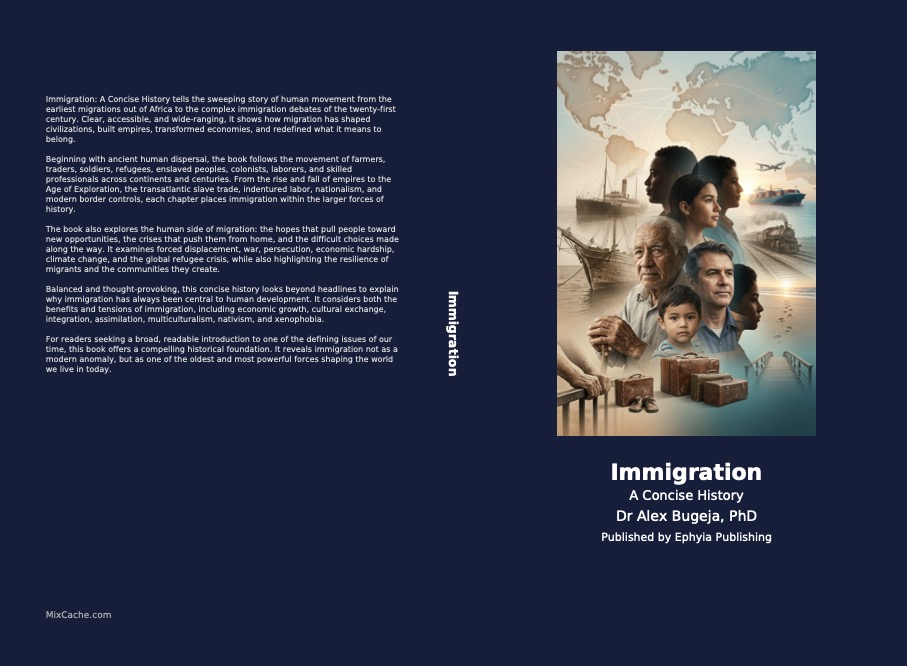
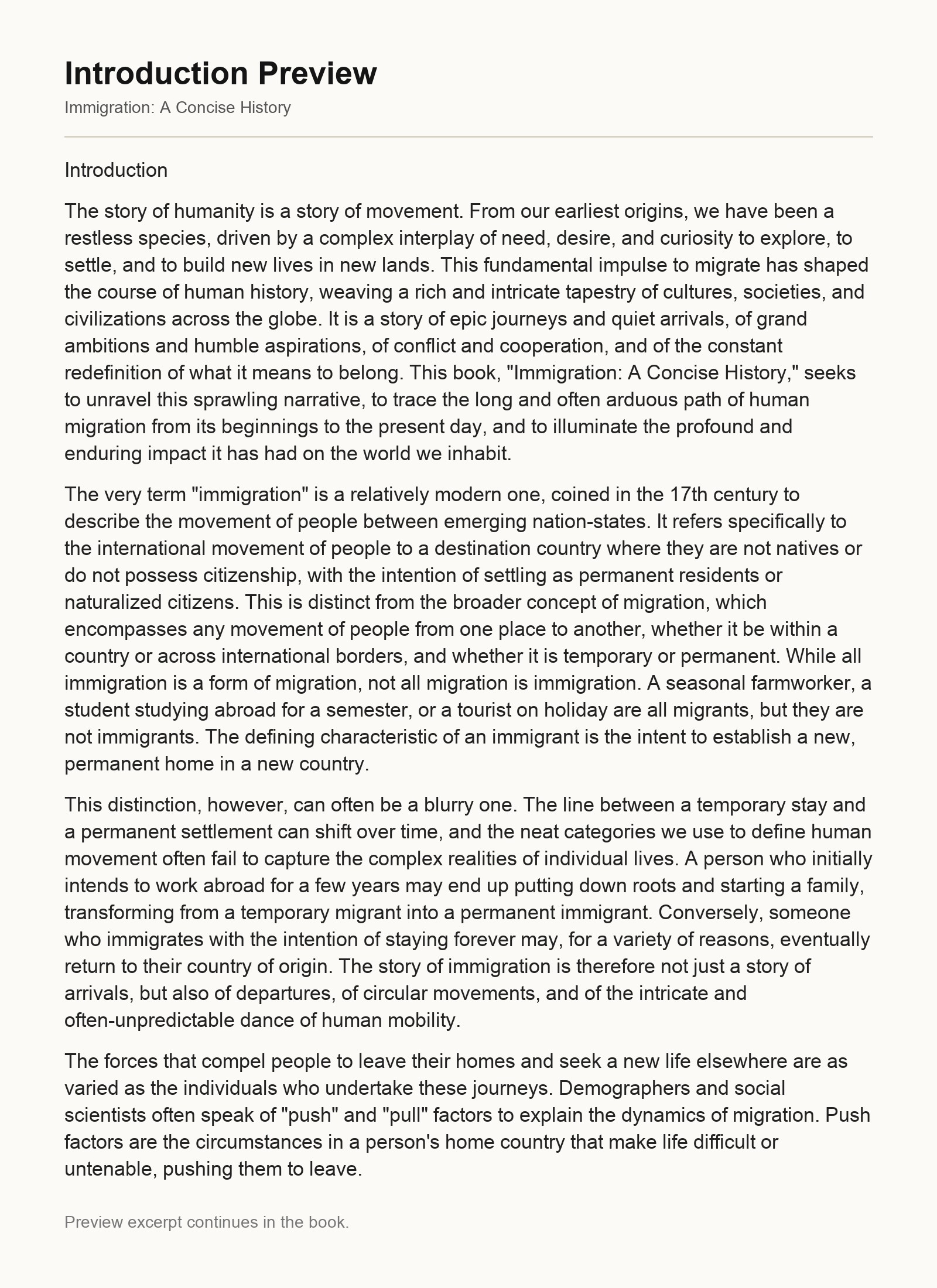
Immigration: A Concise History tells the sweeping story of human movement from the earliest migrations out of Africa to the complex immigration debates of the twenty-first century. Clear, accessible, and wide-ranging, it shows how migration has shaped civilizations, built empires, transformed economies, and redefined what it means to belong.
Beginning with ancient human dispersal, the book follows the movement of farmers, traders, soldiers, refugees, enslaved peoples, colonists, laborers, and skilled professionals across continents and centuries. From the rise and fall of empires to the Age of Exploration, the transatlantic slave trade, indentured labor, nationalism, and modern border controls, each chapter places immigration within the larger forces of history.
The book also explores the human side of migration: the hopes that pull people toward new opportunities, the crises that push them from home, and the difficult choices made along the way. It examines forced displacement, war, persecution, economic hardship, climate change, and the global refugee crisis, while also highlighting the resilience of migrants and the communities they create.
Balanced and thought-provoking, this concise history looks beyond headlines to explain why immigration has always been central to human development. It considers both the benefits and tensions of immigration, including economic growth, cultural exchange, integration, assimilation, multiculturalism, nativism, and xenophobia.
For readers seeking a broad, readable introduction to one of the defining issues of our time, this book offers a compelling historical foundation. It reveals immigration not as a modern anomaly, but as one of the oldest and most powerful forces shaping the world we live in today.
What You'll Find Inside:
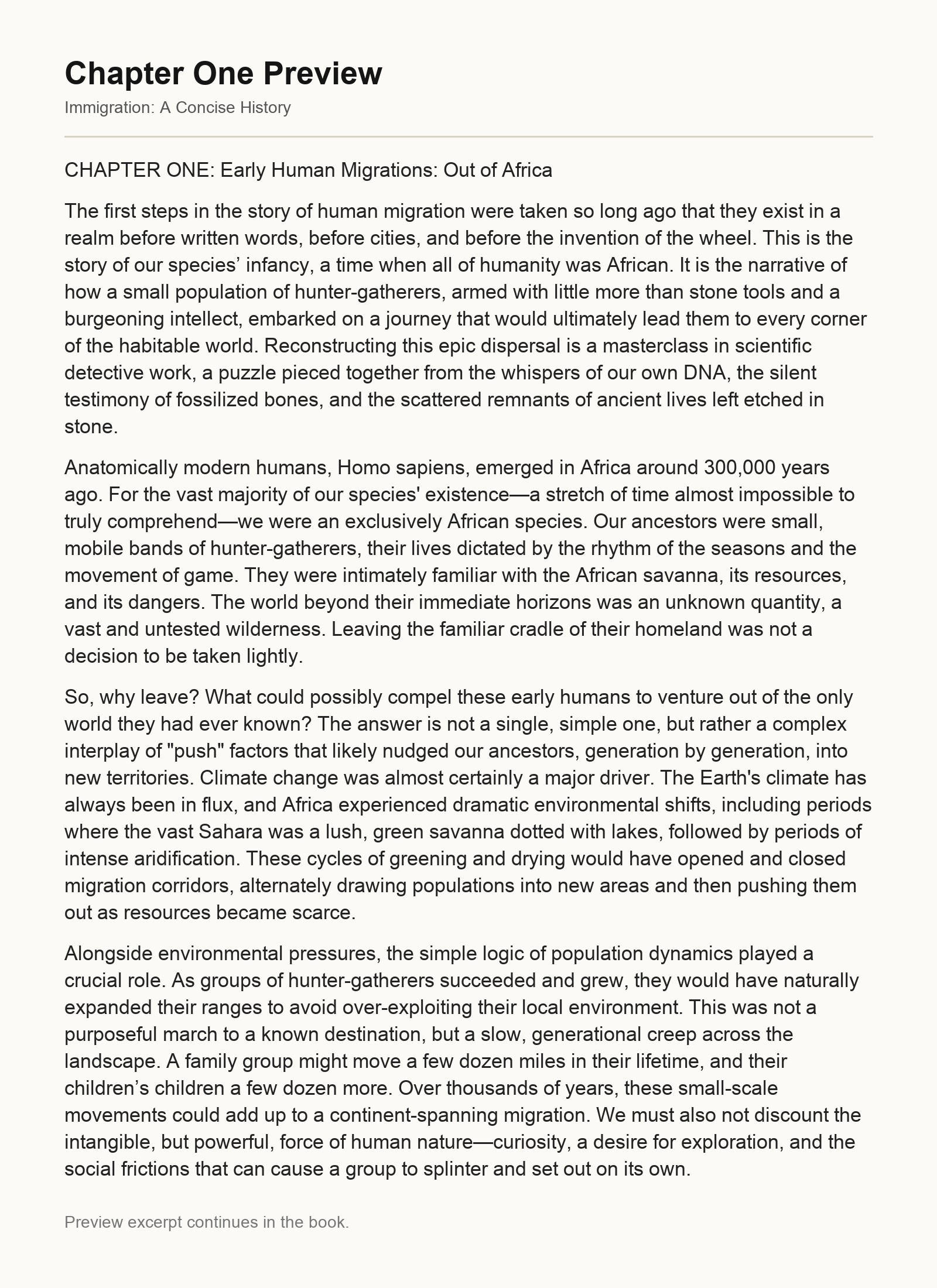
- Traces human migration from early Out of Africa movements to contemporary 21st-century patterns, emphasizing migration as a continuous human phenomenon.
- Examines major forced migration systems including the transatlantic slave trade, indentured labor, and refugee displacements across historical periods.
- Analyzes how migration has shaped empires, nations, and cultural landscapes from ancient civilizations to modern multicultural societies.
- Explores socioeconomic impacts of migration, including labor market effects, remittances, brain drain, and economic development in sending and receiving countries.
- Addresses contemporary challenges such as climate-induced migration, global refugee crises, border security policies, and future immigration trends.
Who's It For:
This book is ideal for students, educators, policymakers, and general readers seeking a historical foundation for understanding contemporary immigration issues. It provides essential context for those involved in immigration debates, refugee assistance, or international relations. Readers interested in history, sociology, anthropology, or global affairs will find valuable insights into how past migration patterns shape present realities. The concise yet comprehensive approach makes it accessible for both academic and non-academic audiences aiming to deepen their understanding of human mobility's role in shaping our world.
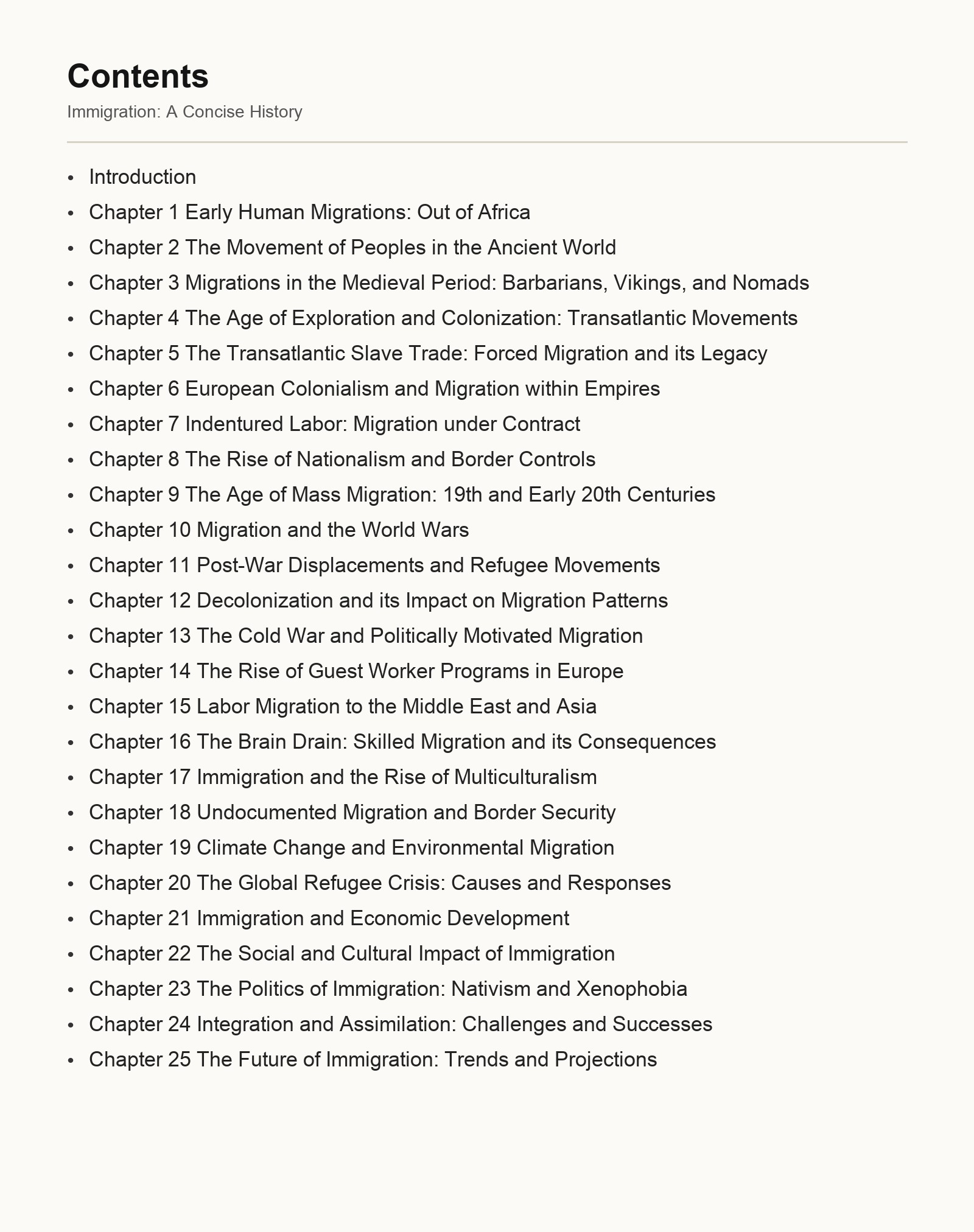
Table of Contents:
-
Introduction
-
Chapter 1 Early Human Migrations: Out of Africa
-
Chapter 2 The Movement of Peoples in the Ancient World
-
Chapter 3 Migrations in the Medieval Period: Barbarians, Vikings, and Nomads
-
Chapter 4 The Age of Exploration and Colonization: Transatlantic Movements
-
Chapter 5 The Transatlantic Slave Trade: Forced Migration and its Legacy
-
Chapter 6 European Colonialism and Migration within Empires
-
Chapter 7 Indentured Labor: Migration under Contract
-
Chapter 8 The Rise of Nationalism and Border Controls
-
Chapter 9 The Age of Mass Migration: 19th and Early 20th Centuries
-
Chapter 10 Migration and the World Wars
-
Chapter 11 Post-War Displacements and Refugee Movements
-
Chapter 12 Decolonization and its Impact on Migration Patterns
-
Chapter 13 The Cold War and Politically Motivated Migration
-
Chapter 14 The Rise of Guest Worker Programs in Europe
-
Chapter 15 Labor Migration to the Middle East and Asia
-
Chapter 16 The Brain Drain: Skilled Migration and its Consequences
-
Chapter 17 Immigration and the Rise of Multiculturalism
-
Chapter 18 Undocumented Migration and Border Security
-
Chapter 19 Climate Change and Environmental Migration
-
Chapter 20 The Global Refugee Crisis: Causes and Responses
-
Chapter 21 Immigration and Economic Development
-
Chapter 22 The Social and Cultural Impact of Immigration
-
Chapter 23 The Politics of Immigration: Nativism and Xenophobia
-
Chapter 24 Integration and Assimilation: Challenges and Successes
-
Chapter 25 The Future of Immigration: Trends and Projections
Author:
Published By:
Date Published:
May 21, 2026
Type:
Nonfiction
Language:
English
Also Available In:
Word Count:
58,991 words
Reading Time:
4 hours 8 minutes
Sample:
Order:
Order Immigration (Paperback) on MixCache.com:
Buy NowPrint copy is made to order and ships worldwide. Includes the ebook free, ready to read instantly.
$5 account credit for all new MixCache.com accounts, usable toward any ebook purchase!*