Browse by Category
Fiction
- Action & Adventure
- African American
- Anthologies
- Children's Fiction
- Classics
- Comics & Graphic Novels
- Coming of Age
- Contemporary
- Cultural & Regional
- Drama
- Erotica
- Fantasy
- General
- Historical Fiction
- Horror
- Humor & Satire
- Literary Fiction
- Mystery, Thriller & Suspense
- Poetry
- Religious & Inspirational
- Romance
- Science Fiction
- Short Stories
- War & Military
- Westerns
- Women's Fiction
- Young Adult
Non-Fiction
- Antiques & Collectibles
- Arts & Photography
- Biographies & Memoirs
- Business & Money
- Children's Non-Fiction
-
Computers & Technology
- Artificial Intelligence
- Computer Science
- Cybersecurity & Cryptography
- Data Science & Analytics
- Databases & Big Data
- Game Development & Design
- General
- Hardware & DIY
- Mobile App Development
- Networking & Cloud Computing
- Operating Systems
- Programming
- Robotics
- Software
- Software Engineering
- User Experience (UX) & Design
- Web Development & Design
- Cooking, Food & Wine
- Crafts, Hobbies & Home
- Education & Teaching
- Engineering
- General
- Health, Fitness & Dieting
-
History
- African History
- African History - North Africa
- African History - Sub-Saharan Africa
- American History
- American History - 20th Century
- American History - Civil War
- American History - Colonial Period
- Ancient History
- Asian History
- Asian History - China
- Asian History - India
- Asian History - Japan
- Asian History - Southeast Asia
- European History
- European History - Ancient Greece
- European History - Ancient Rome
- European History - Medieval
- European History - Modern
- European History - Renaissance
- General
- Middle Eastern History
- Military History
- Military History - Aviation
- Military History - Naval
- Social & Cultural History
- World History
- Humor & Entertainment
- Industrial Technology
- Language Learning
- Law
- LGBTQ+ Non-Fiction
- Literary Criticism
- Medical Books
- Parenting & Relationships
- Philosophy
- Politics & Social Sciences
- Reference
- Religion & Spirituality
-
Science & Math
- Agricultural Sciences
- Astronomy & Space Science
- Behavioral Sciences
- Biological Sciences
- Botany & Plant Science
- Chemistry
- Earth Sciences
- Engineering - Chemical
- Engineering - Civil
- Engineering - Electrical
- Engineering - Mechanical
- Environment
- General
- Geology
- Mathematics
- Nature & Ecology
- Oceanography
- Paleontology
- Physics
- Statistics
- Self-Help
- Sports & Outdoors
- Study Aids
- Sustainability & Green Living
- Textbooks
- Transportation
- Travel
- True Crime
- Urban Planning & Development
- Veterinary Medicine
- Writing & Publishing
Jump to Section
MixCache.com Total Access
Unlimited reading and audiobooks for every book published by MixCache.com.
Included titles carry the MTA badge.
Learn more →A History of Honduras
About this book:
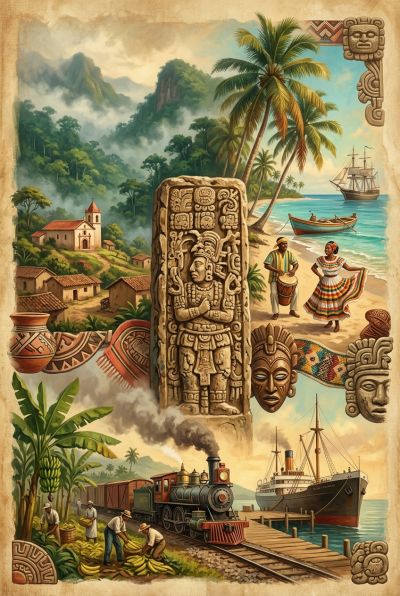
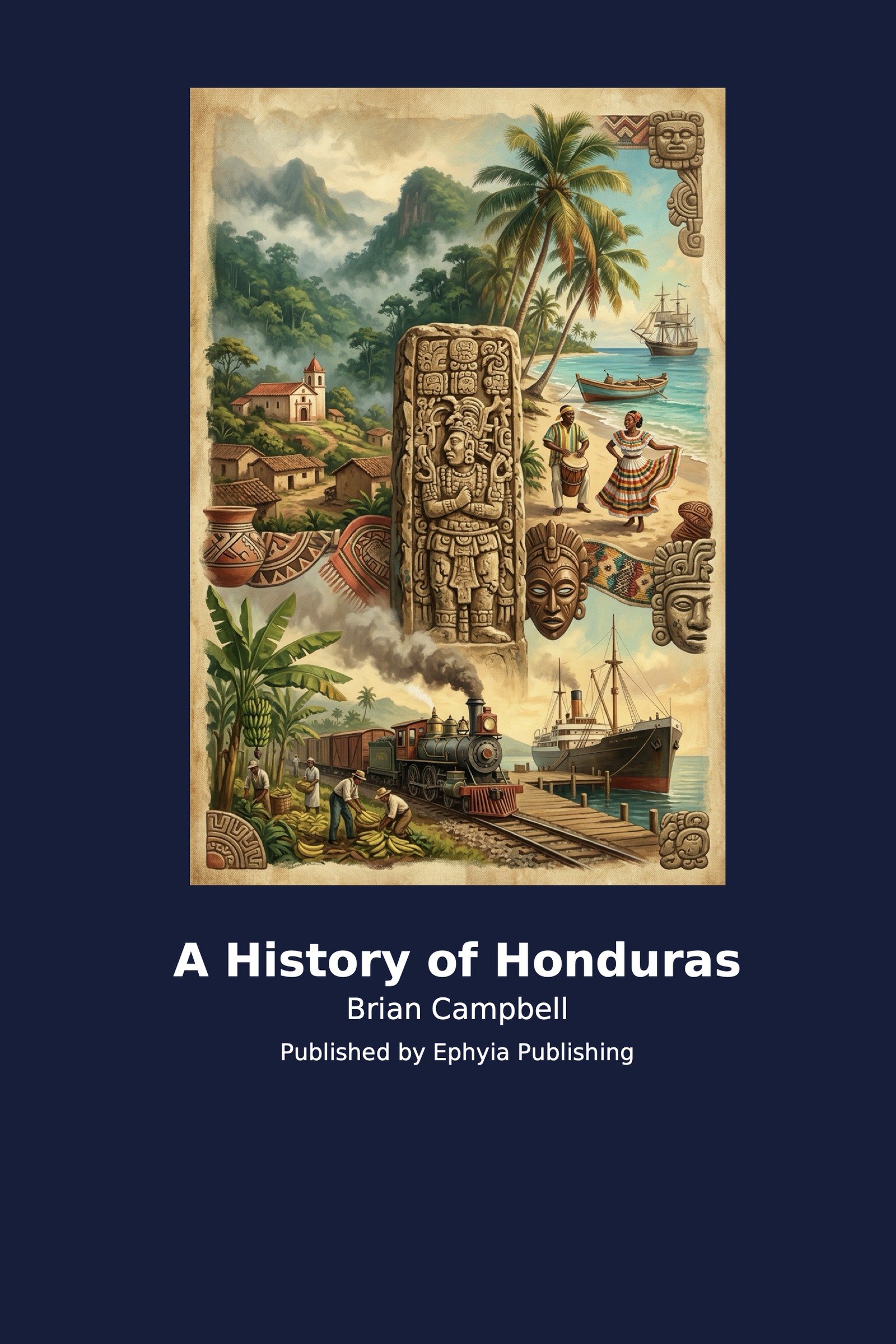
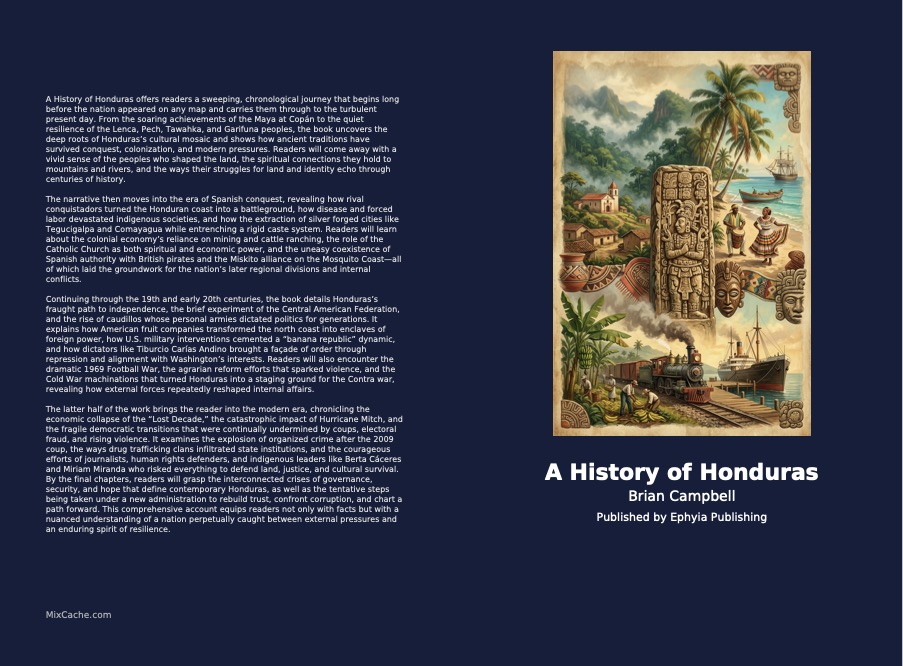
A History of Honduras offers readers a sweeping, chronological journey that begins long before the nation appeared on any map and carries them through to the turbulent present day. From the soaring achievements of the Maya at Copán to the quiet resilience of the Lenca, Pech, Tawahka, and Garifuna peoples, the book uncovers the deep roots of Honduras’s cultural mosaic and shows how ancient traditions have survived conquest, colonization, and modern pressures. Readers will come away with a vivid sense of the peoples who shaped the land, the spiritual connections they hold to mountains and rivers, and the ways their struggles for land and identity echo through centuries of history.
The narrative then moves into the era of Spanish conquest, revealing how rival conquistadors turned the Honduran coast into a battleground, how disease and forced labor devastated indigenous societies, and how the extraction of silver forged cities like Tegucigalpa and Comayagua while entrenching a rigid caste system. Readers will learn about the colonial economy’s reliance on mining and cattle ranching, the role of the Catholic Church as both spiritual and economic power, and the uneasy coexistence of Spanish authority with British pirates and the Miskito alliance on the Mosquito Coast—all of which laid the groundwork for the nation’s later regional divisions and internal conflicts.
Continuing through the 19th and early 20th centuries, the book details Honduras’s fraught path to independence, the brief experiment of the Central American Federation, and the rise of caudillos whose personal armies dictated politics for generations. It explains how American fruit companies transformed the north coast into enclaves of foreign power, how U.S. military interventions cemented a “banana republic” dynamic, and how dictators like Tiburcio Carías Andino brought a façade of order through repression and alignment with Washington’s interests. Readers will also encounter the dramatic 1969 Football War, the agrarian reform efforts that sparked violence, and the Cold War machinations that turned Honduras into a staging ground for the Contra war, revealing how external forces repeatedly reshaped internal affairs.
The latter half of the work brings the reader into the modern era, chronicling the economic collapse of the “Lost Decade,” the catastrophic impact of Hurricane Mitch, and the fragile democratic transitions that were continually undermined by coups, electoral fraud, and rising violence. It examines the explosion of organized crime after the 2009 coup, the ways drug trafficking clans infiltrated state institutions, and the courageous efforts of journalists, human rights defenders, and indigenous leaders like Berta Cáceres and Miriam Miranda who risked everything to defend land, justice, and cultural survival. By the final chapters, readers will grasp the interconnected crises of governance, security, and hope that define contemporary Honduras, as well as the tentative steps being taken under a new administration to rebuild trust, confront corruption, and chart a path forward. This comprehensive account equips readers not only with facts but with a nuanced understanding of a nation perpetually caught between external pressures and an enduring spirit of resilience.
What You'll Find Inside:
- Pre-Columbian civilizations and indigenous cultures, including the Maya at Copán and groups like the Lenca, Pech, Tawahka, and Tolupan
- Spanish conquest, colonization, and indigenous resistance exemplified by the Lempira legend and subsequent colonial society
- Political evolution from independence through 19th-century caudillo rule, the failed Central American Federation, and early republican instability
- 20th-century transformations including the banana republic era, dictatorships like Tiburcio Carías Andino, military rule, and conflicts such as the Football War
- Contemporary challenges from Hurricane Mitch to the 2009 constitutional crisis, rise of organized crime, human rights struggles, and recent political developments
Who's It For:
This book is ideal for students, researchers, and general readers seeking a comprehensive understanding of Honduras' complex history. It will particularly benefit those interested in Latin American studies, Central American politics, or the historical roots of contemporary social and political challenges in Honduras. Professionals working in international development, diplomacy, or humanitarian efforts related to Honduras will also find valuable context for their work.
Table of Contents:
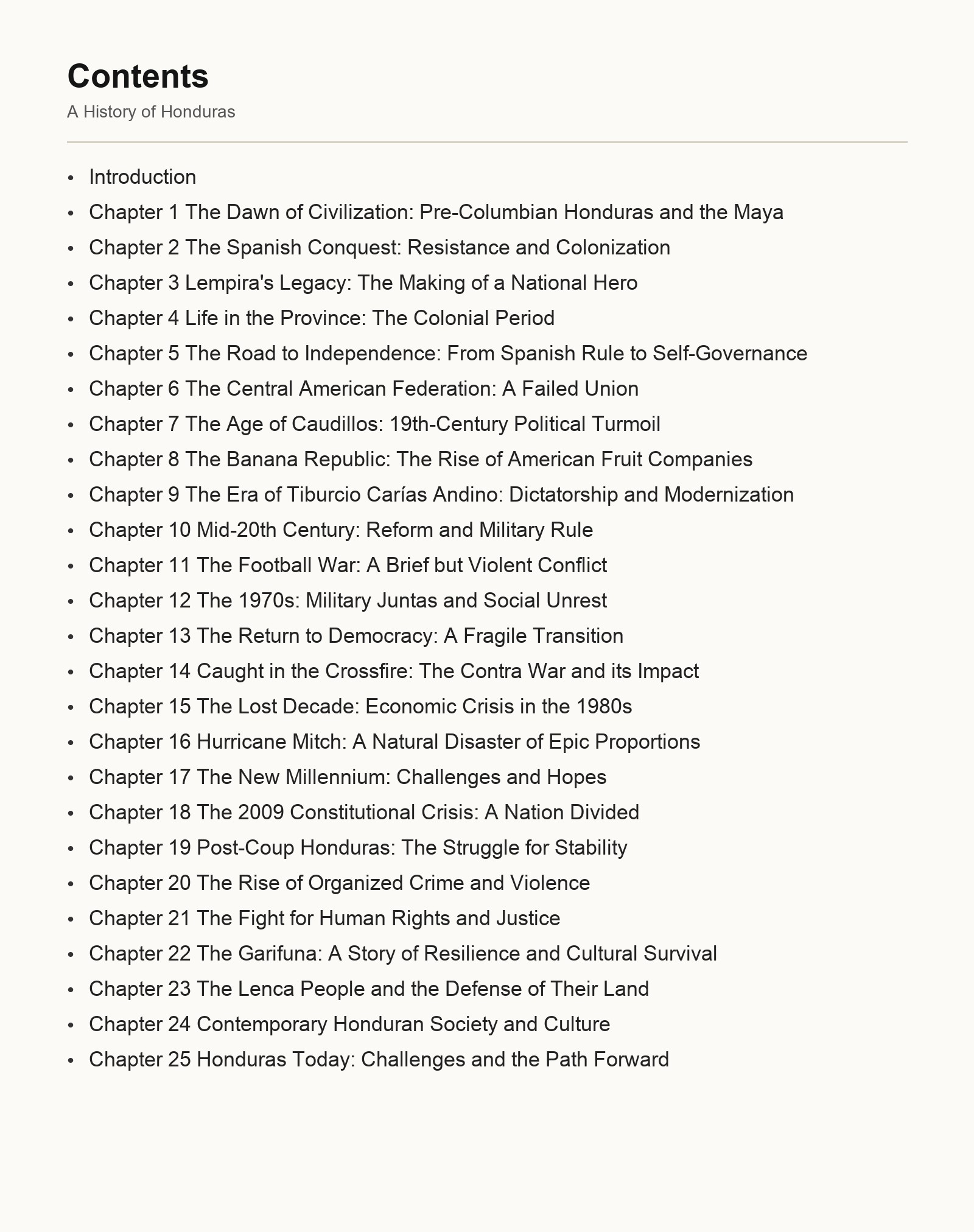
- Introduction
- Chapter 1 The Dawn of Civilization: Pre-Columbian Honduras and the Maya
- Chapter 2 The Spanish Conquest: Resistance and Colonization
- Chapter 3 Lempira's Legacy: The Making of a National Hero
- Chapter 4 Life in the Province: The Colonial Period
- Chapter 5 The Road to Independence: From Spanish Rule to Self-Governance
- Chapter 6 The Central American Federation: A Failed Union
- Chapter 7 The Age of Caudillos: 19th-Century Political Turmoil
- Chapter 8 The Banana Republic: The Rise of American Fruit Companies
- Chapter 9 The Era of Tiburcio Carías Andino: Dictatorship and Modernization
- Chapter 10 Mid-20th Century: Reform and Military Rule
- Chapter 11 The Football War: A Brief but Violent Conflict
- Chapter 12 The 1970s: Military Juntas and Social Unrest
- Chapter 13 The Return to Democracy: A Fragile Transition
- Chapter 14 Caught in the Crossfire: The Contra War and its Impact
- Chapter 15 The Lost Decade: Economic Crisis in the 1980s
- Chapter 16 Hurricane Mitch: A Natural Disaster of Epic Proportions
- Chapter 17 The New Millennium: Challenges and Hopes
- Chapter 18 The 2009 Constitutional Crisis: A Nation Divided
- Chapter 19 Post-Coup Honduras: The Struggle for Stability
- Chapter 20 The Rise of Organized Crime and Violence
- Chapter 21 The Fight for Human Rights and Justice
- Chapter 22 The Garifuna: A Story of Resilience and Cultural Survival
- Chapter 23 The Lenca People and the Defense of Their Land
- Chapter 24 Contemporary Honduran Society and Culture
- Chapter 25 Honduras Today: Challenges and the Path Forward
Author:
Published By:
Date Published:
May 21, 2026
Type:
Nonfiction
Language:
English
Also Available In:
Word Count:
44,339 words
Reading Time:
3 hours 6 minutes
Sample:
Order:
Order A History of Honduras (Hardcover) on MixCache.com:
Buy NowPrint copy is made to order and ships worldwide. Includes the ebook free, ready to read instantly.
$5 account credit for all new MixCache.com accounts, usable toward any ebook purchase!*