
Browse by Category
Fiction
- Action & Adventure
- African American
- Anthologies
- Children's Fiction
- Classics
- Comics & Graphic Novels
- Coming of Age
- Contemporary
- Cultural & Regional
- Drama
- Erotica
- Fantasy
- General
- Historical Fiction
- Horror
- Humor & Satire
- Literary Fiction
- Mystery, Thriller & Suspense
- Poetry
- Religious & Inspirational
- Romance
- Science Fiction
- Short Stories
- War & Military
- Westerns
- Women's Fiction
- Young Adult
Non-Fiction
- Antiques & Collectibles
- Arts & Photography
- Biographies & Memoirs
- Business & Money
- Children's Non-Fiction
-
Computers & Technology
- Artificial Intelligence
- Computer Science
- Cybersecurity & Cryptography
- Data Science & Analytics
- Databases & Big Data
- Game Development & Design
- General
- Hardware & DIY
- Mobile App Development
- Networking & Cloud Computing
- Operating Systems
- Programming
- Robotics
- Software
- Software Engineering
- User Experience (UX) & Design
- Web Development & Design
- Cooking, Food & Wine
- Crafts, Hobbies & Home
- Education & Teaching
- Engineering
- General
- Health, Fitness & Dieting
-
History
- African History
- African History - North Africa
- African History - Sub-Saharan Africa
- American History
- American History - 20th Century
- American History - Civil War
- American History - Colonial Period
- Ancient History
- Asian History
- Asian History - China
- Asian History - India
- Asian History - Japan
- Asian History - Southeast Asia
- European History
- European History - Ancient Greece
- European History - Ancient Rome
- European History - Medieval
- European History - Modern
- European History - Renaissance
- General
- Middle Eastern History
- Military History
- Military History - Aviation
- Military History - Naval
- Social & Cultural History
- World History
- Humor & Entertainment
- Industrial Technology
- Language Learning
- Law
- LGBTQ+ Non-Fiction
- Literary Criticism
- Medical Books
- Parenting & Relationships
- Philosophy
- Politics & Social Sciences
- Reference
- Religion & Spirituality
-
Science & Math
- Agricultural Sciences
- Astronomy & Space Science
- Behavioral Sciences
- Biological Sciences
- Botany & Plant Science
- Chemistry
- Earth Sciences
- Engineering - Chemical
- Engineering - Civil
- Engineering - Electrical
- Engineering - Mechanical
- Environment
- General
- Geology
- Mathematics
- Nature & Ecology
- Oceanography
- Paleontology
- Physics
- Statistics
- Self-Help
- Sports & Outdoors
- Study Aids
- Sustainability & Green Living
- Textbooks
- Transportation
- Travel
- True Crime
- Urban Planning & Development
- Veterinary Medicine
- Writing & Publishing
Jump to Section
MixCache.com Total Access
Unlimited reading and audiobooks for every book published by MixCache.com.
Included titles carry the MTA badge.
Learn more →
Infamy
The Lives of the Condemned and the Cursed
About this book:

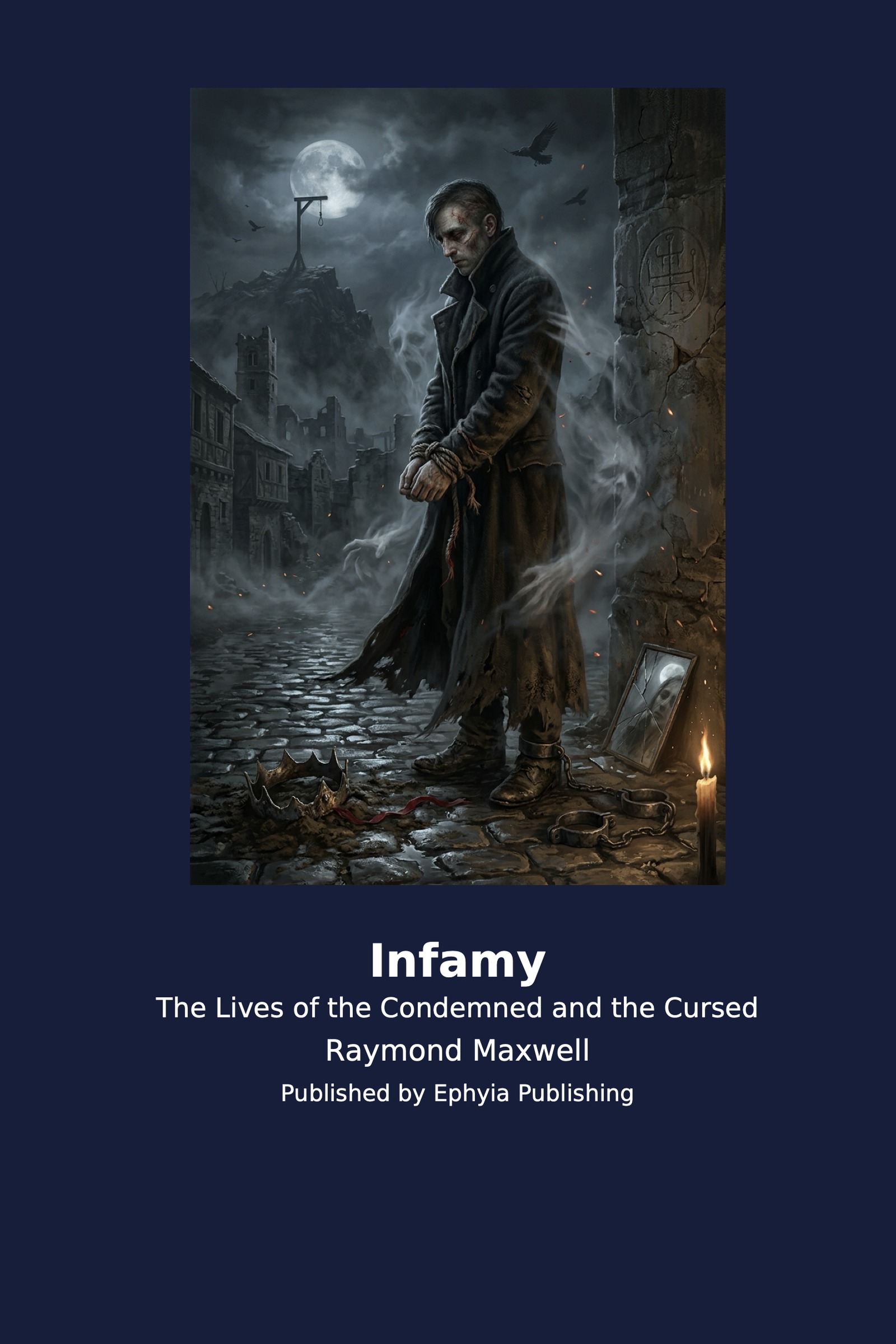
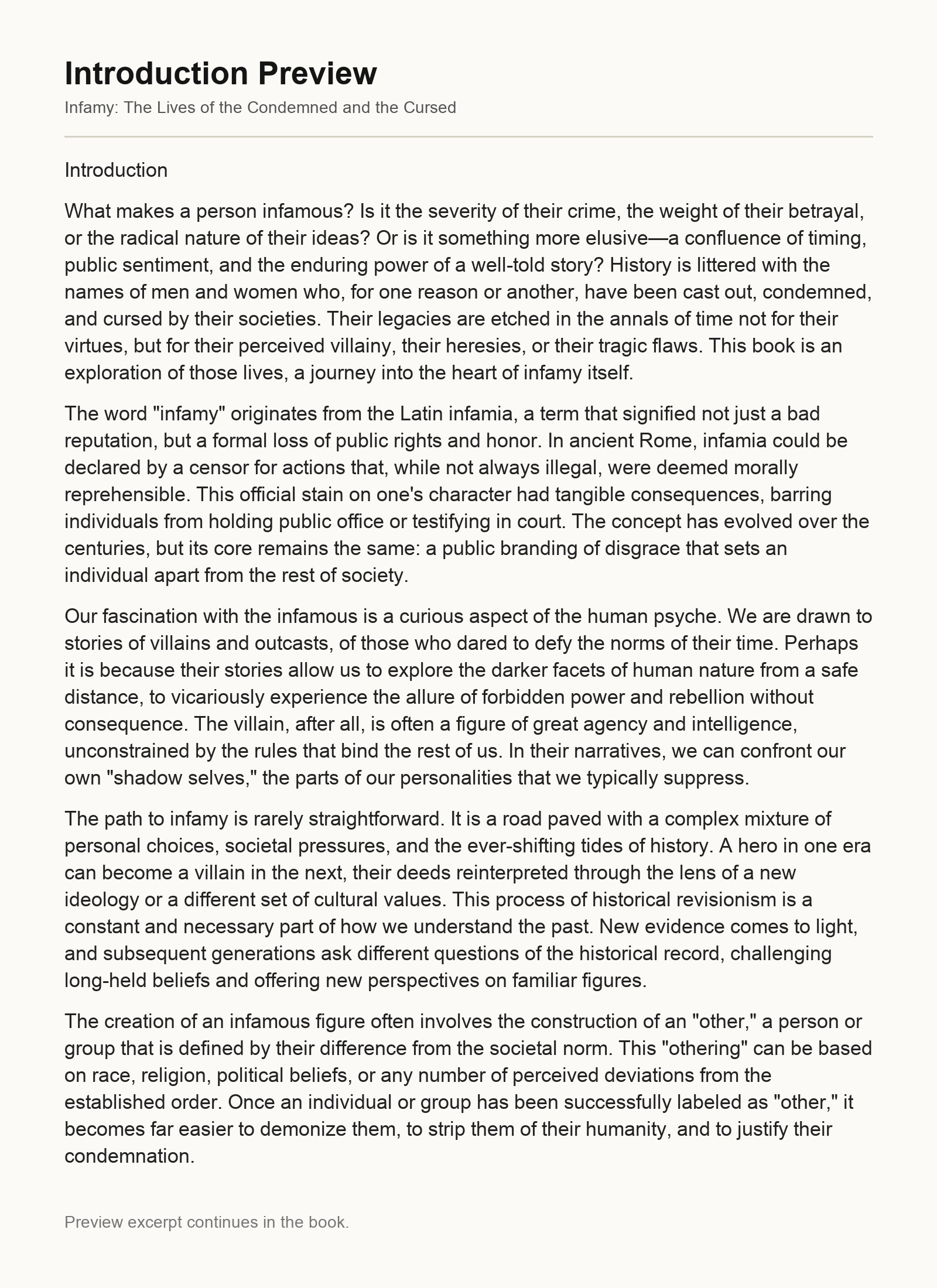
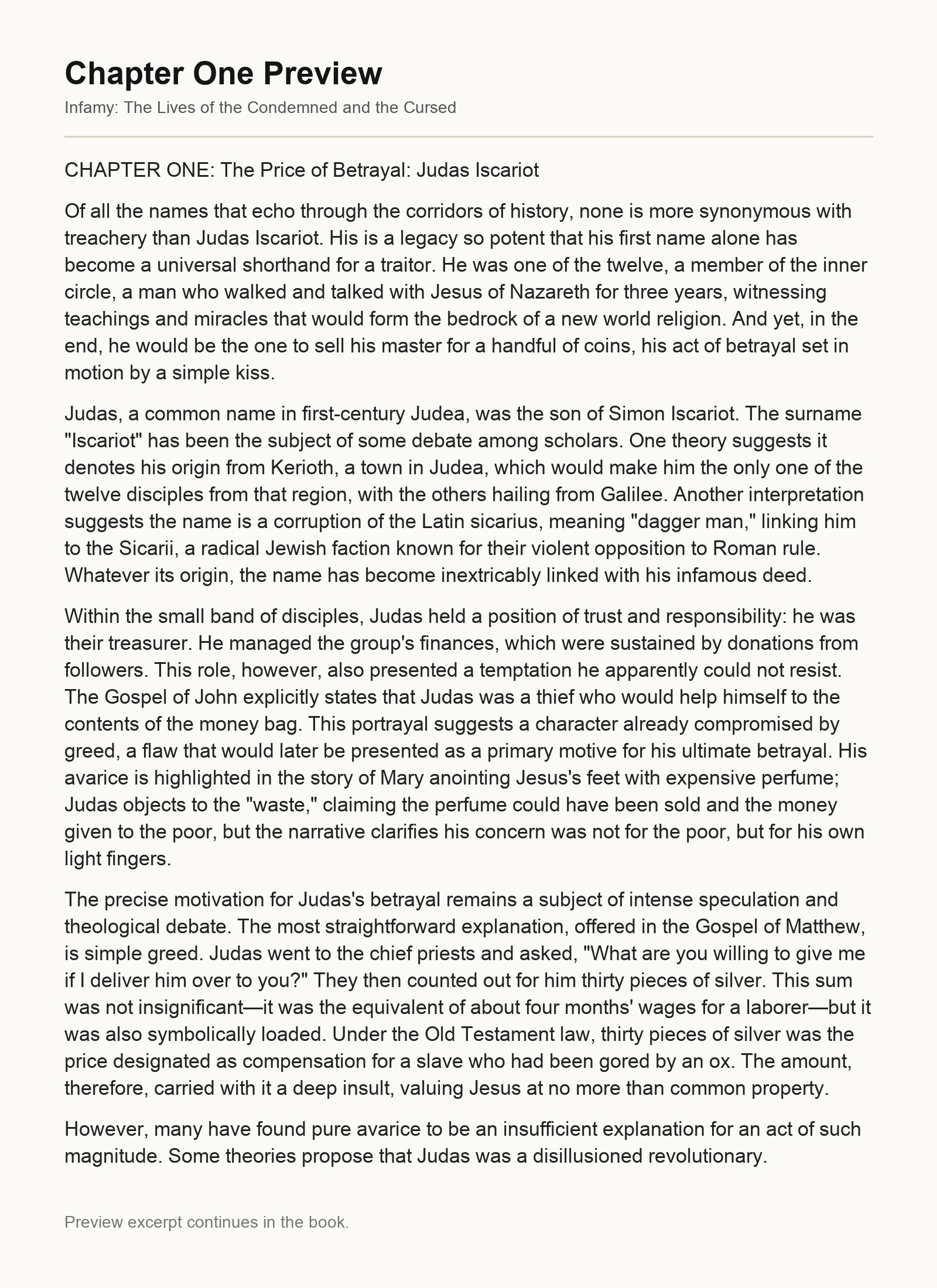
Infamy invites readers on a sweeping tour of history’s most notorious figures, from ancient traitors like Judas Iscariot to modern legends such as Al Capone, revealing how each was judged, condemned, and remembered by their societies. Through meticulously researched chapters, the book examines the motives behind betrayal, the clash of radical ideas with entrenched power, and the cruel machinery of mass hysteria that turned scholars, mystics, and rulers into cautionary tales. Readers will walk the corridors of power with Borgia popes, feel the chill of Vlad the Impaler’s impaled forests, and stand beside Joan of Arc as she faces the flames, gaining insight into the personal ambitions, political pressures, and cultural forces that forged their infamous legacies.
Beyond simple storytelling, the work encourages a critical look at how reputations are constructed and deconstructed over time. It shows how a single phrase—“Let them eat cake”—can become a potent symbol of royal arrogance, how a rumor can ignite a witch hunt, and how scientific visionaries like Galileo and Giordano Bruno were silenced for challenging cosmological orthodoxy. By presenting evidence, accusations, and defenses side by side, the book lets readers weigh the facts themselves, probing the thin line between villain and victim, heretic and hero.
The narrative also explores the broader social mechanisms that produce infamy: the scapegoating of outsiders, the use of exile and ostracism as political tools, and the way societies craft myths to explain disaster or legitimize new orders. From the Athenian practice of ostrakismos to the Soviet Gulag, from the Salem trials to the digital age of viral shaming, readers will see recurring patterns of fear, prejudice, and the desire for a clear narrative of good versus evil that echo across centuries.
Ultimately, Infamy offers more than a catalog of condemned souls; it provides a lens through which to examine our own judgments, biases, and the stories we tell about justice and morality. Readers will finish with a deeper appreciation of how history is continually rewritten, how the infamous can become symbols of resistance or enlightenment, and why the question of what makes a person infamous remains as relevant today as it was in the courts of ancient Rome or the halls of revolutionary France.
What You'll Find Inside:
- Explores how society constructs infamy through propaganda, rumor, and the labeling of 'others' rather than objective facts
- Examines famous historical cases where guilt and innocence remain debated (Judas, Arnold, Lizzie Borden, Richard III)
- Investigates the intersection of science, religion, and power in cases like Galileo, Bruno, and Hypatia
- Analyzes how mass hysteria and scapegoating create infamous episodes (Salem Witch Trials, Anabaptists of Münster)
- Reveals how infamous legacies are reshaped by later generations through historical revisionism
Who's It For:
This book is ideal for history enthusiasts, true crime aficionados, and readers fascinated by how societies construct villains and heroes. It will particularly appeal to those interested in the psychology of public condemnation, the interplay between myth and historical fact, and cases where infamous reputations have been debated for centuries. General readers who enjoy narrative nonfiction that challenges simplistic historical narratives will find the book's exploration of figures from Judas to Nero both enlightening and thought-provoking.
Table of Contents:
-
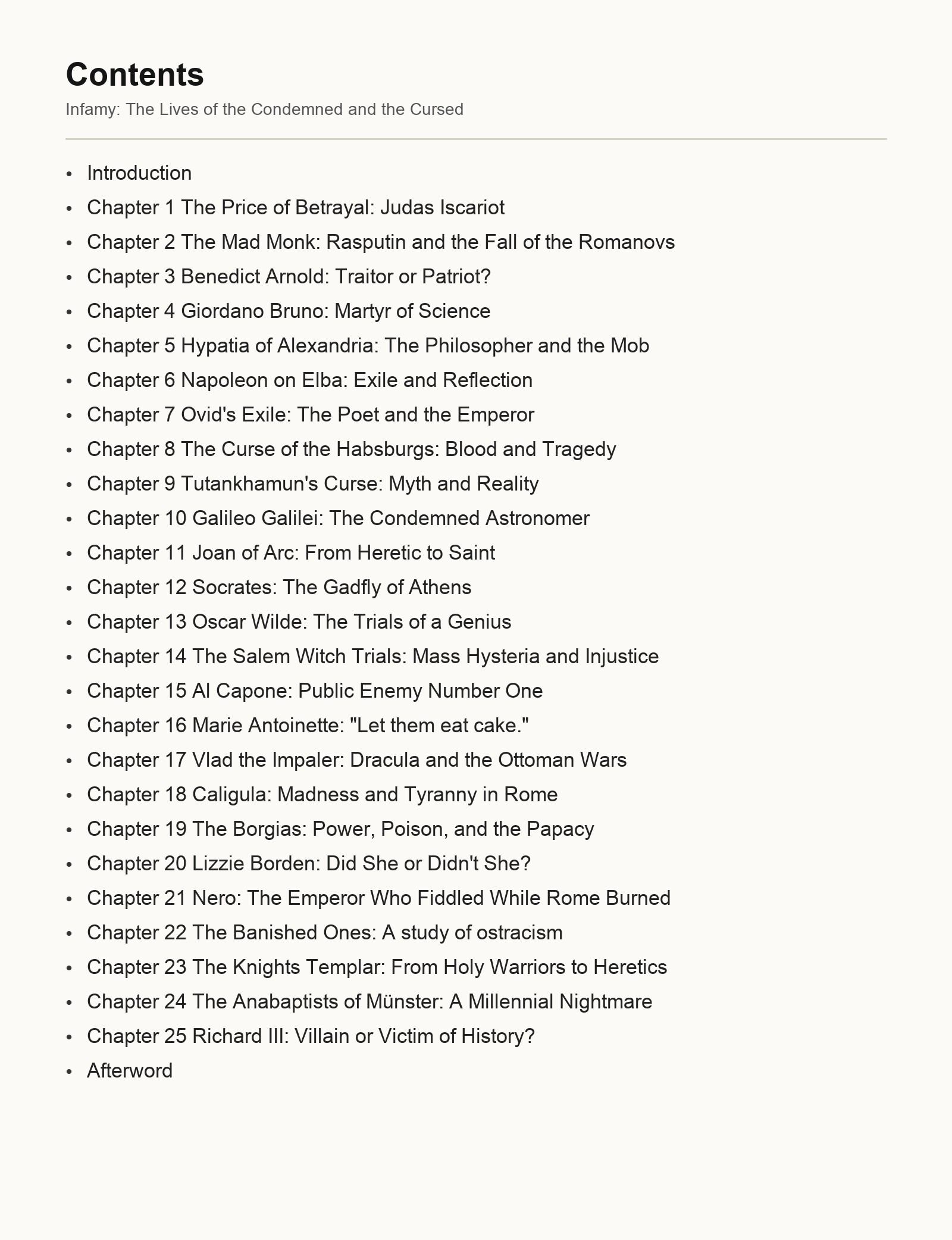
Introduction
-
Chapter 1 The Price of Betrayal: Judas Iscariot
-
Chapter 2 The Mad Monk: Rasputin and the Fall of the Romanovs
-
Chapter 3 Benedict Arnold: Traitor or Patriot?
-
Chapter 4 Giordano Bruno: Martyr of Science
-
Chapter 5 Hypatia of Alexandria: The Philosopher and the Mob
-
Chapter 6 Napoleon on Elba: Exile and Reflection
-
Chapter 7 Ovid's Exile: The Poet and the Emperor
-
Chapter 8 The Curse of the Habsburgs: Blood and Tragedy
-
Chapter 9 Tutankhamun's Curse: Myth and Reality
-
Chapter 10 Galileo Galilei: The Condemned Astronomer
-
Chapter 11 Joan of Arc: From Heretic to Saint
-
Chapter 12 Socrates: The Gadfly of Athens
-
Chapter 13 Oscar Wilde: The Trials of a Genius
-
Chapter 14 The Salem Witch Trials: Mass Hysteria and Injustice
-
Chapter 15 Al Capone: Public Enemy Number One.
-
Chapter 16 Marie Antoinette: "Let them eat cake."
-
Chapter 17 Vlad the Impaler: Dracula and the Ottoman Wars
-
Chapter 18 Caligula: Madness and Tyranny in Rome
-
Chapter 19 The Borgias: Power, Poison, and the Papacy.
-
Chapter 20 Lizzie Borden: Did She or Didn't She?
-
Chapter 21 Nero: The Emperor Who Fiddled While Rome Burned
-
Chapter 22 The Banished Ones: A study of ostracism.
-
Chapter 23 The Knights Templar: From Holy Warriors to Heretics.
-
Chapter 24 The Anabaptists of Münster: A Millennial Nightmare.
-
Chapter 25 Richard III: Villain or Victim of History?
-
Afterword
Ephyia Publishing MixCache.com Book Reference: 15681
Author:
Published By:
Date Published:
May 20, 2026
Type:
Nonfiction
Language:
English
Also Available In:
Word Count:
48,528 words
Reading Time:
3 hours 24 minutes
Sample:
Order:
Buy the Infamy ebook on MixCache.com:
Buy NowThe full ebook will be available immediately to read instantly on any device.
$5 account credit for all new MixCache.com accounts, usable toward any ebook purchase!*





Ratings & Reviews
Ask Questions About This Book
Have a question about the content? Ask our AI assistant!
Start by asking a question about "Infamy"
Example: "Does this book mention William Shakespeare?"
Thinking...