Browse by Category
Fiction
- Action & Adventure
- African American
- Anthologies
- Children's Fiction
- Classics
- Comics & Graphic Novels
- Coming of Age
- Contemporary
- Cultural & Regional
- Drama
- Erotica
- Fantasy
- General
- Historical Fiction
- Horror
- Humor & Satire
- Literary Fiction
- Mystery, Thriller & Suspense
- Poetry
- Religious & Inspirational
- Romance
- Science Fiction
- Short Stories
- War & Military
- Westerns
- Women's Fiction
- Young Adult
Non-Fiction
- Antiques & Collectibles
- Arts & Photography
- Biographies & Memoirs
- Business & Money
- Children's Non-Fiction
-
Computers & Technology
- Artificial Intelligence
- Computer Science
- Cybersecurity & Cryptography
- Data Science & Analytics
- Databases & Big Data
- Game Development & Design
- General
- Hardware & DIY
- Mobile App Development
- Networking & Cloud Computing
- Operating Systems
- Programming
- Robotics
- Software
- Software Engineering
- User Experience (UX) & Design
- Web Development & Design
- Cooking, Food & Wine
- Crafts, Hobbies & Home
- Education & Teaching
- Engineering
- General
- Health, Fitness & Dieting
-
History
- African History
- African History - North Africa
- African History - Sub-Saharan Africa
- American History
- American History - 20th Century
- American History - Civil War
- American History - Colonial Period
- Ancient History
- Asian History
- Asian History - China
- Asian History - India
- Asian History - Japan
- Asian History - Southeast Asia
- European History
- European History - Ancient Greece
- European History - Ancient Rome
- European History - Medieval
- European History - Modern
- European History - Renaissance
- General
- Middle Eastern History
- Military History
- Military History - Aviation
- Military History - Naval
- Social & Cultural History
- World History
- Humor & Entertainment
- Industrial Technology
- Language Learning
- Law
- LGBTQ+ Non-Fiction
- Literary Criticism
- Medical Books
- Parenting & Relationships
- Philosophy
- Politics & Social Sciences
- Reference
- Religion & Spirituality
-
Science & Math
- Agricultural Sciences
- Astronomy & Space Science
- Behavioral Sciences
- Biological Sciences
- Botany & Plant Science
- Chemistry
- Earth Sciences
- Engineering - Chemical
- Engineering - Civil
- Engineering - Electrical
- Engineering - Mechanical
- Environment
- General
- Geology
- Mathematics
- Nature & Ecology
- Oceanography
- Paleontology
- Physics
- Statistics
- Self-Help
- Sports & Outdoors
- Study Aids
- Sustainability & Green Living
- Textbooks
- Transportation
- Travel
- True Crime
- Urban Planning & Development
- Veterinary Medicine
- Writing & Publishing
Jump to Section
MixCache.com Total Access
Unlimited reading and audiobooks for every book published by MixCache.com.
Included titles carry the MTA badge.
Learn more →A History of North Carolina
About this book:


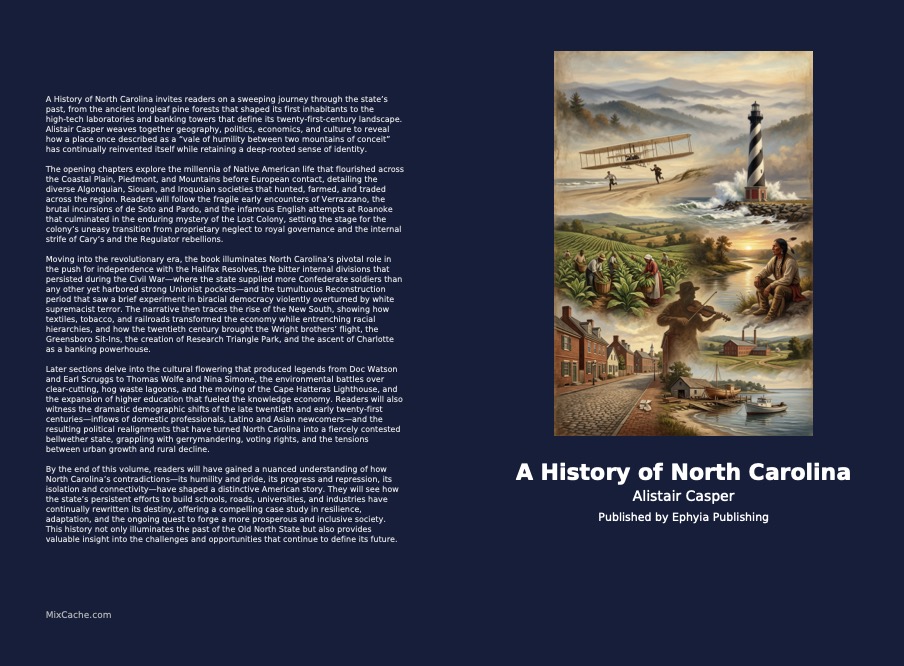
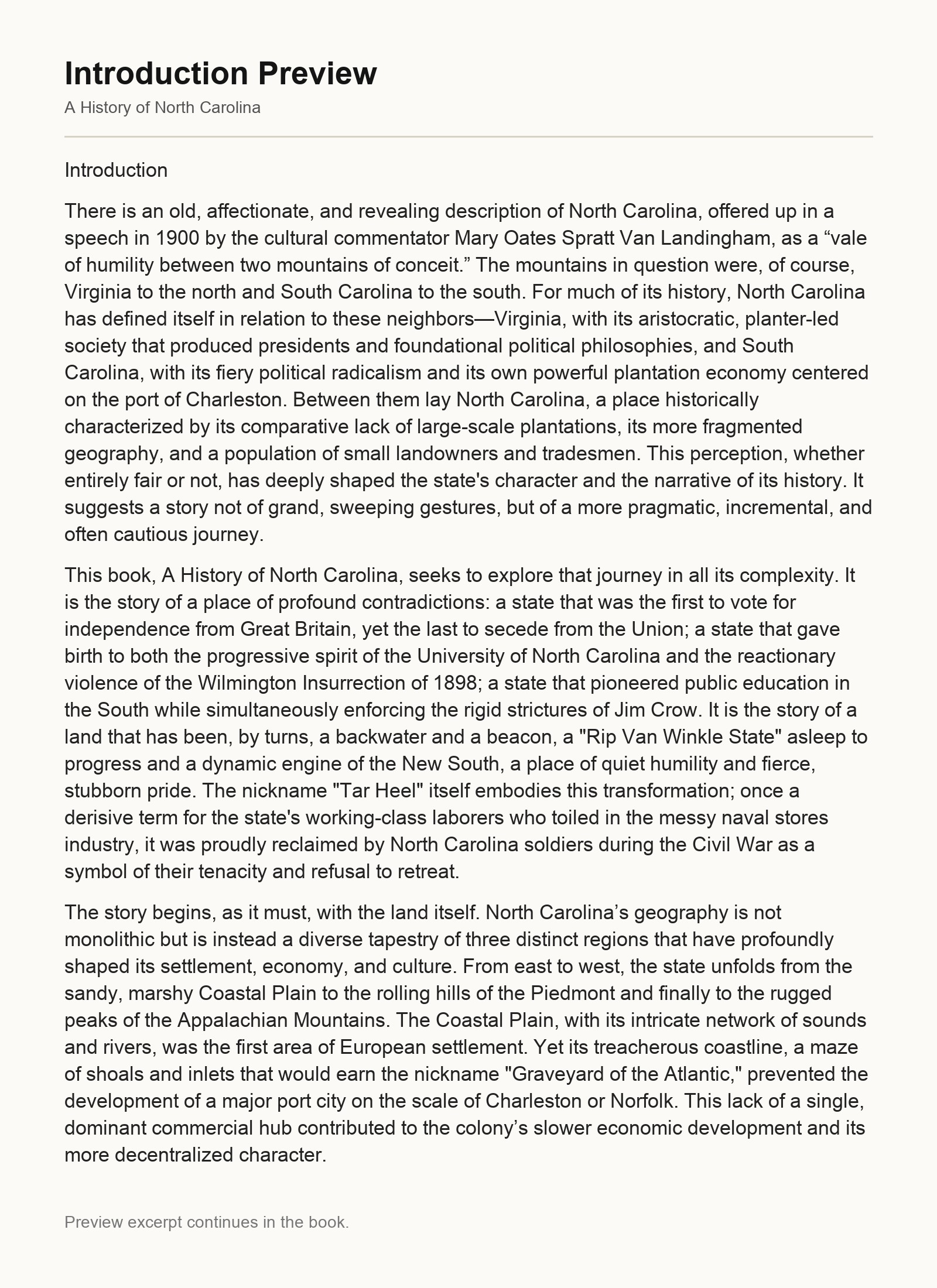
A History of North Carolina invites readers on a sweeping journey through the state’s past, from the ancient longleaf pine forests that shaped its first inhabitants to the high‑tech laboratories and banking towers that define its twenty‑first‑century landscape. Alistair Casper weaves together geography, politics, economics, and culture to reveal how a place once described as a “vale of humility between two mountains of conceit” has continually reinvented itself while retaining a deep‑rooted sense of identity.
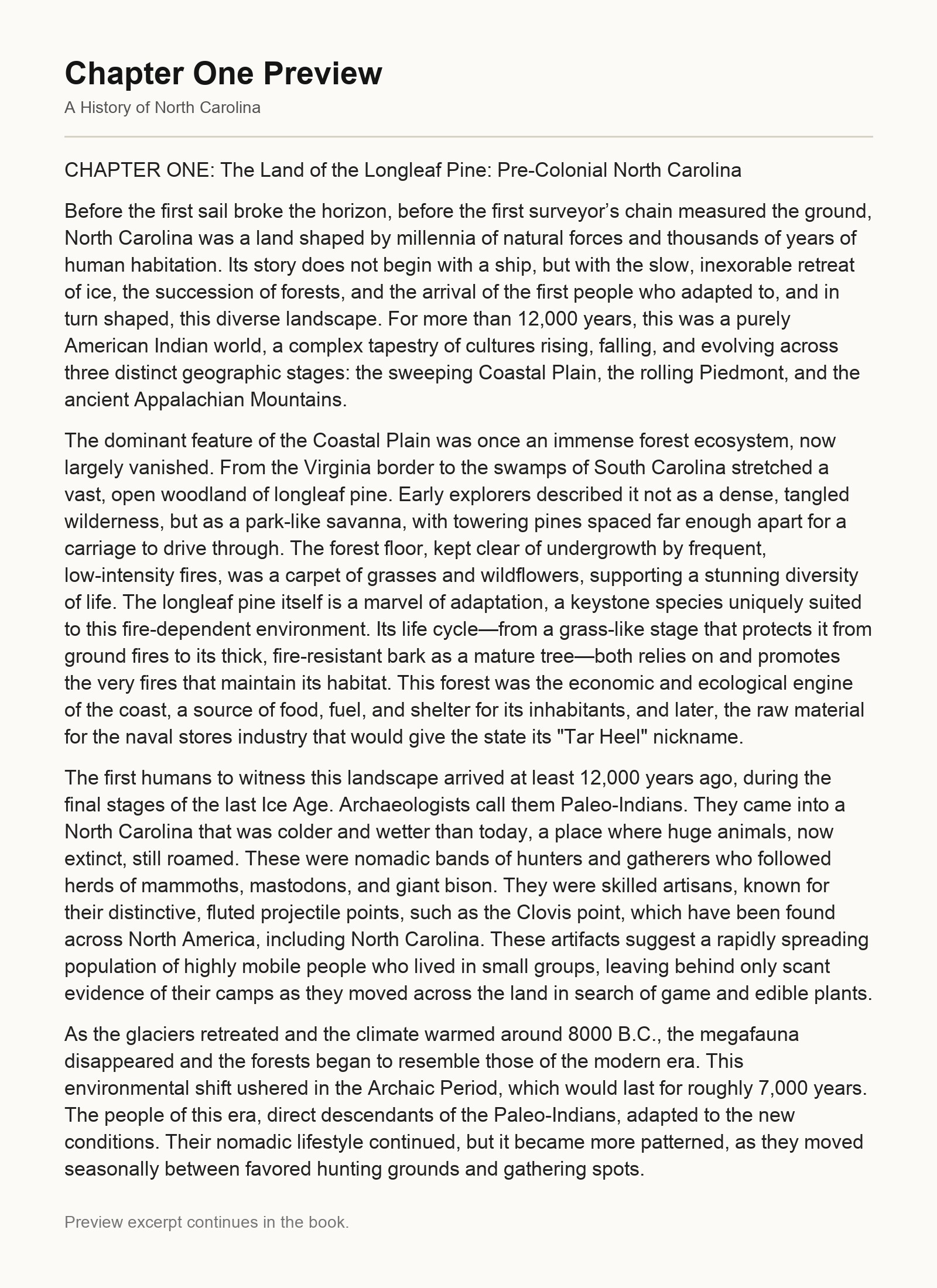
The opening chapters explore the millennia of Native American life that flourished across the Coastal Plain, Piedmont, and Mountains before European contact, detailing the diverse Algonquian, Siouan, and Iroquoian societies that hunted, farmed, and traded across the region. Readers will follow the fragile early encounters of Verrazzano, the brutal incursions of de Soto and Pardo, and the infamous English attempts at Roanoke that culminated in the enduring mystery of the Lost Colony, setting the stage for the colony’s uneasy transition from proprietary neglect to royal governance and the internal strife of Cary’s and the Regulator rebellions.
Moving into the revolutionary era, the book illuminates North Carolina’s pivotal role in the push for independence with the Halifax Resolves, the bitter internal divisions that persisted during the Civil War—where the state supplied more Confederate soldiers than any other yet harbored strong Unionist pockets—and the tumultuous Reconstruction period that saw a brief experiment in biracial democracy violently overturned by white supremacist terror. The narrative then traces the rise of the New South, showing how textiles, tobacco, and railroads transformed the economy while entrenching racial hierarchies, and how the twentieth century brought the Wright brothers’ flight, the Greensboro Sit‑Ins, the creation of Research Triangle Park, and the ascent of Charlotte as a banking powerhouse.
Later sections delve into the cultural flowering that produced legends from Doc Watson and Earl Scruggs to Thomas Wolfe and Nina Simone, the environmental battles over clear‑cutting, hog waste lagoons, and the moving of the Cape Hatteras Lighthouse, and the expansion of higher education that fueled the knowledge economy. Readers will also witness the dramatic demographic shifts of the late twentieth and early twenty‑first centuries—inflows of domestic professionals, Latino and Asian newcomers—and the resulting political realignments that have turned North Carolina into a fiercely contested bellwether state, grappling with gerrymandering, voting rights, and the tensions between urban growth and rural decline.
By the end of this volume, readers will have gained a nuanced understanding of how North Carolina’s contradictions—its humility and pride, its progress and repression, its isolation and connectivity—have shaped a distinctive American story. They will see how the state’s persistent efforts to build schools, roads, universities, and industries have continually rewritten its destiny, offering a compelling case study in resilience, adaptation, and the ongoing quest to forge a more prosperous and inclusive society. This history not only illuminates the past of the Old North State but also provides valuable insight into the challenges and opportunities that continue to define its future.
What You'll Find Inside:
- North Carolina's three distinct geographic regions—Coastal Plain, Piedmont, and Mountains—have fundamentally shaped its settlement patterns, economic development, and cultural identity throughout history.
- The state was the first colony to officially call for independence with the Halifax Resolves of 1776, yet later became the last to secede from the Union, illustrating its complex revolutionary legacy.
- From the antebellum 'Rip Van Winkle' stagnation to the New South boom, North Carolina's economy transformed through railroads, textiles, tobacco, and later the high-tech Research Triangle Park and Charlotte banking sector.
- The civil rights struggle in North Carolina ranged from the Wilmington coup of 1898 to the pivotal Greensboro sit-ins of 1960, highlighting both violent repression and pioneering non‑violent activism.
- In the 21st century, rapid urban growth, demographic diversification, and intense political polarization have made North Carolina a national bellwether, balancing its historic 'vale of humility' with emerging centers of finance, technology, and education.
Who's It For:
This book is ideal for students, educators, and general readers interested in a comprehensive, narrative-driven history of North Carolina. It will especially benefit those seeking to understand how the state's geography, politics, economy, and social movements have interacted to shape its unique role in American history, from colonial times to the present day.
Table of Contents:
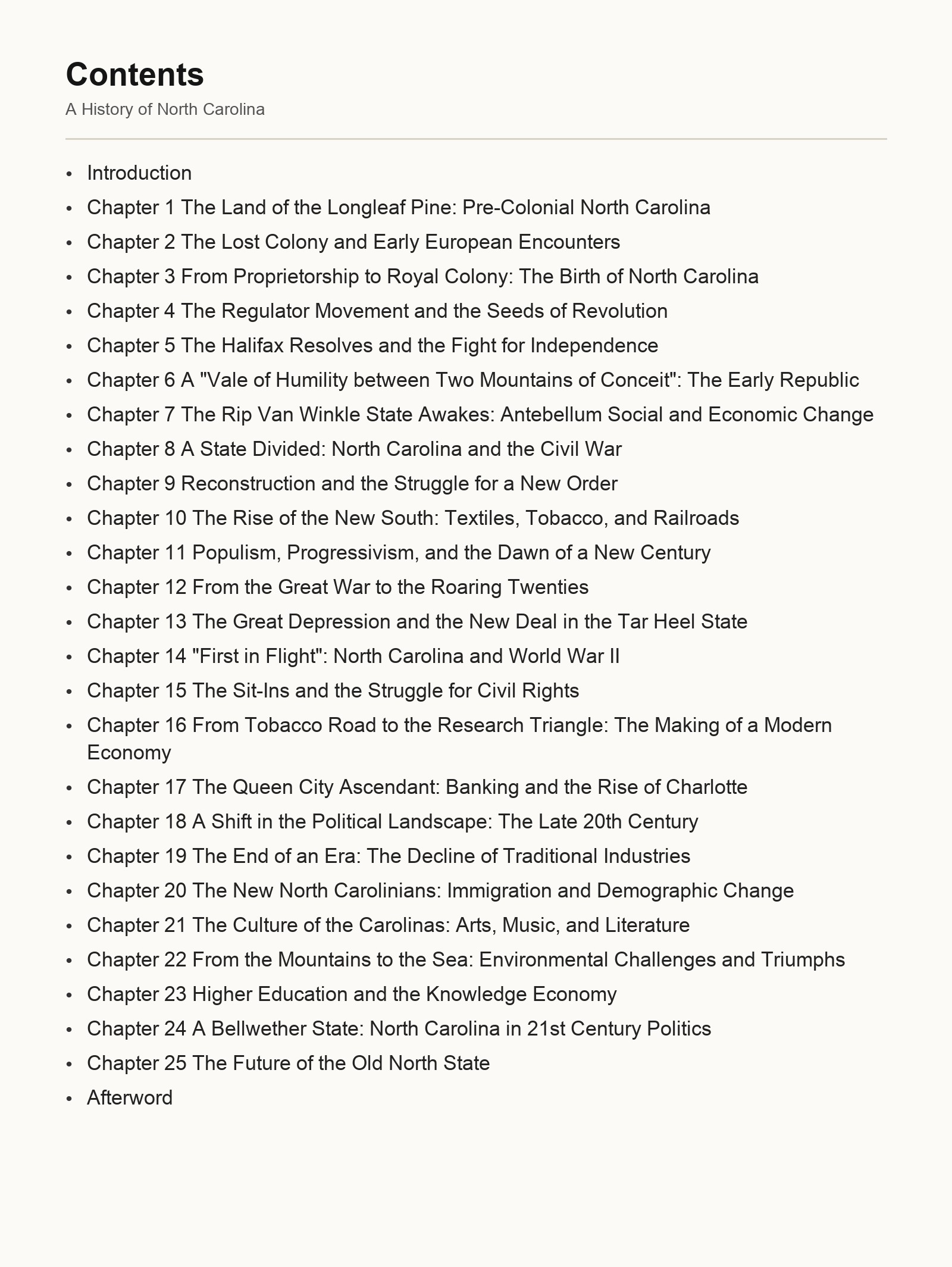
- Introduction
- Chapter 1 The Land of the Longleaf Pine: Pre-Colonial North Carolina
- Chapter 2 The Lost Colony and Early European Encounters
- Chapter 3 From Proprietorship to Royal Colony: The Birth of North Carolina
- Chapter 4 The Regulator Movement and the Seeds of Revolution
- Chapter 5 The Halifax Resolves and the Fight for Independence
- Chapter 6 A "Vale of Humility between Two Mountains of Conceit": The Early Republic
- Chapter 7 The Rip Van Winkle State Awakes: Antebellum Social and Economic Change
- Chapter 8 A State Divided: North Carolina and the Civil War
- Chapter 9 Reconstruction and the Struggle for a New Order
- Chapter 10 The Rise of the New South: Textiles, Tobacco, and Railroads
- Chapter 11 Populism, Progressivism, and the Dawn of a New Century
- Chapter 12 From the Great War to the Roaring Twenties
- Chapter 13 The Great Depression and the New Deal in the Tar Heel State
- Chapter 14 "First in Flight": North Carolina and World War II
- Chapter 15 The Sit-Ins and the Struggle for Civil Rights
- Chapter 16 From Tobacco Road to the Research Triangle: The Making of a Modern Economy
- Chapter 17 The Queen City Ascendant: Banking and the Rise of Charlotte
- Chapter 18 A Shift in the Political Landscape: The Late 20th Century
- Chapter 19 The End of an Era: The Decline of Traditional Industries
- Chapter 20 The New North Carolinians: Immigration and Demographic Change
- Chapter 21 The Culture of the Carolinas: Arts, Music, and Literature
- Chapter 22 From the Mountains to the Sea: Environmental Challenges and Triumphs
- Chapter 23 Higher Education and the Knowledge Economy
- Chapter 24 A Bellwether State: North Carolina in 21st Century Politics
- Chapter 25 The Future of the Old North State
- Afterword
Author:
Published By:
Date Published:
May 18, 2026
Type:
Nonfiction
Language:
English
Also Available In:
Word Count:
51,410 words
Reading Time:
3 hours 36 minutes
Sample:
Order:
Order A History of North Carolina (Hardcover) on MixCache.com:
Buy NowPrint copy is made to order and ships worldwide. Includes the ebook free, ready to read instantly.
$5 account credit for all new MixCache.com accounts, usable toward any ebook purchase!*