
Browse by Category
Fiction
- Action & Adventure
- African American
- Anthologies
- Children's Fiction
- Classics
- Comics & Graphic Novels
- Coming of Age
- Contemporary
- Cultural & Regional
- Drama
- Erotica
- Fantasy
- General
- Historical Fiction
- Horror
- Humor & Satire
- Literary Fiction
- Mystery, Thriller & Suspense
- Poetry
- Religious & Inspirational
- Romance
- Science Fiction
- Short Stories
- War & Military
- Westerns
- Women's Fiction
- Young Adult
Non-Fiction
- Antiques & Collectibles
- Arts & Photography
- Biographies & Memoirs
- Business & Money
- Children's Non-Fiction
-
Computers & Technology
- Artificial Intelligence
- Computer Science
- Cybersecurity & Cryptography
- Data Science & Analytics
- Databases & Big Data
- Game Development & Design
- General
- Hardware & DIY
- Mobile App Development
- Networking & Cloud Computing
- Operating Systems
- Programming
- Robotics
- Software
- Software Engineering
- User Experience (UX) & Design
- Web Development & Design
- Cooking, Food & Wine
- Crafts, Hobbies & Home
- Education & Teaching
- Engineering
- General
- Health, Fitness & Dieting
-
History
- African History
- African History - North Africa
- African History - Sub-Saharan Africa
- American History
- American History - 20th Century
- American History - Civil War
- American History - Colonial Period
- Ancient History
- Asian History
- Asian History - China
- Asian History - India
- Asian History - Japan
- Asian History - Southeast Asia
- European History
- European History - Ancient Greece
- European History - Ancient Rome
- European History - Medieval
- European History - Modern
- European History - Renaissance
- General
- Middle Eastern History
- Military History
- Military History - Aviation
- Military History - Naval
- Social & Cultural History
- World History
- Humor & Entertainment
- Industrial Technology
- Language Learning
- Law
- LGBTQ+ Non-Fiction
- Literary Criticism
- Medical Books
- Parenting & Relationships
- Philosophy
- Politics & Social Sciences
- Reference
- Religion & Spirituality
-
Science & Math
- Agricultural Sciences
- Astronomy & Space Science
- Behavioral Sciences
- Biological Sciences
- Botany & Plant Science
- Chemistry
- Earth Sciences
- Engineering - Chemical
- Engineering - Civil
- Engineering - Electrical
- Engineering - Mechanical
- Environment
- General
- Geology
- Mathematics
- Nature & Ecology
- Oceanography
- Paleontology
- Physics
- Statistics
- Self-Help
- Sports & Outdoors
- Study Aids
- Sustainability & Green Living
- Textbooks
- Transportation
- Travel
- True Crime
- Urban Planning & Development
- Veterinary Medicine
- Writing & Publishing
Jump to Section
MixCache.com Total Access
Unlimited reading and audiobooks for every book published by MixCache.com.
Included titles carry the MTA badge.
Learn more →A History of Suburbs and Suburbia
About this book:
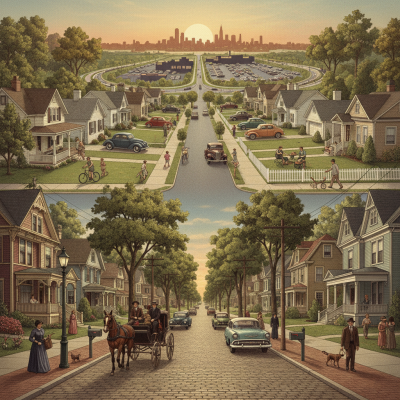


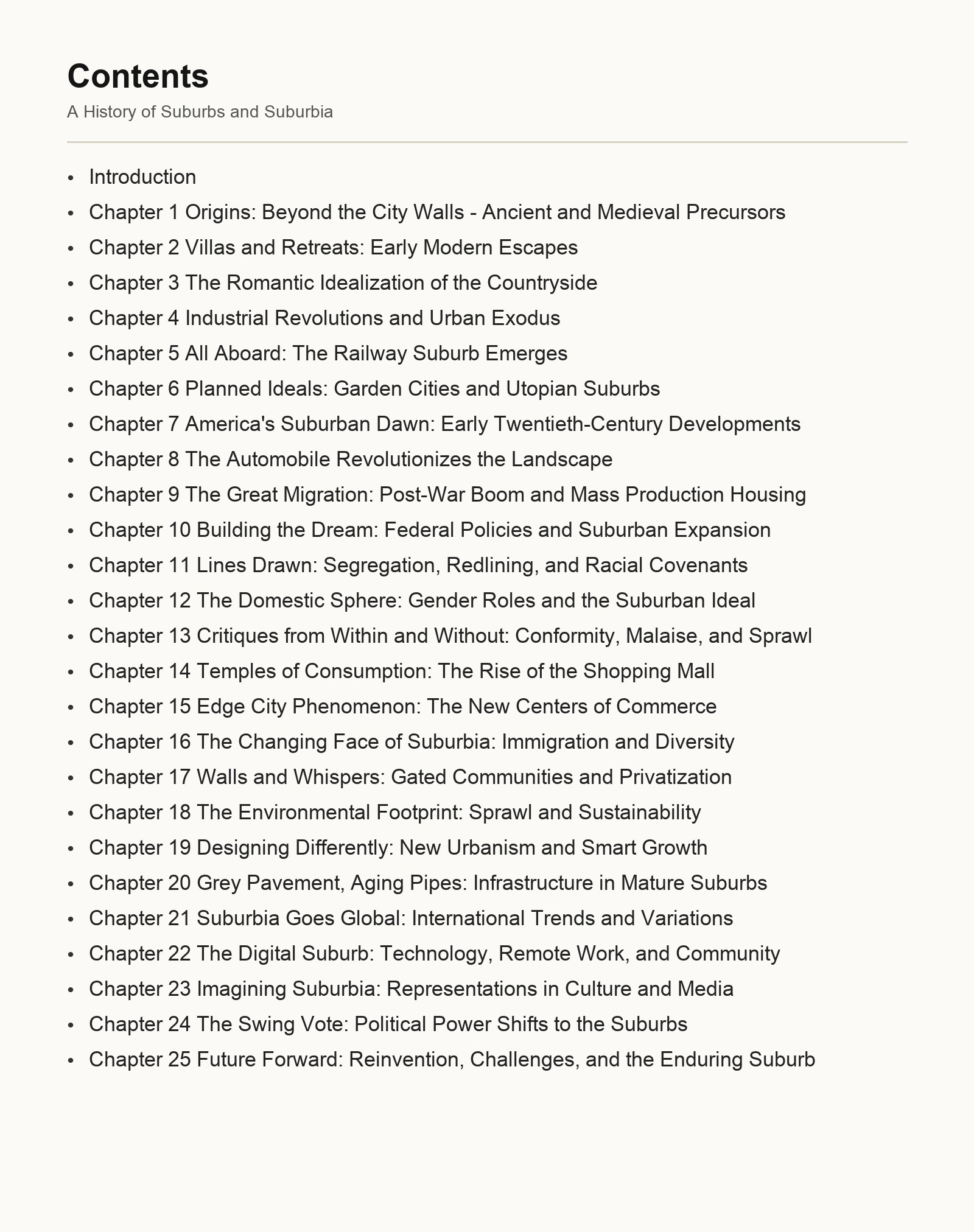
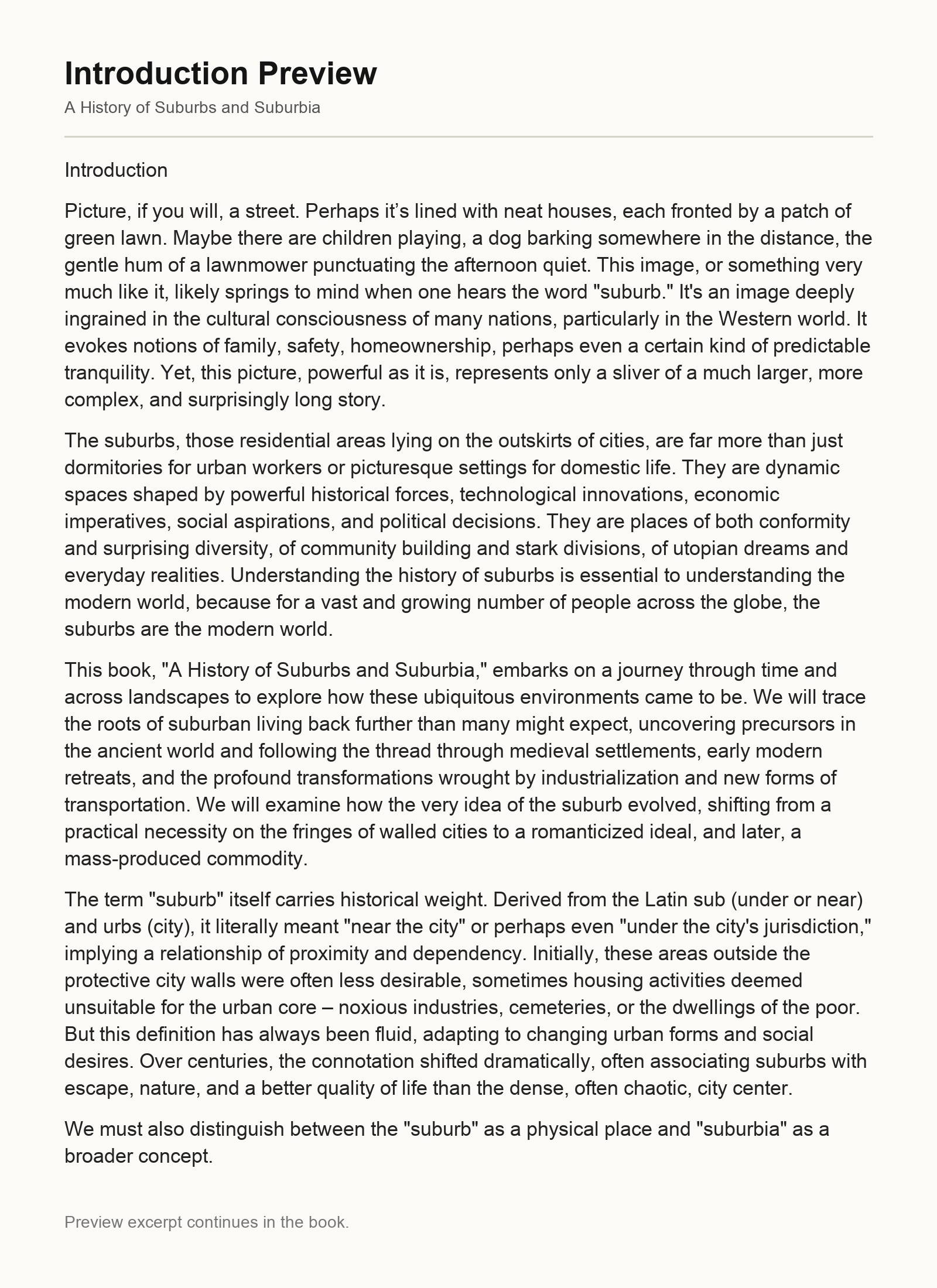
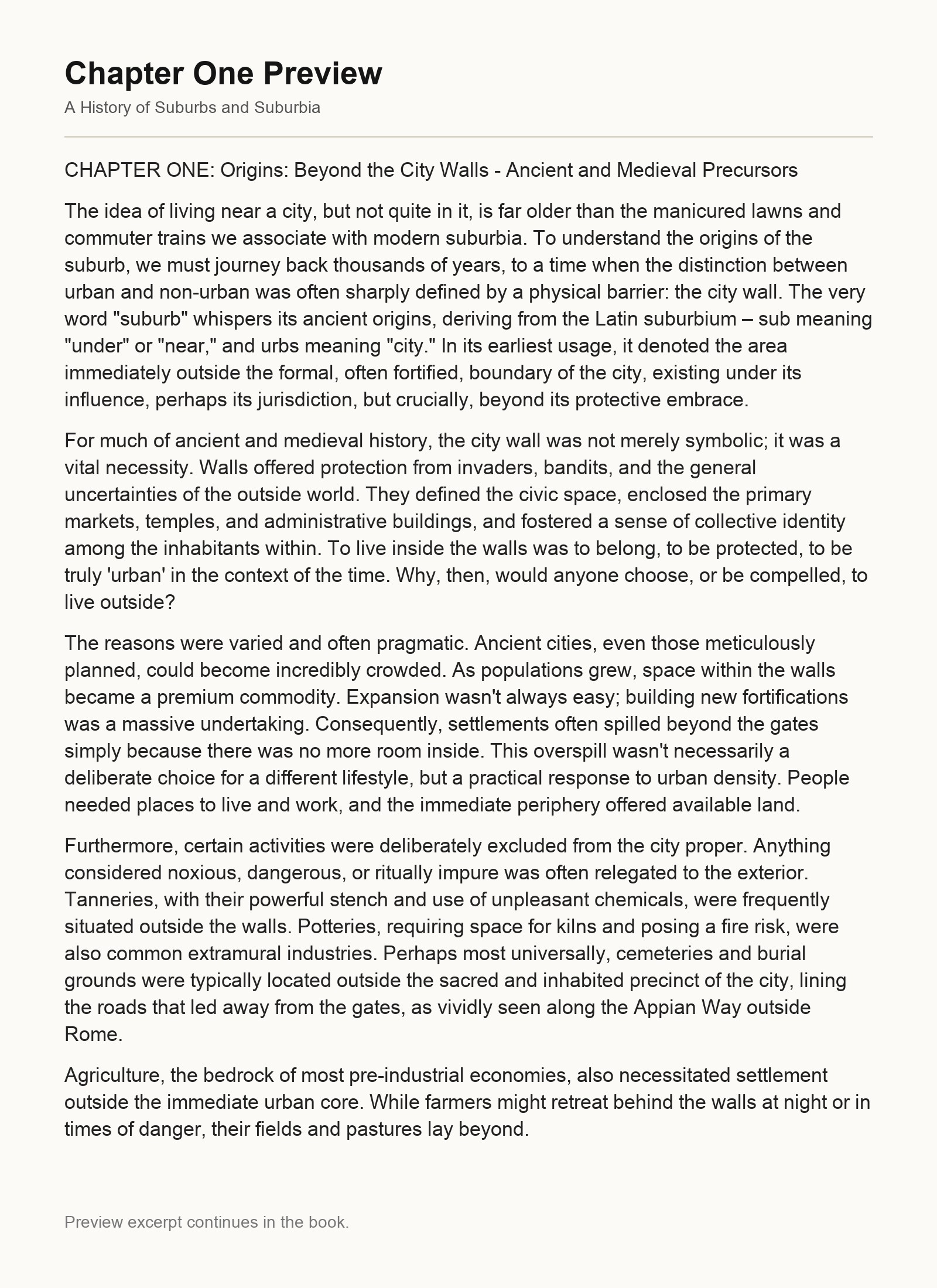
Discover how the spaces just beyond the city walls have shaped modern life in "A History of Suburbs and Suburbia." This book takes you on a sweeping journey from ancient extramural settlements and medieval faubourgs through the romantic ideals of the countryside, the push of industrialization, and the transformative power of railways and automobiles. You’ll learn how each technological leap—from horse-drawn omnibusses to the Interstate Highway System—unlocked new lands for settlement and redefined the daily rhythms of work, home, and community.
Explore the social and ideological forces that turned peripheral areas into aspirational retreats, planned utopias, and mass‑produced postwar tracts. The narrative delves into the creation of garden cities, the rise of the bungalow and streetcar suburb, the federal policies that fueled suburban expansion, and the stark realities of segregation, redlining, and restrictive covenants. You’ll also see how gender roles were molded within the suburban home, how critiques of conformity and sprawl emerged, and how shopping malls and edge cities transformed the metropolitan economy.
Gain a global perspective as the book traces suburbanization across continents, revealing the varied forms of periphery living—from European garden suburbs and Latin American gated enclaves to Asian high‑rise districts and African informal settlements. Chapters on the digital suburb, cultural representations in film and television, and the shifting political power of suburban voters show how suburbia continues to evolve in the age of remote work, e‑commerce, and demographic change. You’ll finish with a forward‑looking discussion of sustainability, reinvention, and the enduring challenges facing mature suburbs.
By the end of this history, you will not only know the facts and dates of suburban development but also feel the lived experience of those who built, inhabited, contested, and reimagined these landscapes. The book equips readers to understand why suburbs matter today—as economic engines, cultural symbols, political battlegrounds, and environmental frontiers—and offers a clear lens through which to view the ongoing transformation of the places we call home.
What You'll Find Inside:
- The book traces suburban origins from ancient extramural settlements outside city walls to medieval faubourgs, revealing early patterns of peripheral living driven by overcrowding, undesirable trades, and marginal populations.
- It examines how transportation breakthroughs—railways, streetcars, and automobiles—enabled middle‑class flight from industrial cities and reshaped settlement scales from linear ribbons to sprawling, automobile‑dependent landscapes.
- Federal policies such as FHA/VA mortgage guarantees, the Interstate Highway Act, and tax incentives directed massive post‑war suburban expansion in the United States, favoring new single‑family homes in racially homogenous areas.
- The text details the institutionalized segregation of suburbs through redlining, racial restrictive covenants, and exclusionary zoning, explaining how these practices created enduring white enclaves and disadvantaged minority neighborhoods.
- It explores evolving suburban ideals—from Romantic visions of nature and elite villas to mass‑produced tract homes, critiques of conformity and sprawl, and contemporary shifts toward diversity, gated communities, sustainability efforts, and digital‑enabled lifestyles.
Who's It For:
This book is ideal for general readers interested in urban history, sociology, or geography who want a comprehensive yet accessible overview of how suburbs have evolved from ancient times to the digital age. It will also benefit students, planners, policymakers, and suburban residents seeking to understand the historical forces shaping their communities and the ongoing challenges of segregation, infrastructure, sustainability, and demographic change.
Author:
Published By:
Date Published:
May 17, 2026
Type:
Nonfiction
Language:
English
Also Available In:
Word Count:
48,888 words
Reading Time:
3 hours 25 minutes
Sample:
Order:
Order A History of Suburbs and Suburbia (Paperback) on MixCache.com:
Buy NowPrint copy is made to order and ships worldwide. Includes the ebook free, ready to read instantly.
$5 account credit for all new MixCache.com accounts, usable toward any ebook purchase!*


 Includes Audiobook