Browse by Category
Fiction
- Action & Adventure
- African American
- Anthologies
- Children's Fiction
- Classics
- Comics & Graphic Novels
- Coming of Age
- Contemporary
- Cultural & Regional
- Drama
- Erotica
- Fantasy
- General
- Historical Fiction
- Horror
- Humor & Satire
- Literary Fiction
- Mystery, Thriller & Suspense
- Poetry
- Religious & Inspirational
- Romance
- Science Fiction
- Short Stories
- War & Military
- Westerns
- Women's Fiction
- Young Adult
Non-Fiction
- Antiques & Collectibles
- Arts & Photography
- Biographies & Memoirs
- Business & Money
- Children's Non-Fiction
-
Computers & Technology
- Artificial Intelligence
- Computer Science
- Cybersecurity & Cryptography
- Data Science & Analytics
- Databases & Big Data
- Game Development & Design
- General
- Hardware & DIY
- Mobile App Development
- Networking & Cloud Computing
- Operating Systems
- Programming
- Robotics
- Software
- Software Engineering
- User Experience (UX) & Design
- Web Development & Design
- Cooking, Food & Wine
- Crafts, Hobbies & Home
- Education & Teaching
- Engineering
- General
- Health, Fitness & Dieting
-
History
- African History
- African History - North Africa
- African History - Sub-Saharan Africa
- American History
- American History - 20th Century
- American History - Civil War
- American History - Colonial Period
- Ancient History
- Asian History
- Asian History - China
- Asian History - India
- Asian History - Japan
- Asian History - Southeast Asia
- European History
- European History - Ancient Greece
- European History - Ancient Rome
- European History - Medieval
- European History - Modern
- European History - Renaissance
- General
- Middle Eastern History
- Military History
- Military History - Aviation
- Military History - Naval
- Social & Cultural History
- World History
- Humor & Entertainment
- Industrial Technology
- Language Learning
- Law
- LGBTQ+ Non-Fiction
- Literary Criticism
- Medical Books
- Parenting & Relationships
- Philosophy
- Politics & Social Sciences
- Reference
- Religion & Spirituality
-
Science & Math
- Agricultural Sciences
- Astronomy & Space Science
- Behavioral Sciences
- Biological Sciences
- Botany & Plant Science
- Chemistry
- Earth Sciences
- Engineering - Chemical
- Engineering - Civil
- Engineering - Electrical
- Engineering - Mechanical
- Environment
- General
- Geology
- Mathematics
- Nature & Ecology
- Oceanography
- Paleontology
- Physics
- Statistics
- Self-Help
- Sports & Outdoors
- Study Aids
- Sustainability & Green Living
- Textbooks
- Transportation
- Travel
- True Crime
- Urban Planning & Development
- Veterinary Medicine
- Writing & Publishing
Jump to Section
MixCache.com Total Access
Unlimited reading and audiobooks for every book published by MixCache.com.
Included titles carry the MTA badge.
Learn more →A History of the Faroe Islands
About this book:
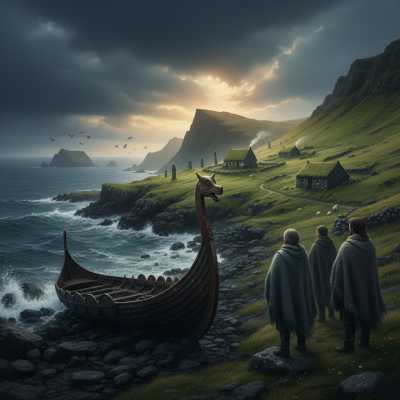
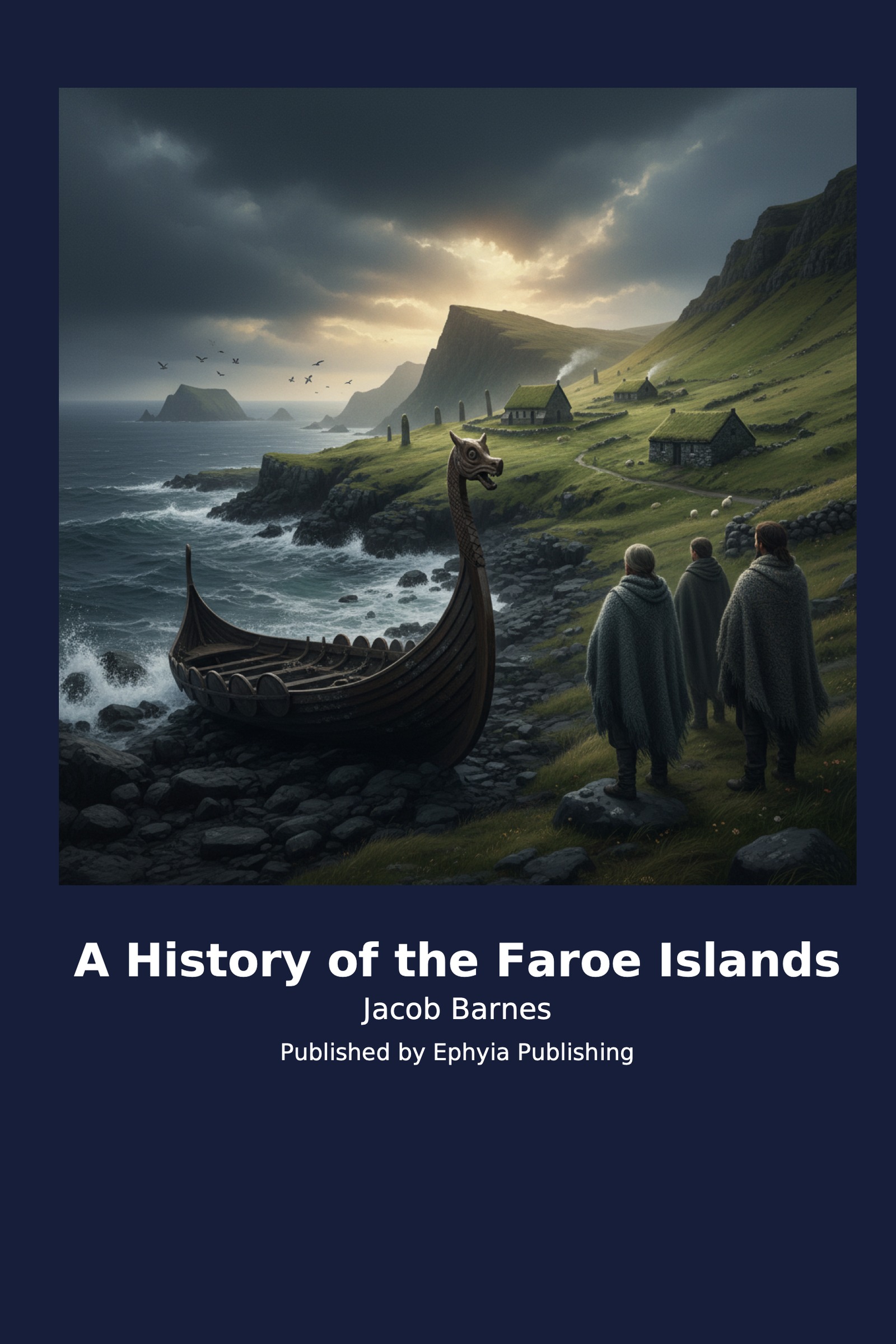
Discover the remarkable story of a tiny archipelago that has punched far above its weight on the world stage. This comprehensive history traces the Faroe Islands from enigmatic pre‑Viking settlers who left traces of sheep DNA and barley pollen in lakebeds, through the daring Norse land‑take that gave the islands their name and their ancient parliament, the Althing, and into the sagas of chieftains like Tróndur í Gøtu and Sigmundur Brestisson, whose feuds and forced conversion to Christianity still echo in Faroese identity.
Follow the islands’ long centuries under Norwegian and later Danish crowns, the devastation of the Black Death that reshaped land ownership, the shift of power to Denmark within the Kalmar Union, and the seismic impact of the Reformation, which replaced Latin with Danish and drove the Faroese language underground for three hundred years. Learn how the Royal Trade Monopoly and the notorious von Gabel era stifled commerce, how the Napoleonic Wars forced a brief taste of self‑reliance, and how the Home Rule Act of 1948 finally granted the Faroes a genuine voice in their own affairs while remaining within the Kingdom of Denmark.
Experience the dramatic twentieth‑century turn toward self‑government: the British “Friendly Occupation” of World War II, the legitimization of the Faroese flag, the tense 1946 independence referendum, and the lasting compromise of home rule that paved the way for a modern welfare state, educational revival, and a fishing industry that transformed the economy. Witness the Cod Wars, the 1990s economic crisis, and the nation’s steady reclamation of authority over fisheries, aviation, and church affairs—all while holding fast to a distinct cultural heartbeat.
See how the Faroese turned isolation into strength, building a world‑class aquaculture sector, pioneering sub‑sea tunnels that knit the islands together, and exporting music, literature, and design that belies their modest population. Understand the ongoing debate over full sovereignty, the nuanced relationship with the European Union, and the enduring tension between tradition and globalization that defines contemporary Faroese life.
By the end of this book you will not only know the dates and events that shaped the Faroe Islands, you will feel the resilience of a people who have repeatedly reinvented themselves against wind, wave, and outside power, and you will appreciate how a remote North Atlantic community continues to chart its own course in a connected world.
What You'll Find Inside:
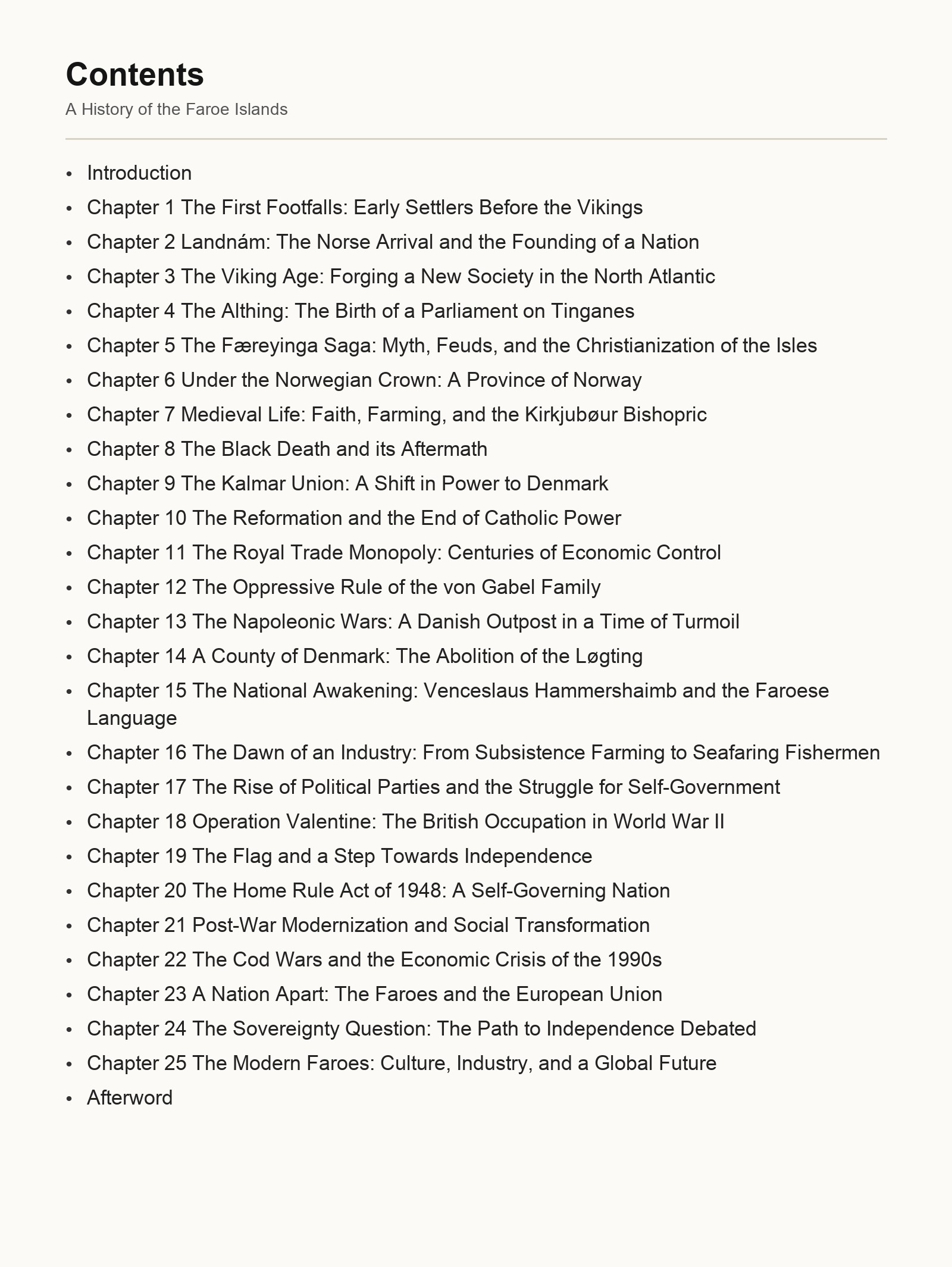
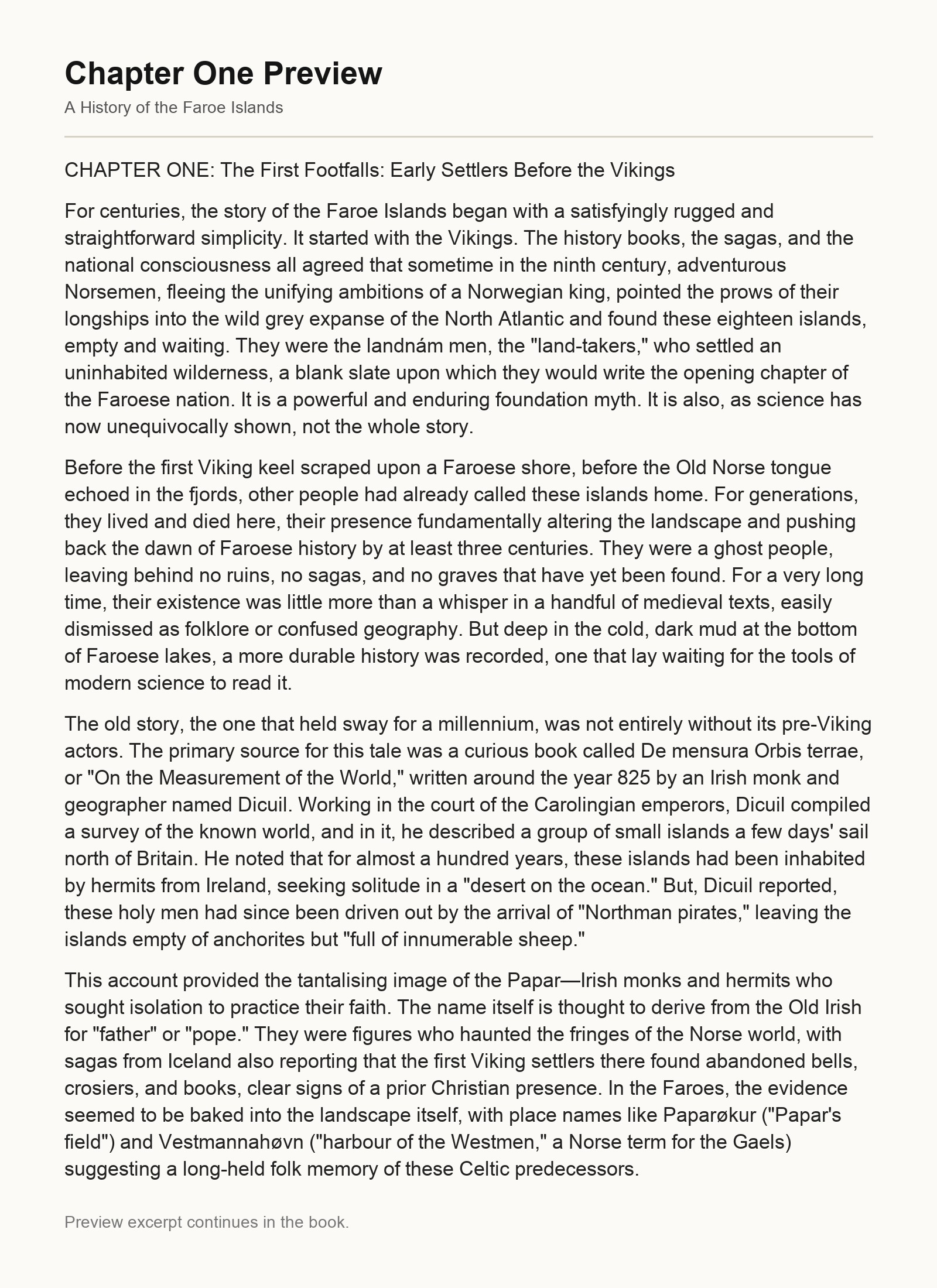
- Evidence of pre-Viking Celtic settlers dating back to the 4th-6th centuries, revealed through sheep DNA and barley pollen in lakebed sediments
- The establishment of the Althing on Tinganes around 900 AD, one of the world's oldest continuous parliaments that still functions today as the Løgting
- Centuries of foreign rule under Norwegian and Danish crowns, including the oppressive von Gabel family monopoly and the Royal Trade Monopoly that controlled Faroese commerce for 250 years
- The 19th-century national awakening led by Venceslaus Hammershaimb who created a standardized written Faroese language, sparking cultural revival and political activism
- The journey to self-governance including WWII British Operation Valentine, the 1946 independence referendum, and the Home Rule Act of 1948 that established self-rule within the Danish Kingdom
Who's It For:
This book is ideal for students and scholars of Nordic history, European history, and post-colonial studies seeking a comprehensive account of a small North Atlantic nation's journey from ancient settlement to modern self-governance. It will particularly appeal to readers interested in linguistic revival efforts, how geography shapes societal development in isolated island communities, and unique parliamentary traditions like the Faroese Løgting. Anyone fascinated by self-determination movements, cultural preservation against odds, or the economic transformation from subsistence farming to high-tech fishing and aquaculture will find valuable insights in this detailed historical narrative.
Table of Contents:
- Introduction
- Chapter 1 The First Footfalls: Early Settlers Before the Vikings
- Chapter 2 Landnám: The Norse Arrival and the Founding of a Nation
- Chapter 3 The Viking Age: Forging a New Society in the North Atlantic
- Chapter 4 The Althing: The Birth of a Parliament on Tinganes
- Chapter 5 The Færeyinga Saga: Myth, Feuds, and the Christianization of the Isles
- Chapter 6 Under the Norwegian Crown: A Province of Norway
- Chapter 7 Medieval Life: Faith, Farming, and the Kirkjubøur Bishopric
- Chapter 8 The Black Death and its Aftermath
- Chapter 9 The Kalmar Union: A Shift in Power to Denmark
- Chapter 10 The Reformation and the End of Catholic Power
- Chapter 11 The Royal Trade Monopoly: Centuries of Economic Control
- Chapter 12 The Oppressive Rule of the von Gabel Family
- Chapter 13 The Napoleonic Wars: A Danish Outpost in a Time of Turmoil
- Chapter 14 A County of Denmark: The Abolition of the Løgting
- Chapter 15 The National Awakening: Venceslaus Hammershaimb and the Faroese Language
- Chapter 16 The Dawn of an Industry: From Subsistence Farming to Seafaring Fishermen
- Chapter 17 The Rise of Political Parties and the Struggle for Self-Government
- Chapter 18 Operation Valentine: The British Occupation in World War II
- Chapter 19 The Flag and a Step Towards Independence
- Chapter 20 The Home Rule Act of 1948: A Self-Governing Nation
- Chapter 21 Post-War Modernization and Social Transformation
- Chapter 22 The Cod Wars and the Economic Crisis of the 1990s
- Chapter 23 A Nation Apart: The Faroes and the European Union
- Chapter 24 The Sovereignty Question: The Path to Independence Debated
- Chapter 25 The Modern Faroes: Culture, Industry, and a Global Future
- Afterword
Author:
Published By:
Date Published:
May 17, 2026
Type:
Nonfiction
Language:
English
Word Count:
47,374 words
Reading Time:
3 hours 19 minutes
Sample:
Order:
Order A History of the Faroe Islands (Paperback) on MixCache.com:
Buy NowPrint copy is made to order and ships worldwide. Includes the ebook free, ready to read instantly.
$5 account credit for all new MixCache.com accounts, usable toward any ebook purchase!*