Browse by Category
Fiction
- Action & Adventure
- African American
- Anthologies
- Children's Fiction
- Classics
- Comics & Graphic Novels
- Coming of Age
- Contemporary
- Cultural & Regional
- Drama
- Erotica
- Fantasy
- General
- Historical Fiction
- Horror
- Humor & Satire
- Literary Fiction
- Mystery, Thriller & Suspense
- Poetry
- Religious & Inspirational
- Romance
- Science Fiction
- Short Stories
- War & Military
- Westerns
- Women's Fiction
- Young Adult
Non-Fiction
- Antiques & Collectibles
- Arts & Photography
- Biographies & Memoirs
- Business & Money
- Children's Non-Fiction
-
Computers & Technology
- Artificial Intelligence
- Computer Science
- Cybersecurity & Cryptography
- Data Science & Analytics
- Databases & Big Data
- Game Development & Design
- General
- Hardware & DIY
- Mobile App Development
- Networking & Cloud Computing
- Operating Systems
- Programming
- Robotics
- Software
- Software Engineering
- User Experience (UX) & Design
- Web Development & Design
- Cooking, Food & Wine
- Crafts, Hobbies & Home
- Education & Teaching
- Engineering
- General
- Health, Fitness & Dieting
-
History
- African History
- African History - North Africa
- African History - Sub-Saharan Africa
- American History
- American History - 20th Century
- American History - Civil War
- American History - Colonial Period
- Ancient History
- Asian History
- Asian History - China
- Asian History - India
- Asian History - Japan
- Asian History - Southeast Asia
- European History
- European History - Ancient Greece
- European History - Ancient Rome
- European History - Medieval
- European History - Modern
- European History - Renaissance
- General
- Middle Eastern History
- Military History
- Military History - Aviation
- Military History - Naval
- Social & Cultural History
- World History
- Humor & Entertainment
- Industrial Technology
- Language Learning
- Law
- LGBTQ+ Non-Fiction
- Literary Criticism
- Medical Books
- Parenting & Relationships
- Philosophy
- Politics & Social Sciences
- Reference
- Religion & Spirituality
-
Science & Math
- Agricultural Sciences
- Astronomy & Space Science
- Behavioral Sciences
- Biological Sciences
- Botany & Plant Science
- Chemistry
- Earth Sciences
- Engineering - Chemical
- Engineering - Civil
- Engineering - Electrical
- Engineering - Mechanical
- Environment
- General
- Geology
- Mathematics
- Nature & Ecology
- Oceanography
- Paleontology
- Physics
- Statistics
- Self-Help
- Sports & Outdoors
- Study Aids
- Sustainability & Green Living
- Textbooks
- Transportation
- Travel
- True Crime
- Urban Planning & Development
- Veterinary Medicine
- Writing & Publishing
Jump to Section
MixCache.com Total Access
Unlimited reading and audiobooks for every book published by MixCache.com.
Included titles carry the MTA badge.
Learn more →A History of Jiangsu
About this book:
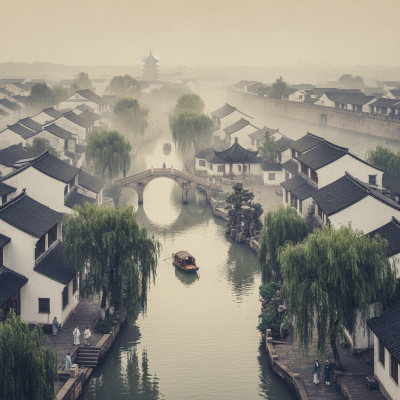
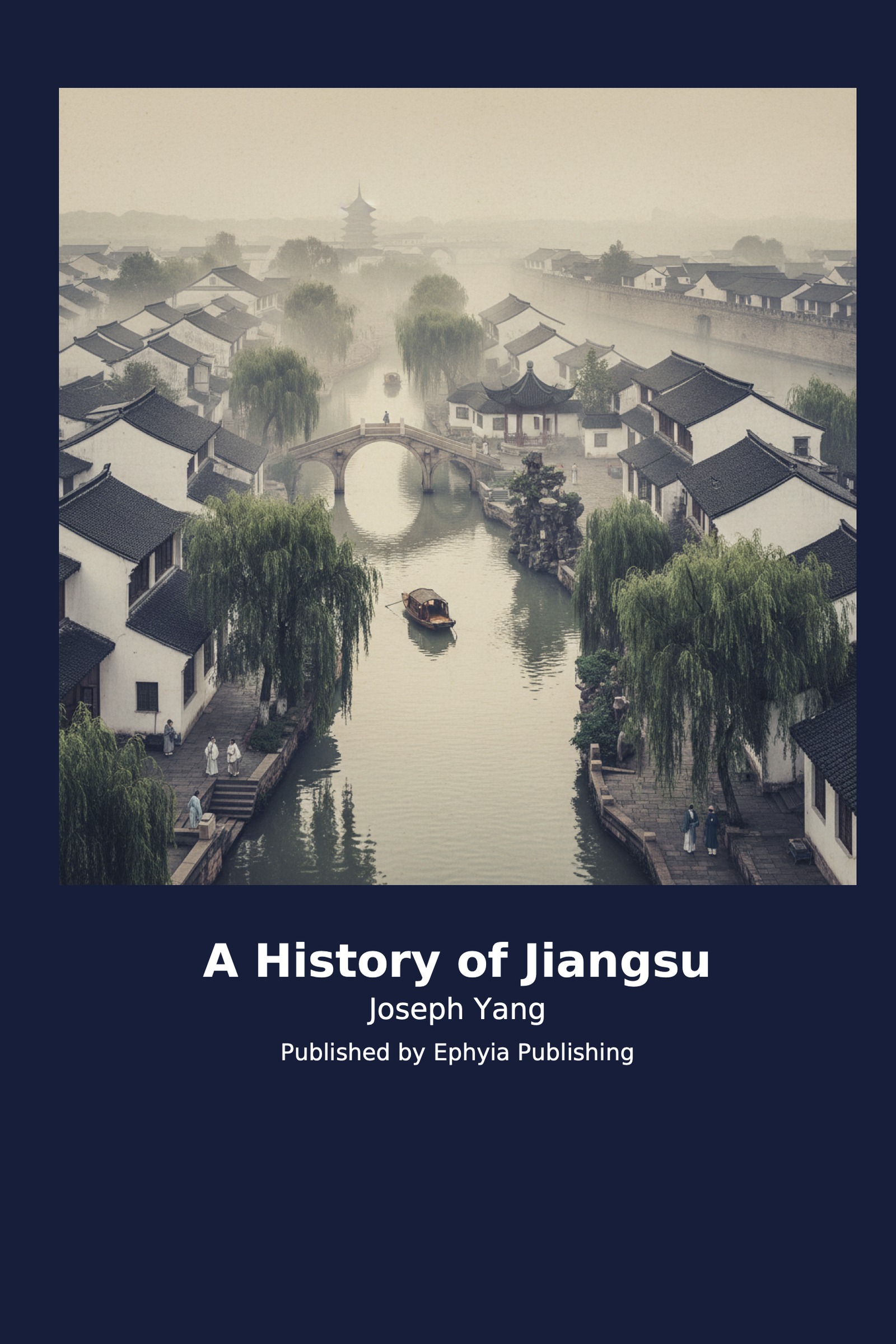
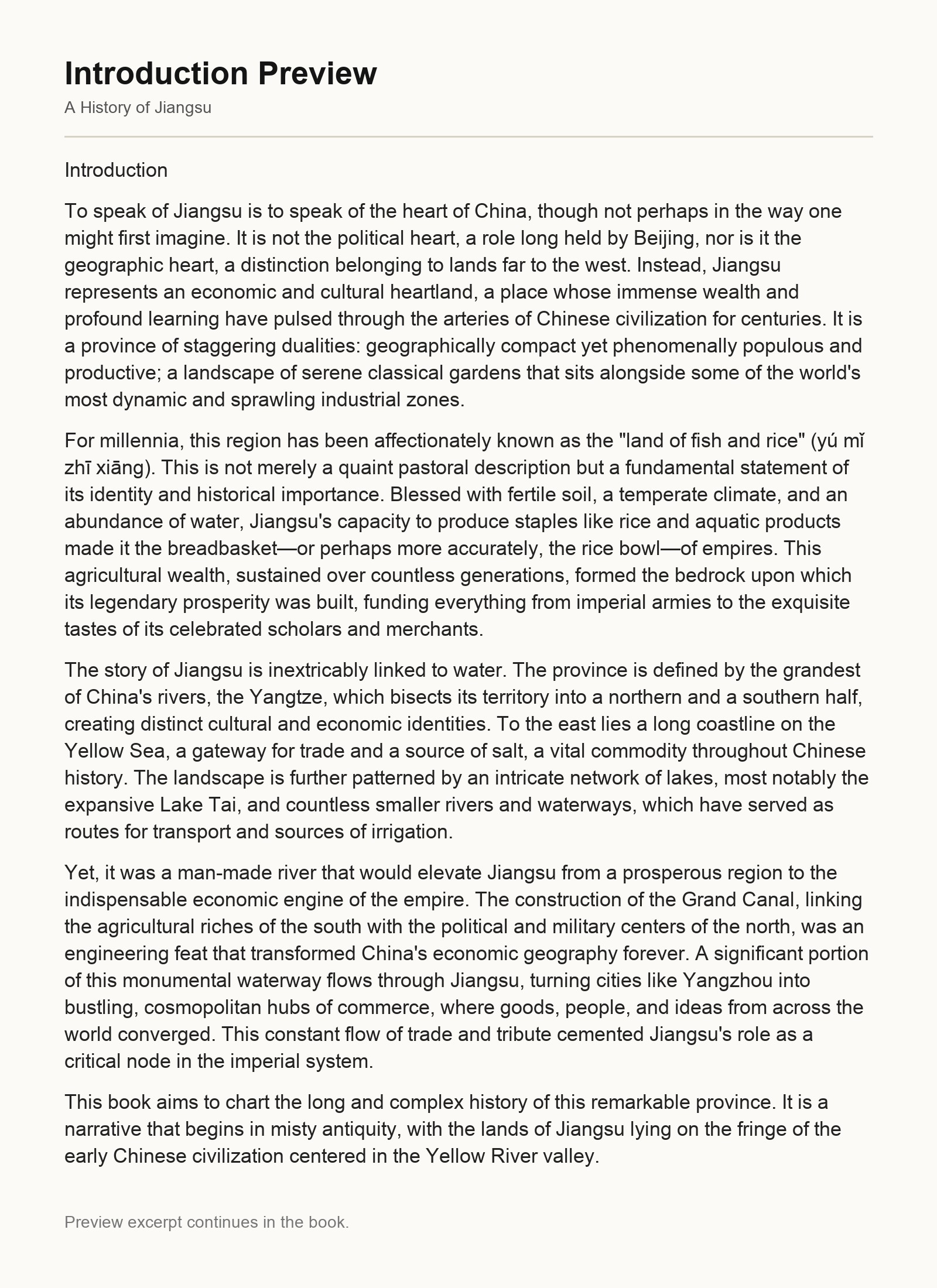
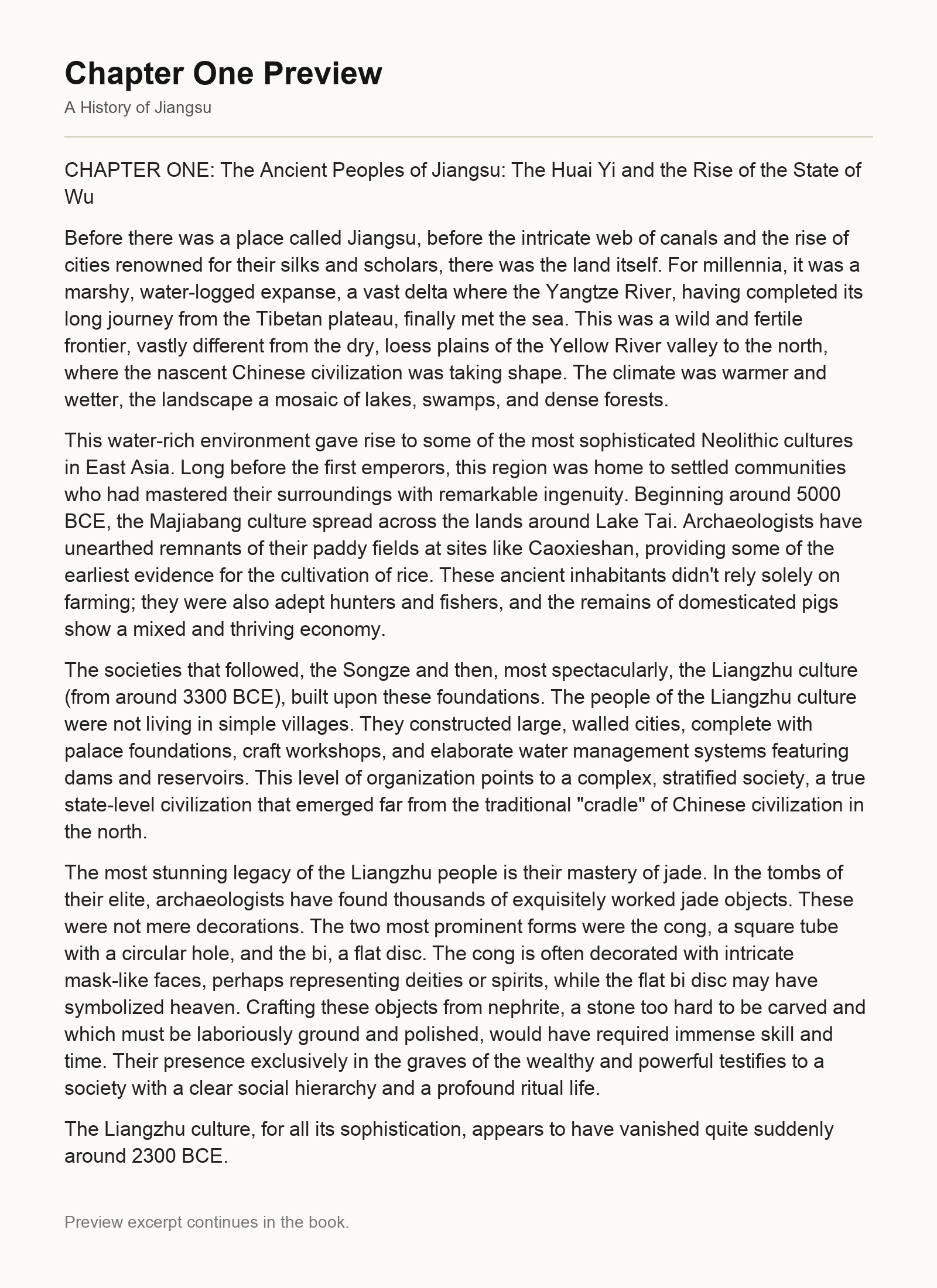
A History of Jiangsu invites readers on a sweeping journey through one of China’s most dynamic provinces, tracing its evolution from the marshy Neolithic settlements of the Liangzhu culture to its present status as a global manufacturing and innovation hub. Joseph Yang weaves together archaeological discoveries, dynastic chronicles, and personal stories to reveal how Jiangsu’s fertile lands, intricate waterways, and strategic position have repeatedly placed it at the crossroads of empire, commerce, and culture. Readers will gain a deep appreciation for the province’s dual identity as both the historic “land of fish and rice” and the relentless engine of China’s modern economy.
Through vivid chapters on the ancient states of Wu and Yue, the grandeur of the Southern Dynasties’ capital at Nanjing, and the engineering marvel of the Grand Canal, the book illuminates how water shaped every era of Jiangsu’s destiny. It shows how the province’s agricultural surplus funded imperial armies, how its silk and salt industries attracted foreign merchants, and how its cities became crucibles for artistic movements ranging from Kunqu opera to the classical gardens of Suzhou. Each period is presented not as isolated fact but as a living continuum of human ingenuity, adaptation, and resilience.
The narrative does not shy away from the darkness that has also marked Jiangsu’s past. Readers will confront the devastation of the Taiping Rebellion, the horror of the Nanjing Massacre, and the social upheavals of the Great Leap Forward and Cultural Revolution, understanding how these traumas fractured communities yet also sowed the seeds for later renewal. By examining these turbulent episodes alongside periods of flourishing—such as the Ming dynasty’s cultural renaissance or the Qing dynasty’s imperial tours—the book offers a balanced perspective on how prosperity and adversity have intertwined to forge Jiangsu’s distinctive character.
In the modern era, the book explores the province’s remarkable transformation from collective township enterprises to high‑tech industrial parks, highlighting the role of foreign investment, migrant labor, and innovative urban planning in Suzhou, Wuxi, Changzhou, and Nanjing. Readers will learn how Jiangsu navigated the challenges of globalization, environmental degradation, and demographic shifts while striving to move up the global value chain, from assembly to invention. The final chapters probe the province’s 21st‑century aspirations—becoming a hub for semiconductor self‑sufficiency, green technology, and integrated regional development—offering a forward‑looking vision grounded in its deep historical roots.
Ultimately, A History of Jiangsu is more than a chronicle of dates and events; it is an immersive experience that lets readers walk alongside ancient jade artisans, Tang‑dynasty poets, Ming garden designers, revolutionary soldiers, and today’s factory workers and scientists. By the end, they will understand how a relatively small stretch of the Yangtze delta has repeatedly influenced the course of Chinese civilization and continues to shape the nation’s place in the world. The book equips anyone interested in Chinese history, economic development, or cultural heritage with a nuanced, comprehensive portrait of a province that truly embodies the heart of China’s past, present, and future.
What You'll Find Inside:
- Traces Jiangsu's evolution from ancient Huai Yi frontier lands through the rise of Wu state to its integration into imperial China
- Examines Jiangsu's pivotal role as southern capital during Three Kingdoms and Southern Dynasties periods when Nanjing served as imperial seat
- Details how the Grand Canal transformed Jiangsu into China's economic engine by linking southern agriculture to northern power centers
- Highlights cultural zenith during Ming/Qing eras with Suzhou's gardens, Kunqu opera, and Jiangnan scholarly traditions
- Chronicles modern transformation from Taiping devastation through industrial rise to 21st-century manufacturing powerhouse and innovation hub
Who's It For:
This book is ideal for students, researchers, and professionals seeking a comprehensive understanding of Jiangsu's historical significance in Chinese civilization. It will particularly benefit those interested in regional economic development, cultural history, and the interplay between geography and historical change in China. General readers with a passion for deep historical narratives of influential regions will also find valuable insights into how Jiangsu shaped China's political, economic, and cultural landscape across millennia.
Table of Contents:
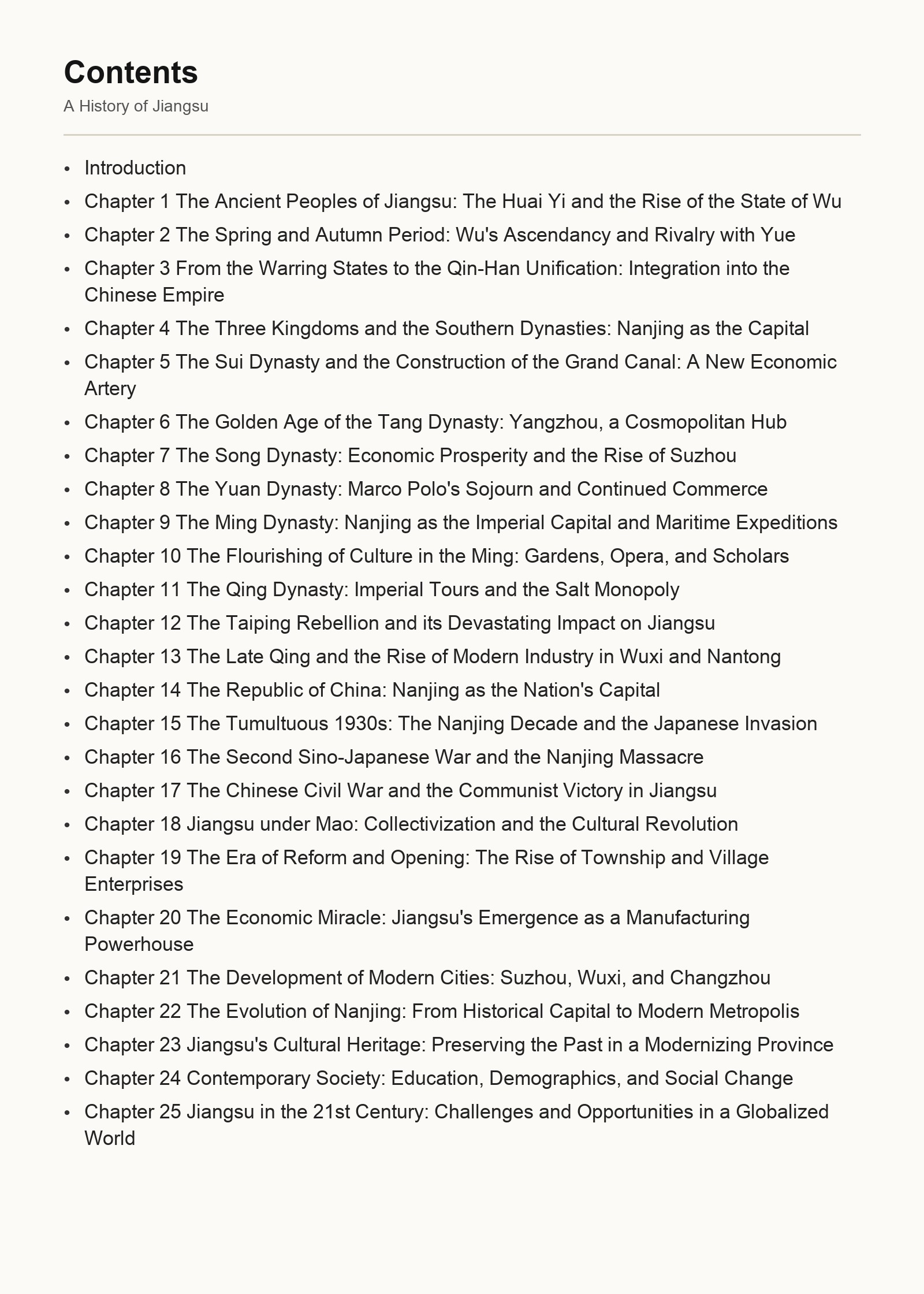
- Introduction
- Chapter 1 The Ancient Peoples of Jiangsu: The Huai Yi and the Rise of the State of Wu
- Chapter 2 The Spring and Autumn Period: Wu's Ascendancy and Rivalry with Yue
- Chapter 3 From the Warring States to the Qin-Han Unification: Integration into the Chinese Empire
- Chapter 4 The Three Kingdoms and the Southern Dynasties: Nanjing as the Capital
- Chapter 5 The Sui Dynasty and the Construction of the Grand Canal: A New Economic Artery
- Chapter 6 The Golden Age of the Tang Dynasty: Yangzhou, a Cosmopolitan Hub
- Chapter 7 The Song Dynasty: Economic Prosperity and the Rise of Suzhou
- Chapter 8 The Yuan Dynasty: Marco Polo's Sojourn and Continued Commerce
- Chapter 9 The Ming Dynasty: Nanjing as the Imperial Capital and Maritime Expeditions
- Chapter 10 The Flourishing of Culture in the Ming: Gardens, Opera, and Scholars
- Chapter 11 The Qing Dynasty: Imperial Tours and the Salt Monopoly
- Chapter 12 The Taiping Rebellion and its Devastating Impact on Jiangsu
- Chapter 13 The Late Qing and the Rise of Modern Industry in Wuxi and Nantong
- Chapter 14 The Republic of China: Nanjing as the Nation's Capital
- Chapter 15 The Tumultuous 1930s: The Nanjing Decade and the Japanese Invasion
- Chapter 16 The Second Sino-Japanese War and the Nanjing Massacre
- Chapter 17 The Chinese Civil War and the Communist Victory in Jiangsu
- Chapter 18 Jiangsu under Mao: Collectivization and the Cultural Revolution
- Chapter 19 The Era of Reform and Opening: The Rise of Township and Village Enterprises
- Chapter 20 The Economic Miracle: Jiangsu's Emergence as a Manufacturing Powerhouse
- Chapter 21 The Development of Modern Cities: Suzhou, Wuxi, and Changzhou
- Chapter 22 The Evolution of Nanjing: From Historical Capital to Modern Metropolis
- Chapter 23 Jiangsu's Cultural Heritage: Preserving the Past in a Modernizing Province
- Chapter 24 Contemporary Society: Education, Demographics, and Social Change
- Chapter 25 Jiangsu in the 21st Century: Challenges and Opportunities in a Globalized World
Author:
Published By:
Date Published:
May 17, 2026
Type:
Nonfiction
Language:
English
Word Count:
49,267 words
Reading Time:
3 hours 27 minutes
Sample:
Order:
Order A History of Jiangsu (Hardcover) on MixCache.com:
Buy NowPrint copy is made to order and ships worldwide. Includes the ebook free, ready to read instantly.
$5 account credit for all new MixCache.com accounts, usable toward any ebook purchase!*