
Browse by Category
Fiction
- Action & Adventure
- African American
- Anthologies
- Children's Fiction
- Classics
- Comics & Graphic Novels
- Coming of Age
- Contemporary
- Cultural & Regional
- Drama
- Erotica
- Fantasy
- General
- Historical Fiction
- Horror
- Humor & Satire
- Literary Fiction
- Mystery, Thriller & Suspense
- Poetry
- Religious & Inspirational
- Romance
- Science Fiction
- Short Stories
- War & Military
- Westerns
- Women's Fiction
- Young Adult
Non-Fiction
- Antiques & Collectibles
- Arts & Photography
- Biographies & Memoirs
- Business & Money
- Children's Non-Fiction
-
Computers & Technology
- Artificial Intelligence
- Computer Science
- Cybersecurity & Cryptography
- Data Science & Analytics
- Databases & Big Data
- Game Development & Design
- General
- Hardware & DIY
- Mobile App Development
- Networking & Cloud Computing
- Operating Systems
- Programming
- Robotics
- Software
- Software Engineering
- User Experience (UX) & Design
- Web Development & Design
- Cooking, Food & Wine
- Crafts, Hobbies & Home
- Education & Teaching
- Engineering
- General
- Health, Fitness & Dieting
-
History
- African History
- African History - North Africa
- African History - Sub-Saharan Africa
- American History
- American History - 20th Century
- American History - Civil War
- American History - Colonial Period
- Ancient History
- Asian History
- Asian History - China
- Asian History - India
- Asian History - Japan
- Asian History - Southeast Asia
- European History
- European History - Ancient Greece
- European History - Ancient Rome
- European History - Medieval
- European History - Modern
- European History - Renaissance
- General
- Middle Eastern History
- Military History
- Military History - Aviation
- Military History - Naval
- Social & Cultural History
- World History
- Humor & Entertainment
- Industrial Technology
- Language Learning
- Law
- LGBTQ+ Non-Fiction
- Literary Criticism
- Medical Books
- Parenting & Relationships
- Philosophy
- Politics & Social Sciences
- Reference
- Religion & Spirituality
-
Science & Math
- Agricultural Sciences
- Astronomy & Space Science
- Behavioral Sciences
- Biological Sciences
- Botany & Plant Science
- Chemistry
- Earth Sciences
- Engineering - Chemical
- Engineering - Civil
- Engineering - Electrical
- Engineering - Mechanical
- Environment
- General
- Geology
- Mathematics
- Nature & Ecology
- Oceanography
- Paleontology
- Physics
- Statistics
- Self-Help
- Sports & Outdoors
- Study Aids
- Sustainability & Green Living
- Textbooks
- Transportation
- Travel
- True Crime
- Urban Planning & Development
- Veterinary Medicine
- Writing & Publishing
Jump to Section
MixCache.com Total Access
Unlimited reading and audiobooks for every book published by MixCache.com.
Included titles carry the MTA badge.
Learn more →
The Last Emperors: Qing Collapse and the Birth of Modern China
MTA
An in-depth exploration of the late Qing reforms, rebellions, and the 1911 revolution that ended imperial rule
About this book:
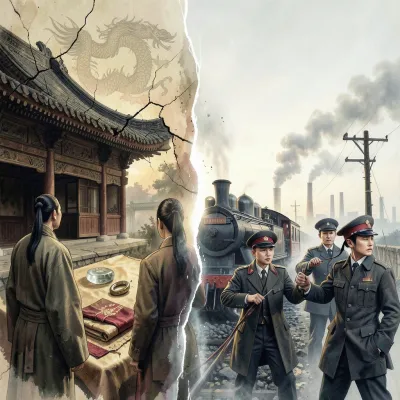
"The Last Emperors: Qing Collapse and the Birth of Modern China" provides a comprehensive account of the Qing dynasty's final decades, spanning from the mid-19th century Opium Wars to the 1911 Revolution and its immediate aftermath. The book argues that the Qing's collapse was not a sudden event but a prolonged, uneven crisis stemming from internal weaknesses and relentless external pressures. It meticulously details the dynasty's attempts at self-preservation through various reform movements—from "Self-Strengthening" to the "New Policies"—demonstrating how these efforts, though often ambitious, were ultimately insufficient and, paradoxically, contributed to the dynasty's downfall by creating the very forces that would challenge its authority.
The narrative highlights the critical roles of key figures like Empress Dowager Cixi, portraying her not as a mere decadent autocrat but as a pragmatic, though often ruthless, political operator navigating court factions, fiscal scarcity, and foreign intrusion. It also examines the rise of influential Han Chinese officials and regional militarists like Zeng Guofan, Li Hongzhang, and Yuan Shikai, whose personal armies and administrative networks fundamentally shifted the balance of power from the central court to the provinces. The book underscores how the Qing's institutional rigidity, fiscal fragilities, and ideological adherence to Confucian orthodoxy prevented it from fully adapting to the technological and political demands of the modern world.
External shocks, particularly the Opium Wars and the humiliating defeat in the Sino-Japanese War of 1894-1895, are presented as pivotal moments that exposed the Qing's vulnerabilities and accelerated foreign encroachment through unequal treaties, railway concessions, and devastating indemnities. The Boxer Uprising, while a desperate attempt to resist foreign influence, ultimately backfired, leading to the occupation of Beijing and the imposition of the punitive Boxer Protocol, further shackling the Qing fiscally and symbolically. In response, the late Qing launched the "New Policies" of 1901-1911, including the abolition of the millennia-old examination system, the establishment of modern schools and legal codes, and the creation of provincial assemblies, which fostered a new generation of educated elites demanding greater political participation.
The book concludes by detailing the fragmented and often accidental nature of the 1911 Revolution, tracing its path from the Wuchang Uprising to the eventual abdication of the child emperor Puyi under Yuan Shikai's brokered negotiations. It emphasizes that the Republic's birth was a complex compromise, inheriting many of the Qing's unresolved problems, including military regionalization (leading to the Warlord Era), fiscal insolvency, and the challenge of national unity in a multi-ethnic state. Ultimately, "The Last Emperors" reveals how the Qing's collapse served as a crucible, forging new political identities and capacities that, while failing to immediately deliver a stable, unified China, laid the foundational issues and intellectual currents that would shape the nation's tumultuous path through the 20th century.
What You'll Find Inside:
- The Qing collapse resulted from a century-long crisis where external pressures (Opium Wars, unequal treaties, foreign concessions) interacted with internal weaknesses (fiscal rigidity, regional militarization, ideological inflexibility), creating structural conditions for breakdown that accumulated silently like pressure along a fault line.
- The Self-Strengthening Movement attempted to borrow Western military and industrial tools while preserving Confucian governance, but failed to address deeper institutional rot—demonstrating that technological borrowing without administrative reform created a hybrid system that satisfied neither reformers nor conservatives.
- Empress Dowager Cixi emerged as a pragmatic political broker who balanced reform and conservatism to preserve dynastic survival, permitting modernization only when it didn't threaten Qing authority, Manchu supremacy, or her personal power, ultimately blocking transformative change when it challenged the existing order.
- The Boxer Protocol's indemnity shackled Qing finances for decades while forcing administrative modernization—foreign-controlled customs revenue funded new schools, legal codes, and provincial assemblies that inadvertently nurtured revolutionaries and constitutionalists alike, creating contradictions that accelerated collapse.
- The 1911 Revolution unfolded as a cascade of provincial defections driven by railway rights movements, provincial assemblies, revolutionary networks (including overseas Chinese), and military professionalism—not a single planned event but a convergence of accidents and long-prepared networks exploiting Qing weakness.
Who's It For:
This book is ideal for university students and scholars of modern Chinese history seeking a nuanced, deeply researched analysis of the Qing dynasty's final decades. It will particularly benefit readers interested in understanding how reform movements, revolutionary networks, and institutional transformations interacted to produce China's transition from empire to republic, offering fresh interpretations by situating historical figures within their specific constraints and choices rather than relying on hindsight.
Table of Contents:
- Introduction
- Chapter 1 Threshold of Collapse: Court, Crisis, and the Weight of History
- Chapter 2 The Opium Wars’ Long Shadow: Treaty Ports and Unequal Sovereignty
- Chapter 3 The Taiping Aftermath: Reconstruction and Regional Militarization
- Chapter 4 Self-Strengthening: Industry, Armies, and the Limits of Borrowed Tools
- Chapter 5 The Tongzhi Restoration: Conservatism in Reformist Clothing
- Chapter 6 Empress Dowager Cixi: Power, Perception, and Policy
- Chapter 7 The Frontier on Fire: Xinjiang, Tibet, and the Perils of Empire
- Chapter 8 The Sino-Japanese War (1894–1895): Defeat and the End of Illusions
- Chapter 9 Scramble for Concessions: Finance, Railways, and Foreign Leverage
- Chapter 10 Reform Fever: The Hundred Days and the Thought‑World of 1898
- Chapter 11 Conservatism Strikes Back: Purges, Compromises, and Survival
- Chapter 12 The Boxer Uprising: Violence, Faith, and Global Intervention
- Chapter 13 The Boxer Protocol: Indemnities, Occupation, and Fiscal Shackles
- Chapter 14 New Policies (1901–1911): Education, Law, and Centralization
- Chapter 15 The Constitutional Movement: Provincial Assemblies and Political Imagination
- Chapter 16 Army of a New Age: Beiyang Reforms and Military Professionalism
- Chapter 17 Commerce and Public Opinion: Chambers, Press, and the Urban Sphere
- Chapter 18 The Overseas Chinese and Revolutionary Networks
- Chapter 19 Sun Yat-sen and Rivals: Programs, Personalities, and Patronage
- Chapter 20 From Secret Societies to Parties: The Tongmenghui and Its Opponents
- Chapter 21 The Railway Rights Recovery Movement: Debt, Dignity, and Provincialism
- Chapter 22 1911: Wuchang to Nanjing—A Revolution of Accidents and Design
- Chapter 23 Negotiating the End: Yuan Shikai, Abdication, and the Republic’s Birth
- Chapter 24 After the Dragon Throne: Continuities, Ruptures, and Warlordism
- Chapter 25 Legacies of Collapse: Statecraft, Citizenship, and the Problem of Modern China
Author:
Published By:
Date Published:
May 15, 2026
Type:
Nonfiction
Language:
English
Word Count:
79,808 words
Reading Time:
5 hours 35 minutes
Sample:
MixCache.com Total Access
Get unlimited access to this book + all books published by MixCache.com for $11.99/month
Subscribe to MTAOr purchase this book individually below
Order:
Buy the The Last Emperors: Qing Collapse and the Birth of Modern China ebook on MixCache.com:
Buy Now
Full ebook will be available immediately
- read online or download as a PDF file.
$5 account credit for all new MixCache.com accounts, usable toward any ebook purchase!*






Ratings & Reviews
Ask Questions About This Book
Have a question about the content? Ask our AI assistant!
Start by asking a question about "The Last Emperors: Qing Collapse and the Birth of Modern China"
Example: "Does this book mention William Shakespeare?"
Thinking...