
Browse by Category
Fiction
- Action & Adventure
- African American
- Anthologies
- Children's Fiction
- Classics
- Comics & Graphic Novels
- Coming of Age
- Contemporary
- Cultural & Regional
- Drama
- Erotica
- Fantasy
- General
- Historical Fiction
- Horror
- Humor & Satire
- Literary Fiction
- Mystery, Thriller & Suspense
- Poetry
- Religious & Inspirational
- Romance
- Science Fiction
- Short Stories
- War & Military
- Westerns
- Women's Fiction
- Young Adult
Non-Fiction
- Antiques & Collectibles
- Arts & Photography
- Biographies & Memoirs
- Business & Money
- Children's Non-Fiction
-
Computers & Technology
- Artificial Intelligence
- Computer Science
- Cybersecurity & Cryptography
- Data Science & Analytics
- Databases & Big Data
- Game Development & Design
- General
- Hardware & DIY
- Mobile App Development
- Networking & Cloud Computing
- Operating Systems
- Programming
- Robotics
- Software
- Software Engineering
- User Experience (UX) & Design
- Web Development & Design
- Cooking, Food & Wine
- Crafts, Hobbies & Home
- Education & Teaching
- Engineering
- General
- Health, Fitness & Dieting
-
History
- African History
- African History - North Africa
- African History - Sub-Saharan Africa
- American History
- American History - 20th Century
- American History - Civil War
- American History - Colonial Period
- Ancient History
- Asian History
- Asian History - China
- Asian History - India
- Asian History - Japan
- Asian History - Southeast Asia
- European History
- European History - Ancient Greece
- European History - Ancient Rome
- European History - Medieval
- European History - Modern
- European History - Renaissance
- General
- Middle Eastern History
- Military History
- Military History - Aviation
- Military History - Naval
- Social & Cultural History
- World History
- Humor & Entertainment
- Industrial Technology
- Language Learning
- Law
- LGBTQ+ Non-Fiction
- Literary Criticism
- Medical Books
- Parenting & Relationships
- Philosophy
- Politics & Social Sciences
- Reference
- Religion & Spirituality
-
Science & Math
- Agricultural Sciences
- Astronomy & Space Science
- Behavioral Sciences
- Biological Sciences
- Botany & Plant Science
- Chemistry
- Earth Sciences
- Engineering - Chemical
- Engineering - Civil
- Engineering - Electrical
- Engineering - Mechanical
- Environment
- General
- Geology
- Mathematics
- Nature & Ecology
- Oceanography
- Paleontology
- Physics
- Statistics
- Self-Help
- Sports & Outdoors
- Study Aids
- Sustainability & Green Living
- Textbooks
- Transportation
- Travel
- True Crime
- Urban Planning & Development
- Veterinary Medicine
- Writing & Publishing
Jump to Section
MixCache.com Total Access
Unlimited reading and audiobooks for every book published by MixCache.com.
Included titles carry the MTA badge.
Learn more →
Borders in Flux: Migration, Nationhood, and the Making of Modern Europe
MTA
Exploring migration, forced displacement, and border politics from the 18th century to the present
About this book:
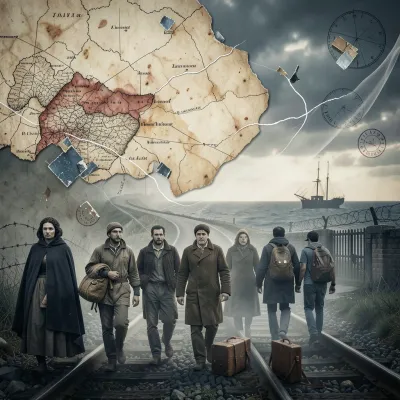
This book traces the evolution of European borders and migration from the 18th century to the present, arguing that the movement of people—whether through labor migration, forced displacement, or colonial retreat—has been the primary force shaping modern national identities and state structures. In the pre-industrial era, mobility was often seasonal and fluid, but the rise of the nation-state and the upheavals of the French Revolution introduced the modern passport and the concept of territorial citizenship. The 19th and early 20th centuries saw these boundaries harden as industrialization drew rural populations to cities and mass overseas emigration channeled millions of Europeans to the Americas, while the collapse of multi-ethnic empires began a long, often violent process of ethnic homogenization.
The mid-20th century marked a catastrophic turning point, as total war and state-sponsored genocide transformed borders into instruments of annihilation. World War II and its aftermath saw the largest forced population transfers in history, including the Holocaust and the mass expulsion of ethnic Germans from Eastern Europe. During the Cold War, the continent was defined by the rigid "Iron Curtain," which restricted movement between East and West even as Western European nations established guestworker programs to fuel economic reconstruction. Simultaneously, decolonization brought a new wave of migration from former imperial territories, forever altering the demographic and cultural landscape of the metropoles and triggering enduring debates over integration and secularism.
In the contemporary era, the European Union has attempted to reconcile the removal of internal frontiers through the Schengen Agreement with the fortification of a high-tech "Fortress Europe" at its external edges. The book analyzes how modern technologies—such as biometric databases, drones, and algorithmic risk profiling—have transformed the border into a dynamic, digital network. However, the 2015 refugee crisis and the 2022 invasion of Ukraine have exposed the fragility of these systems, revealing deep-seated tensions between national sovereignty and humanitarian solidarity. Ultimately, the book illustrates that while borders have become more technologically sophisticated, they remain sites of constant negotiation between states seeking control and individuals driven by the timeless human impulses of necessity, safety, and ambition.
What You'll Find Inside:
- Migration has been the primary force shaping European borders and nationhood from the 18th century to present, compelling states to define who belongs and who does not.
- The book traces the evolution of border control mechanisms—from feudal obligations and tolls to passports, visas, and modern biometric surveillance systems—as states developed tools to manage population movement.
- European nation-building consistently involved tension between inclusion (welcoming 'productive' migrants) and exclusion (targeting minorities, refugees, and others deemed undesirable based on class, race, or religion).
- Major historical events—revolutions, wars, empire collapses, and industrialization—triggered mass migrations that repeatedly forced redrawing of borders and redefinition of citizenship across the continent.
- Contemporary debates over asylum, irregular migration, and integration echo historical patterns, showing that today's sovereignty-mobility-rights struggles have deep roots in Europe's past.
Who's It For:
This book is ideal for students and scholars of European history, migration studies, and political science seeking a comprehensive historical analysis of how population movement has shaped borders, citizenship, and identity. It will also benefit policy makers working on immigration and asylum issues who need historical context for contemporary debates, as well as general readers interested in understanding how past migration patterns inform current European challenges with integration, nationalism, and border policy.
Table of Contents:
- Introduction
- Chapter 1 Concepts of Borders, Mobility, and Nationhood
- Chapter 2 Mapping Movement in the Long Eighteenth Century
- Chapter 3 Revolution, War, and the Passport: 1789–1815
- Chapter 4 Empires in Motion: Habsburg, Ottoman, and Russian Circulations
- Chapter 5 Industrialization, Urban Growth, and Internal Migration
- Chapter 6 1848 and the Making of National Citizens
- Chapter 7 Unification and Exclusion: Germany and Italy, 1860–1914
- Chapter 8 Overseas Emigration: Europe to the Americas
- Chapter 9 Minorities on the Margin: Jews, Roma, and Statelessness before 1914
- Chapter 10 Total War and the Refugee: 1914–1923
- Chapter 11 Redrawing the Map: Treaties, Population Exchanges, and New Borders
- Chapter 12 Paper Citizens: Passports, Visas, and the Interwar State
- Chapter 13 Dictatorship, Persecution, and Flight in the 1930s
- Chapter 14 World War II: Deportation, Genocide, and Displacement
- Chapter 15 Aftermath and Return: DPs, Expulsions, and Reconstruction
- Chapter 16 Crossing the Curtain: Mobility in Cold War Europe
- Chapter 17 Decolonization Comes Home: Postcolonial Migration to Europe
- Chapter 18 Workers in Motion: Guestworker Systems, 1950s–1970s
- Chapter 19 Europe without Internal Frontiers? Schengen, Dublin, and the EU Border Regime
- Chapter 20 1989 and After: Borders, Breakups, and the Balkans
- Chapter 21 Islam, Integration, and the Politics of Belonging
- Chapter 22 Technologies of Control: Databases, Fences, and the Mediterranean
- Chapter 23 The 2015–2016 Refugee Arrivals in Context
- Chapter 24 Populism, Brexit, and the Return of the Nation
- Chapter 25 War and Displacement in Ukraine and Beyond
Author:
Published By:
Date Published:
May 15, 2026
Type:
Nonfiction
Language:
English
Word Count:
102,430 words
Reading Time:
7 hours 10 minutes
Sample:
MixCache.com Total Access
Get unlimited access to this book + all books published by MixCache.com for $11.99/month
Subscribe to MTAOr purchase this book individually below
Order:
Buy the Borders in Flux: Migration, Nationhood, and the Making of Modern Europe ebook on MixCache.com:
Buy Now
Full ebook will be available immediately
- read online or download as a PDF file.
$5 account credit for all new MixCache.com accounts, usable toward any ebook purchase!*



Ratings & Reviews
Ask Questions About This Book
Have a question about the content? Ask our AI assistant!
Start by asking a question about "Borders in Flux: Migration, Nationhood, and the Making of Modern Europe"
Example: "Does this book mention William Shakespeare?"
Thinking...